

Crab is a matter of scholarly difference in Islam. Many scholars from the Maliki, Shafi’i, and Hanbali schools permit eating crab as seafood, while the Hanafi and Shia (Ja’fari) schools generally do not consider it halal. If you follow a specific madhhab, it’s best to follow its ruling and choose seafood accordingly.
Crab is one of those seafood items that often creates confusion among Muslims, especially in countries like the USA and UK where it is widely available in restaurants, seafood buffets, and packaged food products. The main concern usually comes from uncertainty about how Islamic dietary guidelines apply to different types of sea creatures.
In general, in Islamic rulings, seafood is not treated in the same way across all schools of thought. While many types of fish are widely accepted as halal, other sea animals such as shellfish are viewed differently depending on interpretation. This is why questions like whether crab meat is halal or haram, or whether Muslims can eat crab, are commonly searched.
The confusion becomes even more practical in everyday life. Crab is often served in mixed seafood dishes, butter-based sauces, fried platters, and processed meals, which makes it difficult for consumers to determine its status just by looking at a menu or product label.
Is Crab Halal?
Crab is not universally agreed upon in Islam. Some scholars allow seafood broadly, but Hanafi and Shia rulings generally do not consider crab halal. Because of this difference, many Muslims in the USA and UK avoid crab to stay on the safe side of Islamic dietary interpretation.
Quick Answer Table
| Question | Answer |
| Is crab halal? | Depends on Islamic school |
| Is crab haram? | Hanafi & Shia: generally not halal |
| Can Muslims eat crab? | Some allow, many avoid |
| Is crab meat halal? | Depends on ruling followed |
| Is crab safe seafood? | Yes, but ruling differs |
Why Muslims Are Confused About Crab
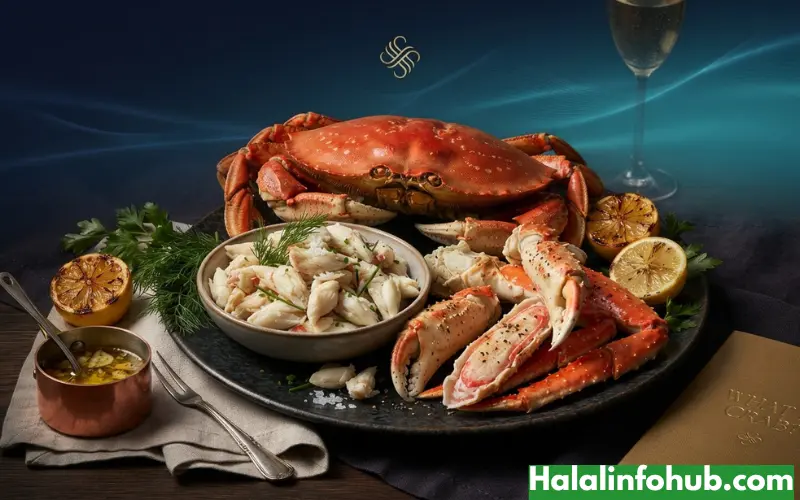
If you ask people in the USA or UK why they’re unsure about crab, the answers usually sound like this:
Some say seafood is always halal.
Others say only fish with scales are allowed.
Some avoid everything except salmon or tuna.
Crab sits right in the middle of all these opinions.
The confusion doesn’t come from the food itself. It comes from how seafood is classified in Islamic law.
And that classification is not identical across all schools of thought.
What Crab Actually Is
Crab is not a fish.
It is a crustacean, which means:
- It has a shell, not scales
- It lives in seawater but behaves differently from fish
- It belongs to a separate biological category
This matters because Islamic rulings often separate:
- Fish (like salmon, tuna)
- Non-fish sea creatures (like crab, lobster, etc.)
That single distinction is where all disagreement starts.
Sunni & Shia Rulings on Crab
| School | View on Crab | Reason |
| Hanafi | Generally not halal | Only fish with scales clearly allowed |
| Shafi’i | Some allow, some differ | Broader seafood interpretation |
| Maliki | More permissive | Many sea creatures allowed |
| Hanbali | Mixed opinions | Depends on interpretation |
| Shia (Ja’fari) | Generally not halal | Scaled fish requirement |
Real Reason Scholars Differ
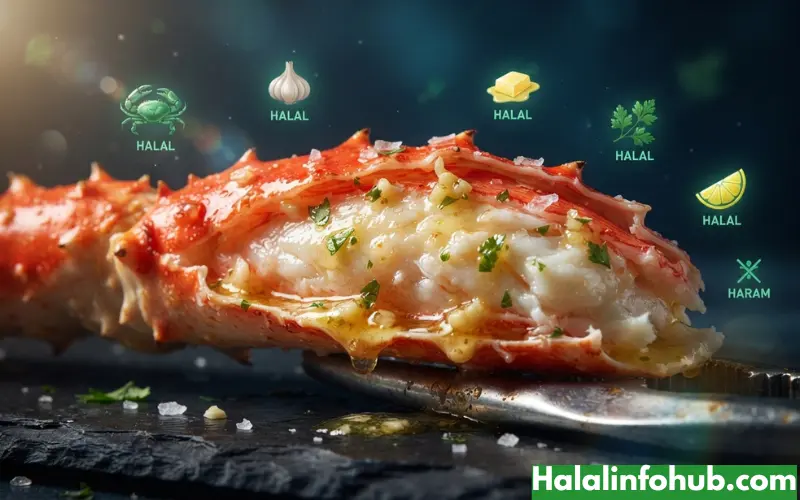
This is where most competitor articles fail.
The disagreement is not emotional or cultural.
It is based on a single principle:
What counts as “seafood” in Islamic law?
Some scholars define seafood broadly — everything from the sea.
Others define it narrowly — only fish that clearly fall under known categories like scaled fish.
Crab falls into the grey zone between these definitions.
Why USA & UK Muslims Search This More
In Muslim-majority countries, crab is not a daily food item.
But in the USA and UK:
- seafood boils are common
- crab legs are popular in buffets
- frozen crab is widely sold
- restaurant menus include crab dishes often
So Muslims don’t just study rulings — they face real-life choices in supermarkets and restaurants.
Crab in Restaurants
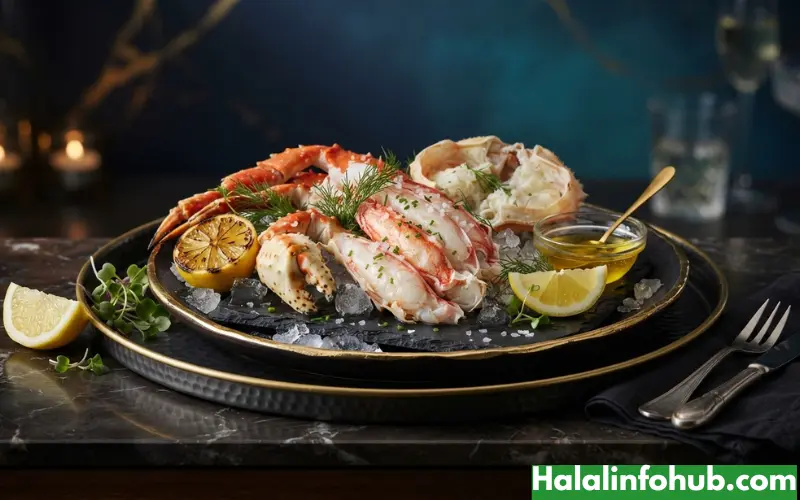
In theory, the ruling on crab is discussed in books.
In real life, things get more complicated.
When you order crab in the USA or UK, it rarely comes alone. It usually arrives as part of a prepared dish, and that’s where most halal concerns actually begin.
Common examples include:
- Crab legs served with garlic butter
- Seafood boils mixed with sausage and shrimp
- Fried crab coated in seasoning blends
- Restaurant platters with multiple seafood types
The issue here is not just the crab itself, but everything around it.
Butter sauces, for example, are sometimes prepared with flavor bases that are not clearly disclosed. Seafood boils often share pots with non-halal meat items. Even frying oil can be shared across different menu items.
So while people focus on “is crab halal,” the real-world concern is usually “how was it cooked?”
Processed Crab Products
Walk into any supermarket in the USA or UK, and you will see:
- Frozen crab meat
- Crab sticks
- Canned crab
- Seafood salad mixes
Now here’s something most people don’t realize:
Not everything labeled “crab” is actually pure crab.
In many cases, especially with crab sticks, the product is made from:
- Minced fish paste
- Starch binders
- Artificial flavoring
- Coloring agents
This changes the discussion completely, because now you’re not only evaluating crab — you’re evaluating a processed food system.
That’s why ingredient reading becomes more important than the label itself.
Why Crab Always Feels Confusing
After years of writing halal seafood content, one pattern is consistent:
Confusion doesn’t come from crab.
It comes from expectations.
People expect a simple yes or no answer, as they get with salmon or tuna. But crab sits in a category where Islamic scholarship does not fully agree across all schools.
So the confusion is not about science or taste — it is about interpretation.
And interpretation is never identical across every school of thought.
Simple Real-Life Decision Table
| Situation | What you should know |
| Plain fish like salmon or tuna | Generally clear and widely accepted |
| Crab in Hanafi or Shia practice | Commonly avoided |
| Crab in mixed seafood dishes | Depends on ingredients & cooking method |
| Frozen or canned crab | Check additives and processing |
| Crab sticks | Often not pure crab |
Practical Buying Guide
If you’re shopping in the USA or UK, crab products are easy to find — but not all are equal.
In supermarkets, always check:
- Ingredient list (especially sauces or flavoring)
- Whether it is pure crab or a processed product
- Any alcohol-based flavor extracts
- Cross-contamination labels
In restaurants, it’s even more important to ask simple questions:
- How is it cooked?
- Are sauces prepared separately?
- Is it mixed with other meats?
These small checks often matter more than the label itself.
What Muslims Actually Do in Practice
This is something most articles avoid saying directly.
In real life, many Muslims don’t follow crab discussions academically. They choose based on comfort level:
- Some avoid crab completely
- Some follow their local scholar or school
- Some only eat it when clearly prepared in a controlled halal environment
There is no single behavior pattern — and that reflects the nature of the ruling itself.
USA vs UK Seafood Context
| Factor | USA | UK |
| Availability of crab dishes | Very high | High |
| Seafood boil culture | Very common | Moderate |
| Halal labeling clarity | Varies | Varies |
| Restaurant awareness | Low to medium | Medium |
Explore More Halal Guides
FAQs
Is crab halal or haram in Islam?
Crab is not a clear-cut case in Islam. Some scholars allow seafood broadly, while Hanafi and Shia schools generally do not consider crab halal. Because of this difference, it is treated as a matter of interpretation.
Can Muslims eat crab?
Yes, some Muslims eat crab depending on the Islamic school of thought they follow. However, many avoid it due to scholarly differences and prefer to stick with widely accepted seafood like fish.
Is crab meat halal in the USA and UK?
Crab meat in the USA and UK depends on both Islamic rulings and preparation. While the meat itself is seafood, restaurant cooking methods and processing can affect its acceptability.
Why is crab considered doubtful in Islam?
Crab is not classified as a typical fish. Different schools of thought define seafood differently, which is why crab falls into a debated category.
Is king crab halal?
King crab follows the same ruling as regular crab. Its halal status depends on the interpretation of the Islamic school of thought being followed.
Is snow crab halal?
Snow crab is treated the same as other crab species, so its ruling is also debated among scholars.
Is crab allowed in Hanafi Islam?
In Hanafi fiqh, crab is generally not considered halal because the school mainly allows fish with clear characteristics like scales.
Is crab halal in Shia Islam?
In Shia (Ja’fari) jurisprudence, crab is generally not considered halal because only fish with scales are allowed.
Why do Muslims in the USA and UK search about crab halal status?
Because crab is commonly served in restaurants, seafood buffets, and packaged foods in Western countries, Muslims often check its status before eating.
What is the safest choice regarding crab?
Many Muslims prefer to avoid crab when unsure and choose widely accepted seafood like salmon or tuna to stay within clear dietary guidelines.
Conclusion
Crab is a seafood item where Islamic scholars do not have one single agreement, which is why its ruling varies among different schools of thought. While some opinions allow broader seafood consumption, others are more specific, which places crab in a category that requires personal religious understanding.
For Muslims in the USA and UK, this means there is no universal answer, and the decision often depends on which Islamic view they follow. It is also important to consider how crab is prepared in restaurants and packaged foods, as ingredients and processing can affect its overall status.
In short, crab is not a simple halal or haram case, and awareness of different scholarly opinions helps in making a confident and informed choice.
Final Takeaway
The real answer is not just about crab.
It’s about understanding that Islamic dietary law sometimes involves differences in interpretation — and crab happens to be one of the clearest examples of that reality.