

Yes, salmon is generally considered halal because it is a fish. Muslims can usually eat fresh, frozen, canned, and grilled salmon without concern. However, smoked salmon, sushi, marinated salmon, and restaurant dishes should be checked for alcohol-based ingredients, sauces, or preparation methods that could affect their halal status.
Is salmon halal? If you’ve ever stood in a supermarket looking at fresh salmon fillets or ordered salmon sushi at a restaurant, you’ve probably wondered whether it’s truly halal. Salmon is one of the most popular seafood choices in the United States and United Kingdom, but many Muslims still want to be sure it meets Islamic dietary guidelines before eating it.
The good news is that salmon is generally considered halal because it is a fish. However, not every salmon product is the same. Fresh salmon, smoked salmon, canned salmon, frozen salmon, and salmon sushi may contain additional ingredients or preparation methods that require closer attention. In many cases, the concern isn’t the fish itself but the marinades, sauces, alcohol-based flavoring’s, or cross-contamination during cooking.
🧠 Related Post: Is Shrimp Halal or Haram?
Why Salmon Rarely Creates the Same Halal Debate as Other Seafood
When Muslims ask whether salmon is halal, the question is usually different from debates surrounding shrimp, crab, or lobster.
Salmon has long been recognised as a true fish, which means there is very little disagreement among the major Islamic schools regarding its basic halal status. Instead, modern questions are usually about how the salmon is prepared rather than the fish itself.
For example, today’s supermarkets sell salmon in many different forms:
- Fresh salmon fillets
- Frozen salmon
- Smoked salmon
- Canned salmon
- Ready-to-cook marinated salmon
- Salmon sushi
- Restaurant grilled salmon
Although the fish itself is generally halal, additional ingredients or cooking methods may change the ruling for the final dish.
This is why understanding the entire product—not just the fish—is important for Muslim consumers in the USA and UK.
Can Muslims Eat Salmon?
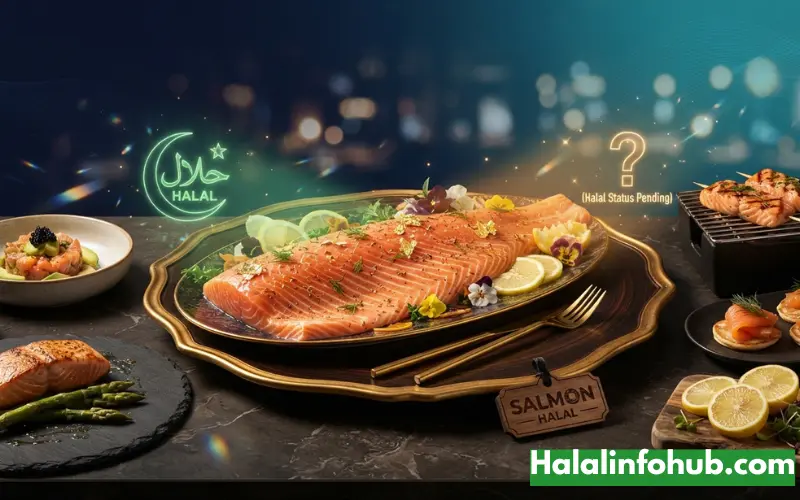
For the vast majority of Muslims, yes.
Salmon is widely accepted as halal because it belongs to the category of fish. Unlike beef, chicken, or lamb, fish do not require halal slaughter (zabiha), making salmon one of the easiest animal protein choices for Muslims.
Whether you’re preparing dinner at home or ordering salmon at a restaurant, the fish itself is generally not the issue.
Instead, you should pay attention to questions such as:
- Has the salmon been marinated?
- Does it contain alcohol-based flavourings?
- Is it served with sauces that may contain cooking wine or mirin?
- Is it prepared separately from non-halal foods?
These practical considerations matter far more than the salmon itself.
What Makes Salmon Halal?
One reason salmon is so widely accepted is its simple composition.
Fresh salmon usually contains only one ingredient:
Salmon.
Unlike processed meat products that often contain emulsifiers, gelatin, preservatives, or flavour enhancers, fresh salmon is naturally straightforward.
Because of this, many Muslims choose salmon as one of the safest seafood options when following a halal diet.
However, once manufacturers or restaurants begin adding extra ingredients, the halal status depends on the complete recipe rather than the fish alone.
Is Salmon Halal According to the Major Islamic Schools?
One of the strengths of salmon as a halal food is that there is very little disagreement among mainstream Sunni scholars.
Hanafi School
The Hanafi school recognises salmon as a fish, making it generally halal to eat. Unlike shellfish such as shrimp, salmon does not generate significant scholarly disagreement because it clearly falls within the category of fish.
Shafi’i School
The Shafi’i school broadly permits seafood, including salmon. Fresh, frozen, grilled, and plain salmon are generally considered halal.
Maliki School
The Maliki school also considers salmon halal and permits its consumption.
Hanbali School
The Hanbali school likewise permits salmon as halal seafood.
Is Salmon Halal in Shia Islam?
This is one of the most searched questions online.
The answer is generally yes.
According to the Ja’fari (Shia) school, fish that have scales are generally considered halal.
Salmon naturally has scales, which means it is generally regarded as permissible according to Ja’fari Islamic rulings.
As a result, many Muslims searching for:
- Is salmon halal in Shia Islam?
- Is salmon halal Shia?
will find that salmon is generally accepted because it meets the requirement of being a scaled fish.
Individual followers should always follow the guidance of their own marja’ if they have specific questions about seafood rulings.
Why Salmon Is Different From Shrimp, Crab and Lobster
Many Muslims notice that salmon rarely appears in scholarly debates, while shrimp, crab, lobster and other seafood often do.
The reason is simple.
Salmon is universally recognised as a fish.
By contrast, shrimp, lobster and crab belong to different marine categories, leading to different scholarly discussions in some schools of Islamic jurisprudence.
Because salmon clearly fits within the category of fish, its halal ruling is much more straightforward.
Fresh, Frozen, Wild and Farm-Raised Salmon
Many consumers wonder whether the source of salmon changes its halal status.
From an Islamic perspective, the answer is generally no.
Whether you buy:
- Wild salmon
- Farm-raised salmon
- Atlantic salmon
- Pacific salmon
- Scottish salmon
- Norwegian salmon
The fish itself remains halal.
The difference usually comes down to:
- Quality
- Taste
- Nutrition
- Sustainability
—not halal status.
Atlantic Salmon vs Wild Salmon: Does It Matter?
Shoppers in the USA and UK often see labels such as:
- Atlantic Salmon
- Wild Alaskan Salmon
- Scottish Salmon
- Norwegian Salmon
These labels describe where the salmon comes from, not whether it is halal.
Whether the salmon is wild-caught or responsibly farm-raised, the basic halal ruling remains the same.
The only time additional attention is needed is when flavourings, marinades, or processing ingredients are added after the fish is harvested.
What Actually Makes Salmon Questionable?
Interestingly, the salmon itself is rarely what creates uncertainty.
Instead, these ingredients deserve closer attention:
- Cooking wine
- Mirin
- Sake
- Teriyaki glaze
- Alcohol-based marinades
- Butter sauces
- Cream sauces
- Natural smoke flavourings
- Seasoning blends
This is why reading ingredient labels is just as important as identifying the type of fish.
Many halal concerns arise after processing, not before.
Not All Salmon Products Are the Same
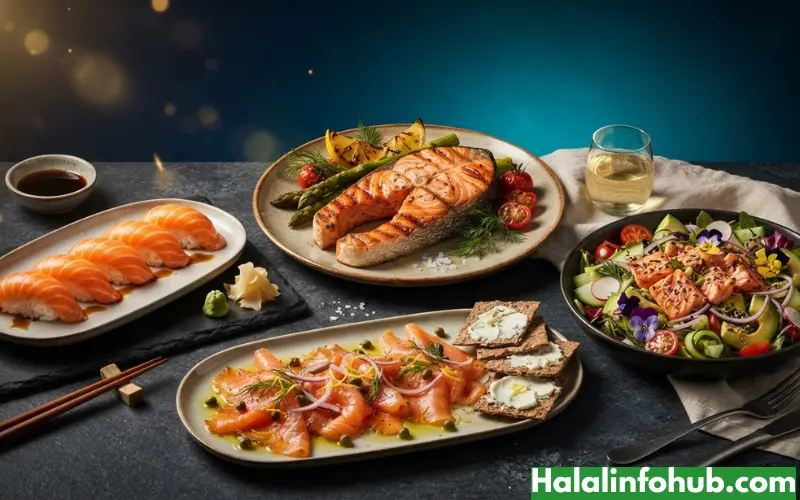
A package labelled simply “Fresh Atlantic Salmon” is very different from one labelled:
- Honey Bourbon Salmon
- Teriyaki Salmon
- Whiskey Glazed Salmon
- Smoked Maple Salmon
- Ready-to-Cook Gourmet Salmon
These products may contain additional ingredients that require closer examination.
Rather than assuming every salmon product is automatically halal, it’s better to evaluate the complete ingredient list before buying.
Is Smoked Salmon Halal?
Smoked salmon is one of the most common areas of confusion for Muslims, especially in the USA and UK, where it is widely sold in supermarkets and served in cafés, hotels, and restaurants.
The salmon itself is generally halal, but the smoking and seasoning process deserves closer attention.
Some smoked salmon products contain only:
- Salmon
- Salt
- Natural wood smoke
These products are generally considered halal-friendly.
However, other varieties may include:
- Wine-based marinades
- Bourbon or whiskey flavouring
- Honey glaze with alcohol extracts
- Artificial smoke flavourings
- Preservatives and seasoning blends
For this reason, always read the ingredient list rather than assuming every smoked salmon product is the same.
Is Raw Salmon Halal?
Yes.
Raw salmon is generally halal because cooking is not a requirement for halal food.
Many Muslims enjoy raw salmon in dishes such as sashimi or homemade sushi. As long as the salmon itself is halal and no questionable ingredients have been added, eating it raw does not change its halal status.
The main concern is usually food safety and freshness rather than halal.
Is Salmon Sushi Halal?
Salmon sushi is one of the fastest-growing seafood dishes in both the United States and the United Kingdom.
Although the salmon itself is generally halal, the sushi as a whole should be evaluated, not just the fish.
Pay attention to:
- Sushi rice (may contain mirin)
- Teriyaki sauce
- Spicy mayonnaise
- Cooking sake
- Alcohol-based glazes
- Imitation crab used in sushi platters
If you’re eating at a Japanese restaurant, don’t hesitate to ask how the sushi rice and sauces are prepared.
Is Frozen Salmon Halal?
Plain frozen salmon is generally halal because it usually contains only salmon.
Many supermarket products simply include:
- Salmon
- Water (protective ice glaze)
These products are generally halal-friendly.
However, frozen ready-to-cook meals may include:
- Garlic butter
- Lemon herb seasoning
- Cream sauces
- Marinades
- Teriyaki glaze
These ingredients should always be checked before purchase.
Is Canned Salmon Halal?
Canned salmon is another popular choice among Muslim families.
Most canned salmon contains only:
- Salmon
- Water or brine
- Salt
These products are generally halal-friendly.
Flavoured canned salmon, however, may include additional ingredients that should be reviewed before eating.
Buying Salmon in the USA & UK
Finding halal-friendly salmon is usually straightforward because fresh fish is widely available.
Popular Stores in the United States
- Walmart
- Costco
- Kroger
- Whole Foods
- Trader Joe’s
- Aldi
- Sam’s Club
Popular Stores in the United Kingdom
- Tesco
- Asda
- Morrisons
- Sainsbury’s
- Aldi
- Lidl
- Waitrose
Fresh and plain frozen salmon from these retailers are generally halal-friendly. Ready-to-cook and flavoured products deserve a closer look.
What Should Muslims Check?
Restaurant meals often introduce ingredients that are not obvious from the menu.
Before ordering salmon, consider asking:
- Is cooking wine used in the sauce?
- Does the glaze contain alcohol?
- Is mirin used in Japanese dishes?
- Is the salmon cooked separately from pork products?
- Are the sauces prepared fresh?
These simple questions can help you make an informed halal choice.
Ingredients Worth Checking
The salmon itself is rarely the concern.
Instead, look for ingredients such as:
- Mirin
- Cooking wine
- Sake
- Whiskey glaze
- Bourbon sauce
- Worcestershire sauce
- Artificial smoke flavouring
- Cream-based sauces
- Butter flavouring
- Natural flavours
Products with shorter ingredient lists are generally easier to evaluate from a halal perspective.
Common Myths About Salmon
Farm-raised salmon is not halal.
Reality: Whether salmon is farm-raised or wild does not change its halal status.
Smoked salmon is automatically haram.
Reality: Smoking alone does not make salmon haram. The ingredients used during processing are what matter.
Raw salmon cannot be halal.
Reality: Raw salmon is generally halal. The concern is food safety, not halal status.
All sushi containing salmon is halal.
Reality: The salmon may be halal, but the rice, sauces, and other ingredients should also be checked.
USA vs UK Comparison
| Product | USA | UK |
| Fresh Salmon | ✅ Generally Halal | ✅ Generally Halal |
| Frozen Plain Salmon | ✅ Generally Halal | ✅ Generally Halal |
| Smoked Salmon | ⚠ Check Ingredients | ⚠ Check Ingredients |
| Salmon Sushi | ⚠ Check Rice & Sauces | ⚠ Check Rice & Sauces |
| Canned Salmon | ✅ Generally Halal | ✅ Generally Halal |
| Restaurant Salmon | ⚠ Ask About Preparation | ⚠ Ask About Preparation |
Halal Buying Checklist
Before buying salmon, ask yourself:
Is it plain fresh or frozen salmon?
Does it contain only salmon?
Has it been marinated?
Does it contain mirin or cooking wine?
Is it served with alcohol-based sauces?
Is it cooked separately from non-halal foods?
If the answer to these questions is satisfactory, salmon is generally one of the safest seafood choices for Muslims.
Halal Decision Matrix
| Product | Halal Status |
| Fresh Salmon | ✅ Generally Halal |
| Wild Salmon | ✅ Generally Halal |
| Farm-Raised Salmon | ✅ Generally Halal |
| Frozen Plain Salmon | ✅ Generally Halal |
| Canned Salmon | ✅ Generally Halal |
| Smoked Salmon | ⚠ Check Ingredients |
| Salmon Sushi | ⚠ Check Rice & Sauces |
| Restaurant Salmon | ⚠ Check Preparation |
| Salmon with Alcohol-Based Marinade | ❌ Avoid |
Explore More Halal Guides
FAQs
Is salmon halal?
Yes. Salmon is generally considered halal because it is a fish.
Is salmon halal or haram?
Fresh and plain salmon is generally halal. Processed products should be checked for additional ingredients.
Can Muslims eat salmon?
Yes. Salmon is widely accepted as halal by the major Islamic schools.
Is salmon halal in Islam?
Yes. Salmon is generally considered halal in Islam because it is a fish.
Is salmon halal according to Hanafi?
Yes. The Hanafi school generally recognises salmon as a halal fish.
Is salmon halal in Shia Islam?
Yes. Salmon has scales, so it is generally considered halal according to Ja’fari (Shia) rulings. Followers should consult their marja’ for personal guidance.
Is salmon halal Shia?
Generally, yes. Salmon is a scaled fish and is widely regarded as permissible in Ja’fari jurisprudence.
Is smoked salmon halal?
The salmon itself is halal, but smoked products should be checked for additional ingredients.
Is salmon sushi halal?
It depends on the rice, sauces, and seasonings used.
Is frozen salmon halal?
Plain frozen salmon is generally halal-friendly.
Is canned salmon halal?
Most plain canned salmon products are generally halal.
Does salmon need halal slaughter?
No. Fish do not require halal slaughter in the same way as land animals.
Conclusion
So, is salmon halal? In almost every case, yes. Salmon is one of the clearest halal seafood choices because it is recognised as a fish by the major Islamic schools, including the Hanafi, Shafi’i, Maliki, and Hanbali traditions. It is also generally considered permissible in Shia Islam because it is a fish with scales.
The biggest halal concerns usually arise after the salmon has been processed or prepared. Smoked salmon, sushi, restaurant dishes, and ready-to-cook products may contain alcohol-based marinades, mirin, specialty sauces, or other ingredients that should be checked before eating.
Fresh, wild, farm-raised, frozen, and plain canned salmon are generally halal. Processed or restaurant-prepared salmon should be evaluated based on their ingredients and preparation methods rather than the fish itself.