


A search for “ttweakairline discount” usually comes from a traveller who has seen the phrase attached to a flight saving and wants to know whether it is a real offer, where it comes from, and how it is used. The phrase itself is not the name of an airline, and it is not a ticket type. It is a search label that joins two ideas: a discount label beginning with “ttweak” and the travel site TravelTweaks, which publishes travel deals and guides.
That joining is exactly where confusion starts. TravelTweaks publishes its own material about discount codes, many unrelated pages repeat and expand those claims with different percentages and partner lists, and at least one similarly named site states plainly that it is not connected to TravelTweaks at all. This article separates those three layers, explains what each one actually shows, and ends with the checks that matter before any money is paid.
Direct answer
Ttweakairline discount refers to flight-discount material published under the TravelTweaks name. TravelTweaks describes a discount code that appears at checkout and gives a reduced fare on selected routes, dates, or fare classes when the code matches the fare rules, with the exact terms shown in the individual offer details.
Three points need care before any other detail. First, no single discount percentage is established as a general fact: third-party pages quote different ranges, while TravelTweaks itself describes the saving as depending on the specific offer. Second, no specific code string was verified against a current TravelTweaks offer page during research, so this article does not present any code as working. Third, a similarly named travel blog states that it is not affiliated with TravelTweaks and issues no such code, so the two names must not be treated as one operator.
This article explains what TravelTweaks publishes, what third-party pages add, where those accounts disagree, and how a reader can check an offer before booking. It is not a recommendation, and it does not judge any site.
See Also: comparing verified and unverified claims about an unfamiliar platform
What the phrase actually describes
The phrase breaks into two parts. “TravelTweaks” is the name of a travel site at traveltweaks.com that publishes travel guides and deal material, including an airlines category. “Ttweakairline” is the label used in search results and in third-party articles for discount material connected with that site. It is not presented in the material found during research as a separate airline with its own fleet, routes, or booking system.
That distinction matters for a practical reason. A discount from an airline is applied by that airline under its own fare rules. A discount code described on a deals site is only useful if a booking site or airline actually accepts it at checkout, on a fare that matches the offer terms. The reader therefore needs to know which of those two things is being described, and the material found during research describes the second kind: a code published by a deals site, used at a booking checkout, subject to offer terms.
Search results also show the same material under several spellings, including “ttweakflight” and “tweakairline”. Spelling variants do not create separate offers. A reader who follows a variant spelling should still check the same things: the exact site publishing the offer, the exact terms, and whether the discount appears before payment.
What TravelTweaks itself publishes
TravelTweaks material found during research describes the ttweakairline discount code in general terms. The code appears at checkout, gives a flight discount when it matches the fare rules, and the reader is told to read the code terms, verify that the itinerary matches, and confirm that the discount appears before completing payment. The same material says TravelTweaks publishes codes for promotions, seasonal sales, and error fares, and that it verifies code validity before posting, with expiration dates, minimum-stay rules, advance-purchase rules, or blackout dates shown in the offer details.
Those are the claims that can be attributed to TravelTweaks itself, and they are narrower than much of the material that repeats them. They describe a mechanism, not a guaranteed saving on any particular flight. The saving depends on the offer, the route, the date, and the fare class, and the reader is expected to confirm the reduced total on screen before paying rather than trusting a headline percentage.
No current, dated, named offer with a verified code string, percentage, and expiry date was established from a TravelTweaks offer page during research. That gap is not a finding that no offer exists. It is a limit on what this article can state: a reader should treat any offer as unconfirmed until the current TravelTweaks offer page itself shows it, with its terms, rather than relying on a page that repeats the claim.
See Also: how to verify information before acting on it
What third-party pages add, and where they disagree
Many third-party pages describe the same discount in much stronger and more specific terms. Several name a code, describe savings of roughly 10% to 20%, and list booking platforms such as Expedia, Booking.com, and MakeMyTrip as places where the code works. Others quote wider ranges, up to 25% in one case and far higher figures in another, and some add claims about hotel discounts, package deals, and millions of users.
Those additions cannot all be true at the same time as general facts, and none of them was verified against a current TravelTweaks offer page during research. A percentage quoted by a third-party page is that page’s claim, not a fare rule. A partner list quoted by a third-party page is that page’s claim, not proof that a booking site accepts the code on a given fare. The wider the claimed range, the more reason there is to check the current offer terms rather than the repeating page.
The disagreement is itself useful information. When several pages describe one offer with different percentages, different partner lists, and different code spellings, the offer is being copied and rewritten rather than checked. A reader who notices that pattern should slow down, go to the publishing site’s own current offer page, and compare the terms there with what the repeating page promised.
| Claim as found online | Source type | Verification status |
|---|---|---|
| A discount code appears at checkout and reduces the fare on selected routes, dates, or fare classes | TravelTweaks material | Attributable to the publishing site; saving depends on the specific offer terms |
| Savings of about 10% to 20% on flight tickets | Third-party pages | Repeated claim, not verified against a current TravelTweaks offer page |
| The code works on named booking platforms such as Expedia, Booking.com, and MakeMyTrip | Third-party pages | Repeated claim, not verified against a current TravelTweaks offer page |
| Much larger savings, hotel and package discounts, and user totals in the millions | Third-party pages | Repeated claim, not verified; treat as marketing wording, not evidence |
The table above is the safest way to read the online material. The first row is what the publishing site itself describes. The remaining rows are what other pages add, and each one still needs the same check: the current offer page, its terms, and the reduced total shown before payment.

Why a headline percentage cannot be trusted on its own
A flight fare is not one price. It is a combination of route, date, fare class, advance purchase, minimum stay, and availability, and a discount code normally applies only where those elements match the offer. That is why TravelTweaks material itself ties the saving to selected routes, dates, or fare classes and tells readers to check the terms and confirm the discount before paying.
A headline percentage hides all of that. A page that promises a flat percentage on all flights, without naming the routes, dates, or fare classes, is describing a simpler offer than the one TravelTweaks describes. A page that promises a percentage far above the range quoted elsewhere is describing a different offer again, or no current offer at all. In both cases the percentage is the least reliable part of the claim, because it is the part most easily copied and enlarged.
The practical test is simple and does not require trusting any repeating page. Find the current offer on the publishing site, read its terms, enter the details of the actual trip, and look at the total before payment. If the total does not fall, the offer does not apply to that trip, whatever any third-party page promised. If no current offer page can be found, there is nothing to verify, and the trip should be priced as a normal booking.
The name confusion that must not be missed
A separate travel blog using a similar “ttweakflight” name states explicitly that it is an independent travel blog, not a booking site, not a coupon service, and not affiliated with TravelTweaks at traveltweaks.com. It states that it issues no “ttweakflight discount code” and that there is no joint discount-code programme with TravelTweaks. That statement is important because searches pair the two names so often that a reader can easily assume they are one business.
The two names should therefore be treated as separate until a source shows otherwise. Material on the independent blog does not prove anything about TravelTweaks offers, and material on TravelTweaks does not prove anything about the blog. A reader who follows a link from a search result should check the domain in the address bar, the site’s own description of itself, and the offer page itself before assuming which site is being dealt with.
The same care applies to lookalike spellings in general. A code, a deal, or a guide is only as reliable as the site that actually publishes it. When two sites share a word in their names, the shared word is not evidence of a shared operator, a shared offer, or a shared guarantee.
Related Post: how to read an ambiguous update when the facts are uncertain
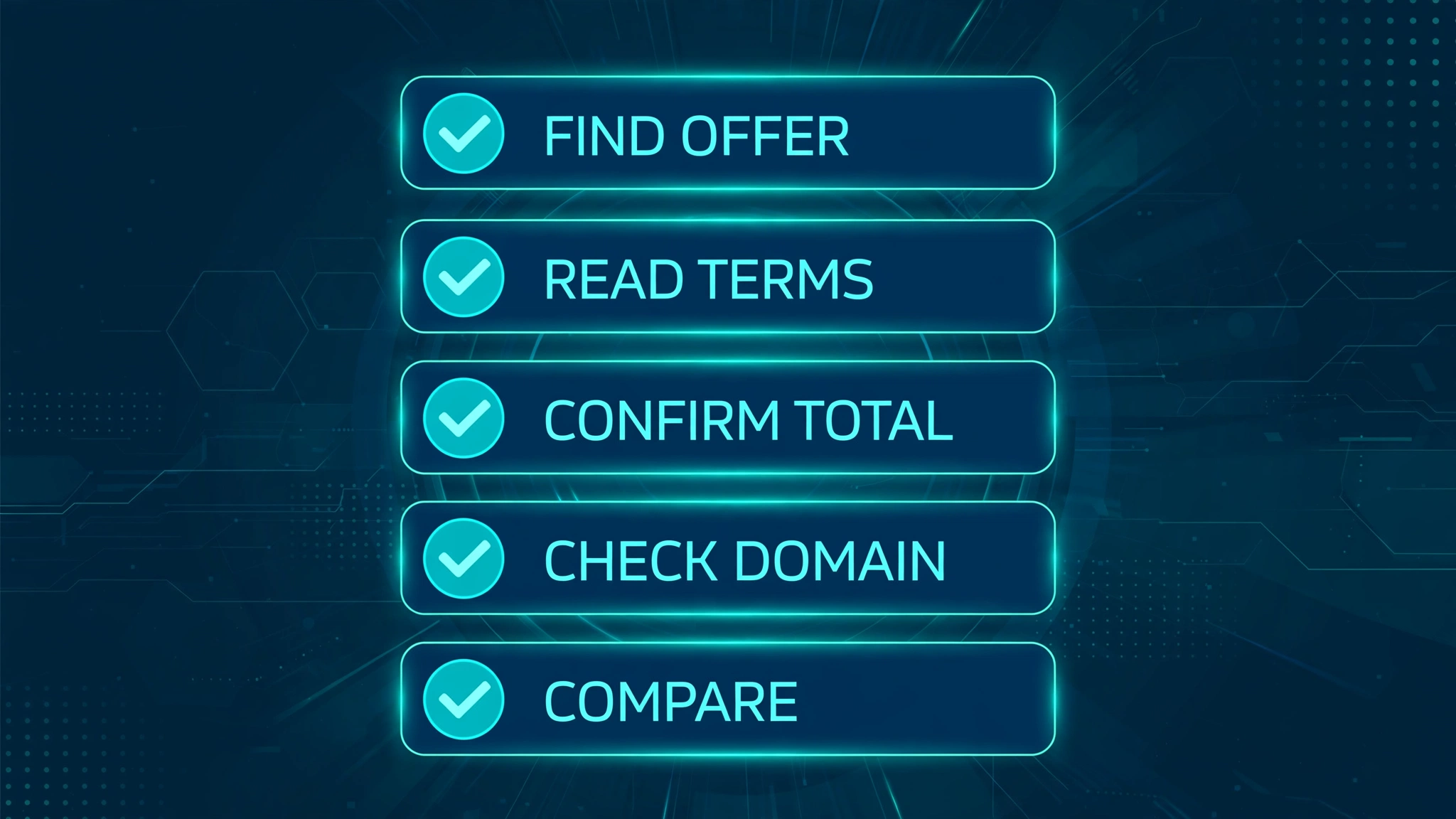
Five checks before paying for a discounted fare
The following five checks apply to this offer and to any flight discount code found online. They cost little, and they separate what can be confirmed from what must be taken on trust.
- Find the current offer on the publishing site. Use the offer page itself, not a repeating page, and check that the offer is current, with its expiry date and terms visible.
- Read the terms against the actual trip. Check the route, dates, fare class, minimum stay, advance-purchase rule, and any blackout dates before entering any code.
- Confirm the reduced total before payment. If the discount does not appear on screen before the payment step, stop and treat the offer as not applying to that trip.
- Check the exact domain at every step. Confirm the domain in search results, in the offer page, and in any email or message, and do not assume a similar name belongs to the same operator.
- Price the same trip without the code. Compare the discounted total with the normal total for the same route, dates, and fare class, so a claimed saving can be measured rather than assumed.
A reader who runs those checks will know more about an offer than any headline percentage can show. The checks also protect against the most common failure in this area, which is not a complicated fraud but a simple mismatch: a code that belongs to another offer, another route, or another date being applied to a trip it was never meant to cover.
See Also: verifying software before downloading it
When a code does not work
A code can fail for ordinary reasons that have nothing to do with the reader. The offer may have expired, the route or fare class may fall outside the terms, the code may already have been used, or the booking site may not accept that code at all. TravelTweaks material itself notes that a code will fail if the route or travel class does not match the offer, and suggests re-entering the code, using a promo link, clearing cookies, or switching browsers before contacting support.
Those steps are worth trying in order, but they have a limit. If the current offer page cannot be found, or if its terms do not cover the trip, no amount of re-entering will create a discount. At that point the correct step is to price the trip normally and decide on that price, rather than to keep searching for another page that promises the same code in stronger terms.
A failed code is also a useful signal about the pages that promoted it. A page that promised a guaranteed saving on all flights, and whose code then fails on a normal booking, has shown that its promise was not based on the offer terms. That page should not be trusted for the next offer either, even if it publishes a new code with a new percentage.
Related Post: troubleshooting connectivity issues step by step
What this means for United States readers
Readers in the United States face the same check in a slightly sharper form, because many of the repeating pages name United States-facing booking platforms and describe savings in general terms that sound as if they apply everywhere. A code described on a general deals page does not automatically apply to a United States departure, a domestic route, or a fare sold in dollars. The offer terms, not the repeating page, decide that.

Conclusion
Ttweakairline discount is best understood as a search label for TravelTweaks flight-discount material, not as an airline or a guaranteed saving. TravelTweaks itself describes a code that reduces the fare on selected routes, dates, or fare classes when the terms match, while third-party pages add different percentages, partner lists, and code names that were not verified against a current offer page during research. A reader who checks the current offer, reads its terms against the actual trip, and confirms the reduced total before payment will have separated what is published from what is merely repeated.
Frequently asked questions
What is ttweakairline discount?
It is a search phrase for flight-discount material published under the TravelTweaks name. TravelTweaks describes a discount code that appears at checkout and reduces the fare on selected routes, dates, or fare classes when the code matches the fare rules.
Is ttweakairline an airline?
No evidence found during research describes it as an airline with its own fleet or booking system. The material describes a discount label connected with TravelTweaks, a travel site that publishes guides and deal material.
Does a ttweakairline discount code guarantee a saving?
No. The saving depends on the specific offer, including its route, dates, fare class, and expiry date. A reader should confirm that the discount appears on screen before payment, and should not plan a budget around a percentage quoted by a third-party page.
Why do different pages quote different percentages?
Because third-party pages copy and rewrite the same material with different figures. TravelTweaks itself describes the saving as depending on the offer terms, not as a single flat percentage for all flights.
Is the similarly named ttweakflight blog the same as TravelTweaks?
No. That blog states that it is independent, not a booking site or coupon service, and not affiliated with TravelTweaks. The two names should be treated as separate.
What should a reader do if a code does not work?
Check the current offer page and its terms, confirm that the route and fare class match, re-enter the code carefully, and try a promo link if one is provided. If the offer does not cover the trip, price the trip normally and decide on that price.