

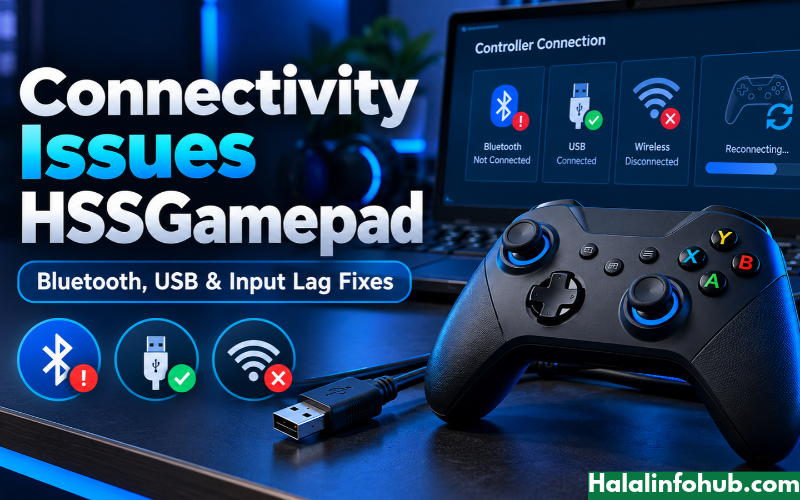
If you are experiencing connectivity issues with HSSGamepad, problems such as failed pairing, unexpected disconnections, delayed inputs, or an unresponsive controller can interrupt your gaming session. These issues may be related to Bluetooth settings, USB connections, battery levels, device compatibility, or outdated drivers and software.
The best way to troubleshoot the problem is to identify how your controller connects and when the issue occurs. In this guide, you will learn practical steps to check Bluetooth pairing, test a wired USB connection, reduce input lag, and diagnose repeated disconnections. Because troubleshooting steps can vary by controller model and operating system, verify any model-specific instructions before changing advanced settings.
Whether HSSGamepad fails to connect at all or works briefly before disconnecting, the following checks can help you narrow down the cause and identify an appropriate fix..
What Are Connectivity Issues HSSGamepad?
Connectivity issues HSSGamepad refers to problems that prevent a game controller from connecting reliably to a compatible gaming device. You might find that the controller does not appear in Bluetooth settings, connects but disconnects during gameplay, or appears connected without responding to button presses.
These problems can be frustrating, especially when you are ready to play and the controller suddenly stops working.
However, a failed connection does not automatically mean your controller is broken. The cause could be as simple as a low battery, an old pairing record, an incompatible connection method, a faulty USB cable, or an issue with the device receiving the controller’s input.
One important limitation is that publicly available information about the exact HSSGamepad model is limited and inconsistent. Not every model necessarily supports the same connection methods, input modes, or button combinations. Therefore, this guide focuses on general controller troubleshooting rather than assuming model-specific features that have not been verified.
Related Post: GamificationSummit Xendit Work
Common HSSGamepad Connectivity Problems
Before changing settings, identify what is happening. The symptom often provides the best clue about where to start.
| Problem | Possible cause | First step to try |
| Controller does not appear in Bluetooth | Pairing mode or battery issue | Charge it and follow the model’s pairing instructions |
| Bluetooth pairing fails | Old pairing data or compatibility issue | Remove the saved pairing and reconnect |
| Controller disconnects randomly | Low battery or wireless interference | Charge it and test closer to the device |
| Controller connects but buttons do not work | Game settings or input compatibility | Test another game or controller test utility |
| PC does not recognize the controller | USB cable, port, driver, or compatibility issue | Try another data-capable cable or port |
| Noticeable input lag | Wireless interference or system performance | Reduce interference and test the controller nearby |
| Controller fails on multiple devices | Possible controller fault | Test a supported wired connection, if available |
These are possible causes, not definitive diagnoses. Work through the simplest checks before attempting more advanced changes.
How to Fix Connectivity Issues HSSGamepad Step by Step
1. Charge the controller fully
Start with the battery. A controller with insufficient charge may behave unpredictably, struggle to maintain a wireless connection, or shut down during gameplay.
Connect it to a suitable power source using the recommended charging cable. Allow it to charge according to the manufacturer’s instructions, then try connecting it again.
If your controller uses replaceable batteries, check that they are installed correctly and have sufficient charge.
Avoid assuming that a controller is fully charged simply because its indicator light turns on. If it continues disconnecting despite a full charge, move on to the next checks.
2. Restart the controller and connected device
Temporary Bluetooth or operating-system problems can sometimes prevent a controller from connecting correctly.
Try this sequence:
- Turn off the controller.
- Restart the phone, computer, or other compatible device.
- Turn the controller back on.
- Follow the pairing instructions for your exact model.
- Test the connection before launching a game.
Restarting can clear temporary software problems without deleting important files or changing advanced settings.
3. Remove the old Bluetooth pairing
If the controller appears in the Bluetooth list but refuses to reconnect, the saved pairing may be causing a problem.
On your phone or computer, open Bluetooth settings and locate the saved controller entry. Select the option to forget or remove the device.
Next, put the controller into pairing mode using its official instructions and connect it again from the device’s Bluetooth menu.
Do not use a random button combination found in a guide for another controller. Pairing procedures vary between models, and an incorrect combination may activate a different mode or do nothing at all.
4. Check the controller’s pairing mode
Some controllers require a specific startup sequence or pairing button before they become discoverable. Others use different procedures depending on the device they are connecting to.
If your HSSGamepad does not appear in the Bluetooth list:
- Confirm that the controller is powered on.
- Check that it is in pairing mode.
- Keep it close to the device during setup.
- Temporarily disconnect it from another device if it is already connected elsewhere.
- Consult the manual for the correct indicator-light behavior.
If the controller still does not appear, try pairing it with another compatible device. This helps establish whether the problem is specific to your original device.
5. Reduce wireless interference
Wireless connections can be affected by nearby devices and physical obstructions. Busy wireless environments may cause intermittent connections or delayed input.
Try moving closer to your gaming device and reducing the distance between the controller and its Bluetooth receiver.
You can also test the following changes:
- Move away from a Wi-Fi router or other sources of wireless congestion.
- Temporarily disconnect unused Bluetooth devices.
- Avoid placing the controller or receiver behind metal objects.
- Keep the wireless receiver away from crowded ports and other electronics when practical.
Change one thing at a time and test the controller again. If the connection becomes stable after moving to a different location, wireless interference or range may have contributed to the problem.
6. Check USB cables and ports
If your particular controller supports a wired USB connection, test it with a suitable data-capable cable.
A cable can supply power without carrying the data needed for controller input. Therefore, a charging light does not prove that the cable supports gameplay.
Try these checks:
- Disconnect the controller and inspect the cable and connectors.
- Connect it to another USB port.
- Try a different cable known to support data transfer.
- Check whether the operating system detects the controller.
- Test the controller outside the game.
If it works with another cable, the original cable may be faulty or unsuitable. If the computer does not detect it with multiple known-good cables and ports, investigate device compatibility, drivers, or possible hardware problems.
Not every HSSGamepad model necessarily supports wired play, so confirm this capability before relying on this test.
Related Post: LCFTechMods Gaming Update by LyncConf
How to Fix HSSGamepad Connectivity Problems on Windows
When the controller works on a phone but fails on a Windows PC, the problem may involve the computer’s Bluetooth connection, USB interface, game settings, or controller compatibility.
Check Bluetooth settings
First, make sure Bluetooth is enabled and that Windows can discover other devices. Remove the controller’s old pairing record if necessary and try connecting it again.
If other Bluetooth devices also fail, troubleshoot the computer’s Bluetooth connection rather than focusing exclusively on the controller.
Check Windows updates and drivers
Outdated or malfunctioning drivers can interfere with device detection. Check Windows Update and your computer or Bluetooth adapter manufacturer’s official support page for applicable updates.
Avoid downloading unofficial driver packages from unknown websites. A website claiming to provide a special HSSGamepad driver is not automatically trustworthy.
If the controller connects successfully but a particular game does not recognize it, check the game’s supported controllers and input settings before reinstalling drivers.
Test the controller outside the game
A controller may connect to Windows correctly while a game fails to recognize its inputs.
If available, use Windows’ built-in game-controller testing tools or a trusted controller diagnostic utility. Check whether button presses and stick movements are detected.
If the inputs work in a test utility but not in one game, investigate that game’s settings and compatibility. If they fail everywhere, check the connection, input mode if supported, and device drivers.
Related Post: Ftasiatrading Saving Tips
How to Fix HSSGamepad Connectivity Problems on Android
Android users may encounter pairing failures, disconnections, or controllers that connect but do not work correctly in a particular game.
Start by charging the controller, restarting the phone, and removing the saved Bluetooth pairing before connecting it again.
Check Bluetooth permissions and compatibility
Make sure Bluetooth is enabled and follow the normal pairing procedure. Some games support only particular controller types or input configurations, so a successful Bluetooth connection does not guarantee that every game will accept the controller.
Test it in a game that explicitly supports external controllers or use a reputable input-testing application.
Check battery-saving settings
Some Android devices restrict background activity or certain connected-device behavior to conserve power. If a problem appears only after the phone has been idle or the screen has been locked, review the device’s battery and Bluetooth settings.
Do not disable system protections or change hidden settings without understanding their purpose. Exact options differ by Android version and manufacturer.
Update the phone’s software
Check for available system updates through the phone’s normal settings. If the controller worked before a recent update, look for relevant compatibility information and test it on another device if possible.
This can help distinguish a phone-specific issue from a controller problem.
Why Does HSSGamepad Connect but Not Respond?
A controller that appears connected but does not register inputs may have a different problem from one that cannot establish a connection.
Possible explanations include:
- The game does not support the controller.
- The game has disabled controller input.
- Button mapping is incorrect.
- The controller is using an incompatible input mode, if multiple modes are available.
- The controller is paired with a different device or application.
- The game or operating system is experiencing a temporary problem.
First, test the controller outside the game. If its buttons work in another compatible application, review the original game’s input settings.
If the buttons fail across multiple applications, remove and re-establish the connection, then check the controller’s manual for supported modes and troubleshooting instructions.
Do not assume that every HSSGamepad supports XInput, DirectInput, or a specific mode-switching shortcut unless that information is confirmed for your model.
How to Reduce HSSGamepad Input Lag
Input lag occurs when there is a noticeable delay between pressing a button and seeing the action on screen. The controller’s connection is one possible cause, but it is not the only one.
Move closer to the device
If you are using a wireless connection, reduce the distance between the controller and the receiver. Test in a location with fewer obstructions and less wireless congestion.
Disconnect unnecessary wireless devices
Temporarily disconnect unused Bluetooth devices and see whether the controller responds more consistently. If the lag improves, investigate possible wireless congestion.
Check game performance
If the game itself is running slowly, the delay may come from low frame rates, high system load, or display settings rather than the controller connection.
Test the controller in another game or application. If the delay occurs only in one game, check its performance and input settings.
Test a wired connection if supported
A suitable wired connection can help determine whether the problem is specific to wireless operation. If input lag disappears when wired, investigate the wireless connection first.
If the delay remains, check the game’s performance, input configuration, and device compatibility.
How to Tell Whether the Controller Is Faulty
Do not replace the controller before performing a few basic tests. A failed connection may be caused by the host device, cable, or software rather than the controller itself.
Use this diagnostic approach:
| Test result | What it may indicate |
| Works on another compatible device | Original device settings or compatibility issue |
| Works with a different cable | Original cable or connector problem |
| Works wired but not wirelessly | Wireless pairing, interference, or Bluetooth issue |
| Connects but fails in only one game | Game compatibility or input configuration |
| Fails on multiple compatible devices | Possible controller hardware or firmware issue |
| Will not charge or powers off repeatedly | Possible battery, charging, or hardware fault |
These results provide clues rather than absolute proof. For example, a controller may fail on multiple devices because of an incompatible connection method, not necessarily because it is broken.
If the controller repeatedly fails after testing with compatible devices and known-good accessories, consult the seller or manufacturer support channel if one is available. Check warranty terms before opening the controller or attempting a repair.
How to Prevent Future HSSGamepad Connectivity Issues
Once the controller is working again, a few habits can reduce the chance of recurring problems.
Keep the controller charged. Recharge it before long gaming sessions and follow the recommended battery-care instructions.
Use trusted software sources. Install system updates and drivers through official device or component manufacturers whenever possible.
Avoid unnecessary pairing changes. If the controller works reliably, do not repeatedly reset it or switch connection modes without a reason.
Inspect cables and ports. Damaged connectors and unsuitable cables can cause intermittent detection.
Check compatibility before buying accessories. A cable, wireless adapter, or replacement accessory must support the connection method used by your particular controller.
Keep a record of changes. If a problem starts after an update or setting change, noting what changed can make troubleshooting faster.
FAQs
1. Why is my HSSGamepad not connecting?
Possible causes include low battery, incorrect pairing mode, an old Bluetooth pairing record, device compatibility, or a faulty cable. Charge the controller, restart your device, and follow the pairing instructions for your model.
2. Why does HSSGamepad keep disconnecting?
Random disconnections may result from low battery, wireless interference, device power management, or a hardware issue. Test the controller near the device and check whether the problem occurs on another compatible device.
3. How do I reconnect HSSGamepad to Bluetooth?
Remove the old controller entry from your device’s Bluetooth settings, restart the controller if necessary, and pair it again using the instructions for your specific model.
4. Why does HSSGamepad connect but not work in a game?
The game may not support the controller, or its input settings may be incorrect. Test the controller in another compatible game or input-testing application before troubleshooting further.
5. Can a USB cable fix HSSGamepad connectivity issues?
It may help if your controller supports wired data connections. Use a suitable data-capable cable and another USB port to determine whether the issue is related to wireless connectivity or the wired connection.
6. How do I fix HSSGamepad input lag?
Test the controller closer to the device, reduce wireless interference, check game performance, and try a wired connection if supported. The cause may be the game or device rather than the controller itself.
7. Do I need a special HSSGamepad driver?
That depends on the specific model and the operating system. Check the manufacturer’s documentation or your device’s official support resources. Avoid installing unverified drivers from unfamiliar websites.
8. Why does HSSGamepad work on my phone but not my PC?
The PC may have a Bluetooth, USB, driver, or game-compatibility problem. Check whether Windows detects the controller and test it outside the game.
9. Should I reset HSSGamepad to factory settings?
A reset may help if the controller has a documented reset procedure and ordinary pairing fixes have failed. Check your model’s manual first because reset methods differ, and some may erase saved settings.
10. How can I tell whether HSSGamepad is broken?
Test it on other compatible devices and use a known-good cable if wired operation is supported. If it continues failing across supported configurations, consult the seller or manufacturer support channel if available.
11. Can wireless interference affect a game controller?
Yes. Wireless congestion, distance, and physical obstructions can affect some wireless connections. Test the controller closer to the device and reduce nearby sources of interference.
12. Where can I find official HSSGamepad instructions?
Use the documentation provided with your controller or the support page of the verified manufacturer or seller. Public information under the HSSGamepad name is inconsistent, so verify the exact model before following model-specific instructions.
Conclusion
Connectivity issues HSSGamepad users experience can come from several sources, including low battery, Bluetooth pairing problems, wireless interference, unsuitable USB cables, game compatibility, or device settings.
Start with the simple fixes: charge the controller, restart your device, remove an old Bluetooth pairing, and reconnect it using the correct instructions. Then test the controller on another compatible device or through a supported wired connection to narrow down the cause.
Most importantly, do not assume that every HSSGamepad model has the same features or reset procedure. Verify your model’s instructions before making advanced changes, and use trusted software sources when updating drivers or troubleshooting tools.
A systematic diagnosis can help you restore a stable connection without unnecessary resets, risky downloads, or premature replacement.