
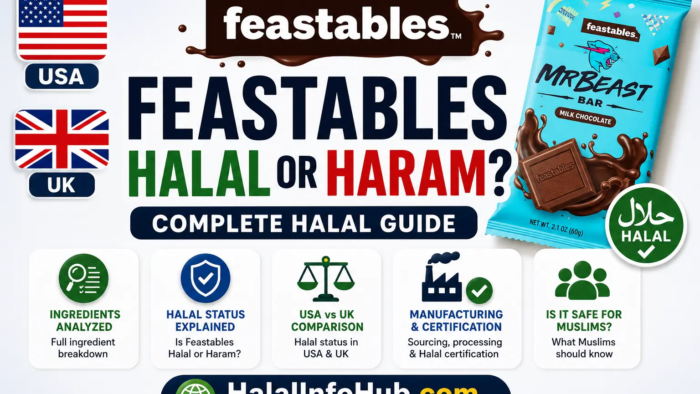
Feastables is generally considered doubtful (mashbooh) for Muslims because the brand does not carry official halal certification in the United States or United Kingdom.
Most Feastables chocolate bars do not contain obvious pork ingredients, but ingredient sourcing, flavour systems, and manufacturing processes are not fully verified under Islamic halal standards.
👉 Final ruling: Doubtful — Muslims should verify ingredients and certification before consuming.
What Is Feastables
Feastables is a snack and chocolate brand created by internet creator MrBeast.
The brand became famous because of:
- YouTube marketing
- viral giveaways
- simple ingredient chocolate bars
- strong online popularity
Feastables products are sold in:
- supermarkets
- online stores
- convenience shops
The brand mainly focuses on:
- milk chocolate
- peanut butter chocolate
- crunchy chocolate snacks
- limited-edition flavours
Because it is a modern viral snack brand, many Muslims now ask:
“Is Feastables halal or haram?”
Related Post: Is Gelatin Halal or Haram?
Why Muslims Question Feastables
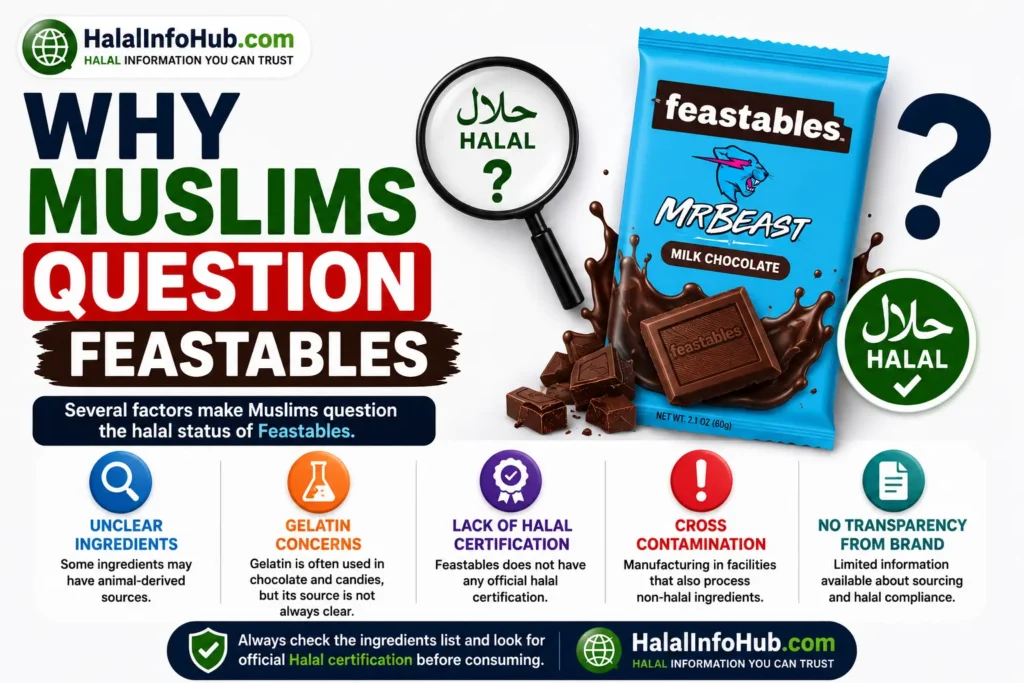
Chocolate may look simple, but modern processed snacks can contain hidden halal concerns.
The main issues usually involve:
- flavouring systems
- emulsifiers
- dairy sourcing
- contamination risks
- unclear processing methods
Even when no obvious haram ingredient appears, halal verification is still important.
Feastables Halal Risk Overview
| Factor | Status | Risk Level |
| Halal Certification | ❌ None | High |
| Pork Ingredients | ❌ Not clearly present | Low |
| Flavor Transparency | ⚠️ Partial | Medium |
| Manufacturing Verification | ⚠️ Unclear | Medium |
| Cross-Contamination Risk | ⚠️ Possible | Medium |
👉 Overall classification: Doubtful (Mashbooh)
Feastables Ingredients Analysis
Most Feastables bars contain ingredients like:
- sugar
- cocoa butter
- milk
- cocoa mass
- sunflower lecithin
- natural flavouring
At first glance, these ingredients may appear halal-friendly.
However, the problem is not always the visible ingredient list.
The real concern comes from:
- flavour sourcing
- industrial processing
- shared equipment
- lack of halal oversight
Are There Haram Ingredients in Feastables?
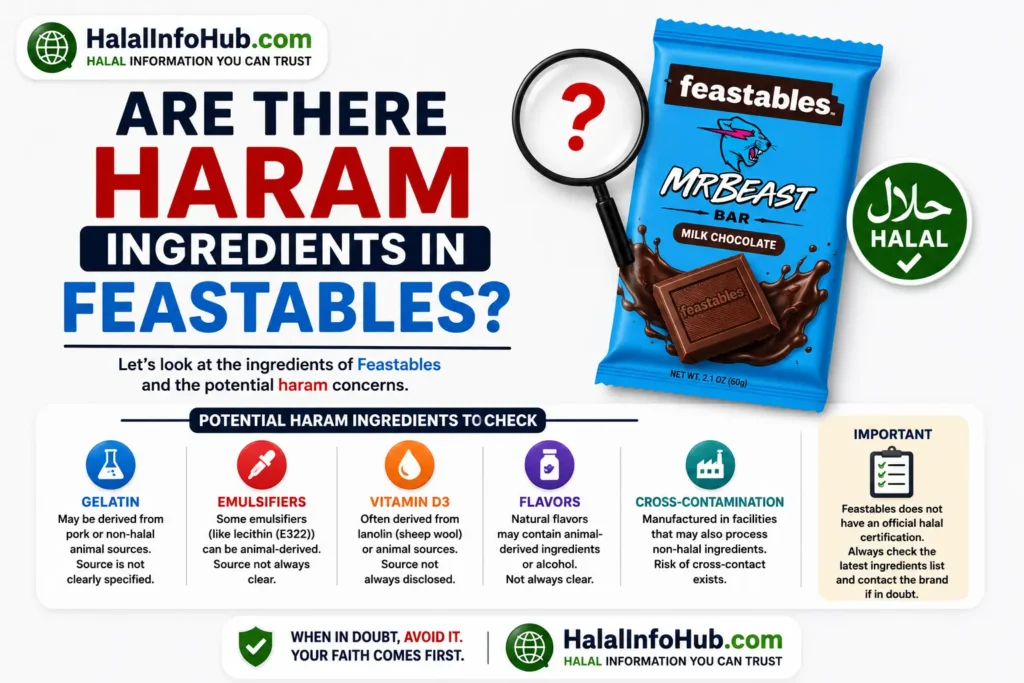
Currently, most Feastables products do not openly list:
- pork gelatin
- alcohol
- obvious animal enzymes
This makes them appear safer than many gummy candies.
However, there are still concerns about:
- natural flavours
- processing aids
- contamination during manufacturing
Without halal certification, Muslims cannot fully verify every stage of production.
Feastables Halal Status in USA
In the United States, Feastables products are sold widely through mainstream retail systems.
Main concerns include:
❌ No halal certification
No major halal authority officially certifies Feastables products.
Shared industrial production
Factories may process multiple products together.
Ingredient sourcing uncertainty
Some ingredients may come from suppliers that are not halal-verified.
Dairy processing concerns
Chocolate production sometimes includes shared systems with non-halal ingredients.
Because of these factors, many Muslims classify Feastables as doubtful in the USA.
Feastables Halal Status in UK
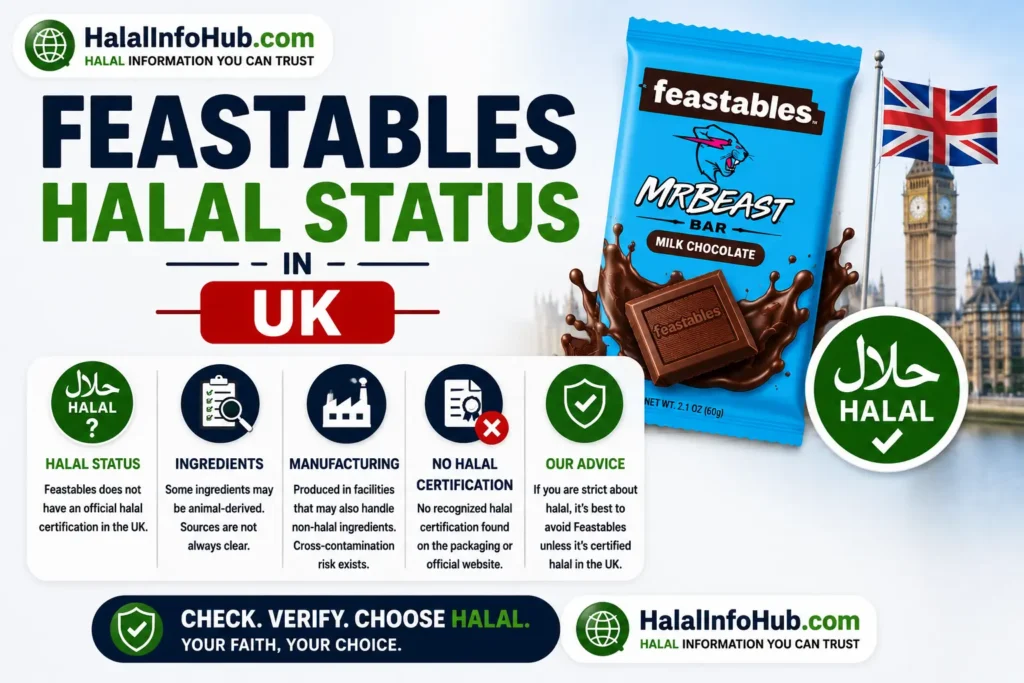
The situation in the United Kingdom is similar.
Although some UK ingredient laws are stricter, halal certification is still the main issue.
Key UK concerns:
- imported production batches
- unclear halal verification
- shared manufacturing systems
- no Islamic certification authority approval
This means Muslims in the UK also face uncertainty.
Feastables USA vs UK Comparison
| Factor | USA | UK |
| Halal Certification | ❌ None | ❌ None |
| Ingredient Transparency | Medium | Medium |
| Muslim Consumer Confidence | Medium-Low | Medium-Low |
| Industrial Production Risk | High | High |
| Overall Halal Safety | Doubtful | Doubtful |
Industrial Chocolate Manufacturing Problem
Modern chocolate factories are extremely industrialized.
Large brands often:
- process many products together
- use shared machinery
- switch ingredients by supplier availability
- prioritize efficiency over religious compliance
This creates halal uncertainty even in products that appear simple.
For Muslims, halal is not only about:
“Does it contain pork?”
It is also about:
- sourcing
- processing
- contamination prevention
- certification
Difference Between “No Haram Ingredient” and “Halal”
This is where many people become confused.
A product may:
- not contain obvious haram ingredients
but still:
- lack halal certification
- use doubtful processing systems
- operate in shared facilities
That does not automatically make it halal.
Halal vs Non-Haram Difference
| Concept | Meaning |
| No obvious haram ingredient | May appear safer |
| Official halal certification | Verified Islamic compliance |
| Shared factory system | Creates uncertainty |
| Halal-approved production | Fully verified |
Cross-Contamination Concerns
Chocolate factories may also process:
- products containing alcohol flavourings
- non-halal confectionery
- gelatin-based snacks
If equipment is shared, contamination risks increase.
Without halal auditing systems, consumers cannot fully verify separation standards.
Safer Halal Chocolate Alternatives
Instead of doubtful products, Muslims can choose:
- halal-certified chocolate brands
- vegan-certified chocolates with halal approval
- Muslim-friendly confectionery brands
These products provide clearer ingredient verification and halal transparency.
Safer Chocolate Choices for Muslims
| Product Type | Safety Level |
| Halal-certified chocolate | ✅ High |
| Vegan + halal certified | ✅ High |
| Mainstream uncertified chocolate | ⚠️ Medium risk |
| Products with alcohol flavouring | ❌ Avoid |
Who Owns Feastables and Why It Matters for Muslims
Feastables was created by MrBeast, one of the biggest internet personalities in the world.
The brand became successful very quickly because of:
- massive YouTube exposure
- influencer marketing
- viral online campaigns
- celebrity-driven trust
Many young Muslims automatically assume:
“If a famous influencer sells it, it must be safe.”
But halal compliance does not depend on popularity.
Islamic dietary rulings depend on:
- ingredients
- sourcing
- processing systems
- certification
not social media influence.
This is important because modern influencer brands often focus on:
- branding
- taste
- marketing
- mass sales
while halal verification may not be part of the production process.
Feastables Manufacturing System Explained
Most modern snack brands do not own every ingredient source themselves.
Instead, they usually work with:
- third-party suppliers
- industrial food manufacturers
- large-scale processing facilities
This creates multiple halal verification challenges.
A single chocolate bar may involve:
- cocoa from one country
- flavouring from another supplier
- dairy processing from another factory
- packaging in a different location
Without halal auditing systems, consumers cannot fully trace every ingredient source.
That is why halal certification is extremely important in modern processed food industries.
Hidden Chocolate Ingredient Concerns
Chocolate products may contain more than just cocoa and sugar.
Modern confectionery sometimes includes:
- emulsifiers
- flavour carriers
- dairy enzymes
- processing agents
- stabilizers
Some of these ingredients may come from:
- plant sources
- synthetic systems
- animal-derived sources
The issue is not always visible on the ingredient list.
That is why ingredient transparency matters so much.
Natural Flavours Problem
One of the most misunderstood food labels is:
“Natural Flavour”
Many consumers think natural flavour automatically means safe or halal.
But “natural flavour” can include complex ingredient systems.
In some cases, flavour ingredients may involve:
- alcohol-based extraction methods
- animal-derived carriers
- industrial processing systems
This does not automatically make the product haram, but it creates uncertainty when halal certification is absent.
Why Halal Certification Is Becoming More Important Globally
Muslim consumers in the USA and UK are becoming more careful than before.
Years ago, many people simply avoided:
- pork
- alcohol
Today, Muslims also think about:
- contamination risks
- ingredient sourcing
- factory systems
- industrial food science
This is why halal certification has become a major global industry.
Halal certification helps verify:
✔ ingredients
✔ processing systems
✔ contamination prevention
✔ supply chain standards
Without certification, uncertainty increases.
Why Modern Chocolate Products Become Doubtful
| Concern | Why It Matters |
| Shared factories | Cross-contamination risk |
| Unclear flavours | Source uncertainty |
| No halal certification | No Islamic verification |
| Global ingredient sourcing | Difficult traceability |
| Industrial production | Mixed processing systems |
Difference Between “Safe-Looking” and “Verified Halal”
Many products appear harmless.
For example:
- chocolate bars
- chips
- candy
- cookies
But appearance does not determine halal status.
A product becomes truly halal when:
✔ ingredients are verified
✔ processing is halal-compliant
✔ contamination is controlled
✔ certification exists
This is why Muslims should avoid relying only on packaging appearance.
Are Feastables Better Than Gelatin Candy?
Compared to gummy candies, Feastables may appear safer because:
- no obvious pork gelatin is listed
- fewer animal-based ingredients are visible
- chocolate products generally contain less gelatin risk
However, “safer” does not automatically mean halal-certified.
The product still lacks:
- official halal approval
- ingredient traceability
- Islamic auditing systems
So Muslims who follow strict halal standards may still avoid it.
Best Way for Muslims to Choose Snacks in USA & UK
The easiest strategy is:
Choose:
✅ halal-certified snacks
✅ transparent brands
✅ Muslim-friendly confectionery
Avoid:
❌ doubtful processed products
❌ unclear flavour systems
❌ uncertified industrial candy
This removes confusion completely.
Important Rule Muslims Should Remember
A product can fall into 3 categories:
| Category | Meaning |
| Clearly halal | Verified and certified |
| Clearly haram | Contains forbidden ingredients |
| Doubtful (mashbooh) | Unclear verification |
Most scholars recommend avoiding doubtful foods when halal certainty is missing.
That is why many Muslims classify Feastables as:
⚠️ doubtful rather than clearly halal.
How to Check Chocolate for Halal Status
Before buying chocolate in USA or UK:
Always check:
✔ halal certification logo
✔ ingredient list
✔ flavouring details
✔ manufacturer transparency
Avoid when:
❌ ingredient sources are unclear
❌ alcohol flavouring is present
❌ no certification exists for doubtful products
See Also
FAQs
Is Feastables halal?
Feastables is not officially halal-certified.
Do Feastables contain gelatin?
Most bars do not appear to contain gelatin.
Is Feastables haram?
It is not clearly haram, but many Muslims classify it as doubtful.
Is Feastables halal in USA?
No official halal certification exists in the USA.
Is Feastables halal in UK?
The halal status remains unclear in the UK as well.
Can Muslims eat Feastables?
Some Muslims may eat it, while others avoid it due to lack of halal verification.
Does Feastables contain alcohol?
No obvious alcohol ingredients are commonly listed, but flavour sourcing is not fully verified.
Conclusion
So, is Feastables halal or haram?
👉 The most accurate answer is:
Feastables is generally considered doubtful (mashbooh) because it lacks halal certification and full ingredient transparency.
The products may not contain obvious haram ingredients like pork gelatin, but Muslims still face uncertainty regarding:
- flavour sourcing
- manufacturing systems
- contamination risks
- industrial processing methods
For Muslims seeking complete certainty, the safest option is always:
✅ halal-certified chocolate
✅ verified halal snack brands
✅ transparent ingredient systems
That removes doubt and makes halal food choices easier and safer in modern food markets.