

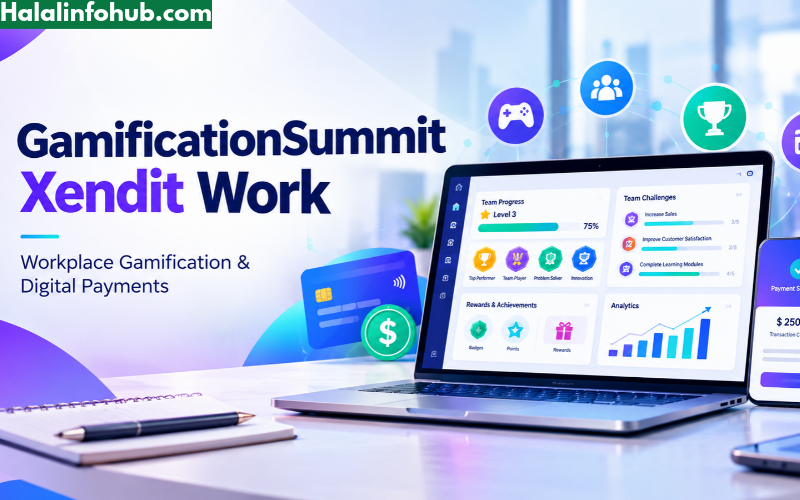
GamificationSummit Xendit Work is a topic that brings together workplace gamification, employee engagement, and digital payment technology. Businesses increasingly explore game-inspired elements such as challenges, progress tracking, rewards, and recognition to make workplace activities more engaging. Xendit, a financial technology company focused on payment infrastructure, provides a relevant perspective on how digital payments support modern businesses.
In this guide, we explore what GamificationSummit Xendit Work means, how workplace gamification operates, its potential benefits, and how to verify claims about any event or initiative associated with Xendit.
What Does GamificationSummit Xendit Work Mean?
The phrase combines three ideas: Gamification Summit, Xendit, and work. Understanding each part makes the keyword easier to interpret.
Gamification means applying selected game-design elements to activities that are not traditionally games. Businesses may use progress bars, challenges, badges, milestones, or feedback to make a task more engaging.
Xendit is a financial technology company that provides payment infrastructure to businesses, particularly across Southeast Asia. Its official website describes its mission as simplifying payments and helping businesses operate in the digital economy. Visit Xendit’s official website.
Work can refer to employee engagement, workplace learning, team collaboration, business processes, or the operational side of organizing an event.
When these terms are combined, they suggest a topic about how gamification and business technology might intersect with Xendit. However, the phrase itself does not establish that a specific event or program exists.
This distinction matters because different online articles describe the keyword in different ways. Some present it as a workplace initiative, others describe an alleged conference, and some discuss the possible use of payment technology in gamified events. Those interpretations should not be treated as interchangeable or as proof of an official Xendit project.
Related Post: LCFTechMods Gaming Update by LyncConf
Is GamificationSummit Xendit Work an Official Xendit Event?
Based on the official public sources reviewed for this article, I could not confirm that “GamificationSummit Xendit Work” is the official name of a Xendit conference, product, or workplace program.
Xendit does publish information about its workplace culture and team activities. For example, a company article describes a virtual company trip that included games, employee storytelling, and a talent show. Another article discusses its approach to remote work, communication, and team collaboration. These are documented examples of workplace activities, but they do not establish that a separate event called GamificationSummit Xendit Work took place.
You can review the original material here:
If you encounter a page claiming that Xendit hosted a particular summit, check whether it links to an official announcement, event agenda, registration page, recording, or other primary documentation.
Until such evidence is available, it is more accurate to discuss the keyword as a topic connecting Xendit and workplace gamification rather than present an unverified summit as a confirmed corporate event.
How Does Workplace Gamification Work?
Workplace gamification uses game-inspired mechanics to make progress easier to understand and participation more engaging. It does not require employees to play video games during working hours. Instead, a business introduces selected elements into an existing task, training program, or team activity.
For example, a company might create a learning program in which employees complete short lessons, receive feedback, and track their progress toward a qualification. The learning objectives remain the same, but progress becomes more visible.
1. Goals and challenges
An effective gamified activity starts with a clear objective. Employees should understand what they need to accomplish, why the task matters, and how completion will be evaluated.
A challenge might involve completing a training module, identifying errors in a practice exercise, or meeting a reasonable project milestone.
The objective should measure useful work rather than activity for its own sake. Asking employees to complete more tasks is not necessarily helpful if quality declines or unnecessary work increases.
Related Post: Connector HSSGamepad
2. Points and progress tracking
Points can represent progress toward a defined goal. Progress bars and milestone indicators can help participants see how far they have progressed and what remains.
For example, an onboarding program might contain five required modules. A progress indicator can show which modules are complete and which still need attention.
Points are most useful when the scoring rules are clear. Employees should not have to guess how their performance is measured or whether the system treats people consistently.
3. Badges and recognition
Badges can acknowledge completed training, demonstrated skills, or meaningful milestones. Recognition may also take the form of feedback from a manager or acknowledgment from colleagues.
A badge should represent something meaningful. Awarding dozens of meaningless badges can make the system feel artificial and reduce the value of genuine achievements.
4. Feedback and improvement
Useful feedback tells participants what they did well and what they can improve. In a training program, for example, a participant might receive an explanation after answering a question incorrectly.
Feedback should be timely, specific, and constructive. A leaderboard alone cannot explain why someone is struggling or how they can improve.
5. Team-based activities
Some organizations use collaborative challenges rather than individual rankings. A team may work together to complete a learning activity, solve a customer-service scenario, or reach a shared project milestone.
Team-based gamification can support collaboration when the task genuinely requires people to help one another. It can become counterproductive if individual contributions are hidden or some employees consistently carry the workload.
How Xendit and Gamification Could Connect
Xendit’s documented business focus is payment infrastructure. Workplace gamification, meanwhile, is a design approach for encouraging participation and making progress visible. These are different functions, although a business could potentially use them together.
The following examples are hypothetical applications, not claims about a confirmed Xendit gamification program.
Gamified business events
An event organizer could create a digital activity in which attendees complete learning sessions, participate in demonstrations, or collect points for visiting approved activity stations.
A payment provider such as Xendit could potentially support eligible payment flows, such as ticket purchases, depending on the organizer’s needs and available services. The event’s own software would still need to manage challenges, points, progress, and participation rules.
Payment processing does not automatically provide a gamification system.
Employee training
A business could divide training into short modules and use progress indicators to show completion. Employees might receive recognition after demonstrating a required skill.
The value comes from making learning manageable and giving employees useful feedback, not simply from adding a score to every activity.
Customer engagement
A business might use challenges or rewards to encourage customers to explore product features or complete a useful onboarding step. If monetary rewards are involved, the company should define eligibility, limits, payment rules, and fraud controls clearly.
Any payment integration would need to be designed and implemented separately from the gamification logic.
Team collaboration
Teams could use shared milestones to track a project or complete a process improvement exercise. A visual progress board may help colleagues understand dependencies and recognize collective achievements.
For this approach to work, the goals must be realistic and the scoring should not encourage employees to hide problems or compete at the expense of colleagues.
Related Post: Error RCSDASSK
Benefits of Workplace Gamification
When designed around meaningful objectives, gamification may help businesses make certain activities easier to follow and more engaging. Its effectiveness depends on the people, task, implementation, and measurement method.
Clearer goals
A well-designed challenge tells participants what success looks like. This can reduce uncertainty in structured activities such as training, onboarding, and process improvement.
Visible progress
Progress indicators can make a large task feel more manageable by showing completed steps and remaining work.
More structured learning
Short challenges, practice exercises, and immediate feedback can help participants identify gaps in their understanding.
Recognition for achievement
Meaningful recognition can help people see that their effort and progress have been noticed. Recognition should be fair and should not depend solely on who completes the most tasks.
Better insight into participation
A carefully designed program can track completion rates, error rates, or time to proficiency. These measurements can help managers identify where participants need more support.
However, a higher score or more clicks does not automatically mean better performance. Businesses should measure actual outcomes rather than assume that gamification has worked because participation increased.
How to Design a Workplace Gamification Program
A business considering gamification should begin with a small, measurable problem rather than launching a complicated points-and-rewards system immediately.
Step 1: Define the business objective
Choose one outcome, such as improving training completion, reducing avoidable errors, or helping employees understand a new process.
Avoid vague goals such as “make work more fun” unless you also define how the result will be assessed.
Step 2: Understand the users
Ask participants which parts of the existing process are confusing, repetitive, or difficult to complete. The answers can help you determine whether gamification is appropriate.
Some problems need clearer instructions, better software, more staff, or improved management rather than a reward system.
Step 3: Select suitable mechanics
Choose the simplest elements that support the objective. A progress bar may be enough for a training course, while a collaborative challenge might suit a team exercise.
Do not introduce public rankings or monetary rewards simply because they are common in games.
Step 4: Explain the rules
Participants should know how points are earned, what qualifies as completion, how errors are handled, and whether personal information will be collected.
If rewards are offered, explain their value, eligibility, and any applicable restrictions before the program begins.
Step 5: Run a small pilot
Test the program with a limited group before introducing it across the organization. Record the starting performance level and define what success would look like.
For example, a training pilot could compare completion and assessment results before and after the change. The results should be interpreted carefully because other factors may also affect performance.
Step 6: Review and improve
Ask participants for feedback, examine the results, and remove mechanics that create confusion or unnecessary pressure.
If the system encourages rushed work, unfair competition, or misleading reporting, revise it before expanding the program.
Common Mistakes to Avoid
Gamification is not automatically effective. Poorly designed systems can create frustration or encourage the wrong behavior.
| Mistake | Why it causes problems | Better approach |
| Rewarding quantity alone | Quality may decline | Measure quality alongside output |
| Using unclear scoring rules | Participants may distrust the system | Publish transparent criteria |
| Overusing leaderboards | Can create unhealthy competition | Consider team goals and private progress |
| Offering meaningless badges | Recognition loses value | Tie rewards to real achievements |
| Tracking too much personal data | Creates privacy concerns | Collect only necessary information |
| Ignoring accessibility | Some participants may be disadvantaged | Provide alternative ways to participate |
| Failing to measure outcomes | The program may look successful without improving work | Define meaningful metrics in advance |
The goal is to support employees and customers, not to manipulate them into doing more work or sharing unnecessary information.
How to Measure Whether Gamification Works
A business should measure results against its original objective. The most appropriate metrics depend on the activity being improved.
| Objective | Potential metric | What to watch |
| Improve training | Completion and assessment rates | Whether knowledge is retained |
| Improve onboarding | Time to complete required steps | Whether new employees understand the process |
| Reduce errors | Error or rework rate | Whether quality actually improves |
| Improve collaboration | Shared milestone completion | Whether contributions are distributed fairly |
| Improve customer onboarding | Successful setup or activation rate | Whether users reach meaningful outcomes |
| Improve participation | Attendance or participation rate | Whether participation leads to useful results |
Whenever possible, compare results with a baseline or a suitable comparison group. Document changes in the process and avoid attributing every improvement to gamification alone.
Do not publish percentage gains as proven results unless the data, methodology, and source can be checked.
Is GamificationSummit Xendit Work Relevant to Businesses?
The topic may be useful for people researching workplace engagement, digital events, employee learning, and payment technology. It is especially relevant when the goal is to understand how different systems might work together.
For example, an event platform could handle registrations and challenges, while a payment provider handles eligible transactions. An internal learning system could track progress, while managers provide coaching and recognition.
These components can complement one another, but they are not the same product. Each requires its own design, implementation, security controls, and evaluation.
FAQs
1. What is GamificationSummit Xendit Work?
It is a search phrase connecting Xendit with gamification and workplace or event activities. It is not, based on the official sources reviewed, a verified name for a specific Xendit product or corporate event.
2. Is GamificationSummit Xendit Work an official conference?
I could not confirm an official conference under this exact name through the public Xendit sources reviewed. Verify any claimed event using an official announcement, agenda, registration page, or recording.
3. What is workplace gamification?
Workplace gamification applies selected game mechanics, such as challenges, progress indicators, points, and recognition, to work activities outside traditional games.
4. How does Xendit relate to gamification?
Xendit provides payment infrastructure for businesses. That technology could potentially support payment steps in a gamified event or reward workflow, but this possibility does not prove a specific partnership or program.
5. Does Xendit offer a gamification product?
The official public materials reviewed do not establish a product called GamificationSummit Xendit Work. Check Xendit’s current product documentation for its actual services rather than assuming it provides a dedicated gamification platform.
6. Can gamification improve employee engagement?
It may help when it provides clear goals, useful feedback, fair recognition, and a meaningful reason to participate. Results depend on the design and should be measured rather than assumed.
7. What are examples of workplace gamification?
Examples include training milestones, progress bars, skill-based badges, team challenges, and recognition for completing important tasks or demonstrating competencies.
8. Can payment technology support a gamified event?
Potentially. A payment provider may support eligible registration, ticketing, or reward-related transactions. The event platform still needs to manage the game mechanics and comply with applicable payment and reward rules.
9. How can a company start using gamification?
Start with one specific objective, choose a simple mechanic, explain the rules, run a small pilot, and measure meaningful outcomes. Improve the design before expanding it.
10. What are the risks of workplace gamification?
Poorly designed systems can encourage unhealthy competition, rushed work, unfair scoring, excessive data collection, or rewards for the wrong behaviors. Clear rules and appropriate privacy safeguards help reduce these risks.
11. How do you measure gamification success?
Measure the outcome connected to the original goal, such as training results, error rates, successful onboarding, or quality-adjusted completion. Increased participation alone does not prove that the program is effective.
12. Where can I verify Xendit announcements?
Use Xendit’s official website, blog, newsroom, product documentation, and direct event announcements. Treat unsupported claims about specific summits, speakers, partnerships, or performance improvements as unverified.
Conclusion
GamificationSummit Xendit Work connects three topics: Xendit, workplace gamification, and event or business activities. Workplace gamification can use challenges, progress tracking, feedback, and recognition to make certain tasks more engaging. Xendit’s documented focus, meanwhile, is payment infrastructure and helping businesses manage payments.
The important distinction is that a possible connection between payment technology and gamification does not establish that a named summit or official program exists. For accurate research, verify event and product claims through primary sources, and treat hypothetical applications as examples rather than confirmed Xendit activities.
For businesses exploring gamification, the most practical approach is to start small, set clear goals, measure meaningful outcomes, and design the experience around users’ needs rather than points or rankings alone.