Is Nerds Halal

Is Nerds Halal or Haram?

Most Nerds products are not considered halal in the United States and the United Kingdom because some varieties contain gelatin, carmine colouring, or unclear ingredients.

👉 Muslims should always check ingredient labels before eating Nerds.

If you are searching “is Nerds halal”, you are not alone. Many Muslims across the United States and the United Kingdom want a clear answer before eating these colourful candies.

At first glance, Nerds look harmless. They are tiny, fruity, crunchy, and sold everywhere in supermarkets, cinemas, and candy stores.

But here is the hidden truth:

👉 Some Nerds products may contain ingredients that are not halal-friendly.

The biggest concerns include:

  • gelatin
  • carmine colouring
  • unclear flavouring sources

Not all Nerds products are the same. Some may avoid gelatin, while others clearly contain gummy ingredients that may not be halal.

👉 This is why one Nerds product may be safe, while another may not be halal at all.

In sweets, hidden ingredients matter more than taste or appearance.

🍬 What Are Nerds?

Nerds are small crunchy candies known for:

  • fruity flavours
  • sour taste
  • bright colours

They are popular among children and adults.

🧠 How Nerds Are Manufactured

To understand whether Nerds are halal or not, it is important to understand how they are made.

Nerds are manufactured using a process where:

  • sugar crystals are coated repeatedly
  • flavouring layers are added
  • colouring agents are sprayed
  • texture is hardened or made chewy (depending on type)

👉 This multi-layer process is where hidden ingredients are often added.

🍭 Popular Nerds Products

  • Nerds Rope
  • Nerds Gummy Clusters
  • Big Chewy Nerds
  • Classic Nerds boxes

👉 Different products use different ingredients.

🍭 Types of Nerds Candy
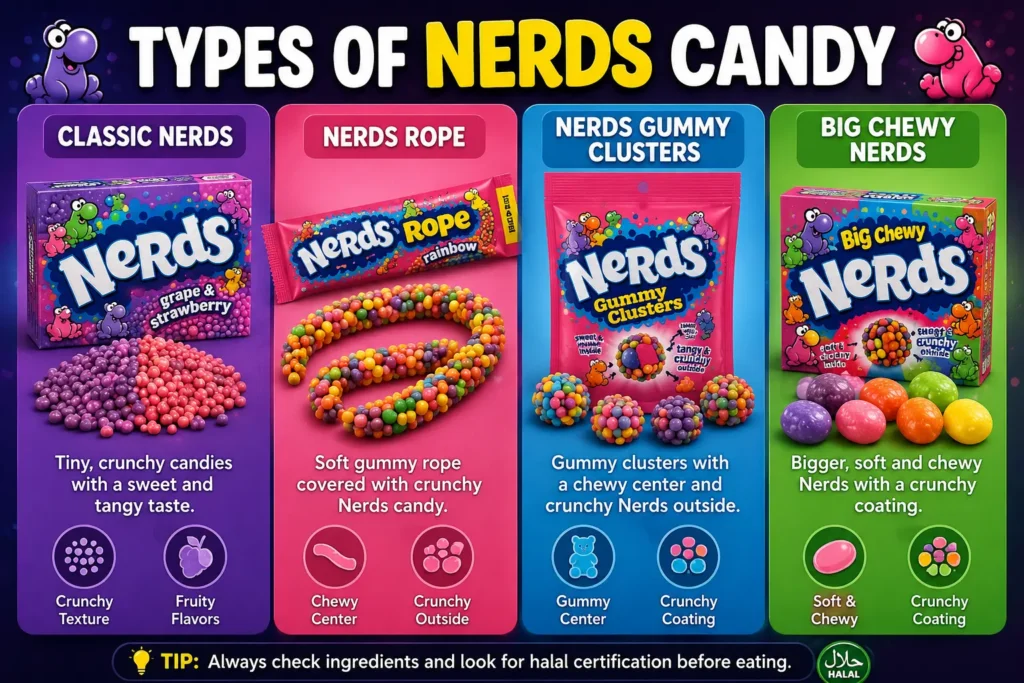
🟣 Classic Nerds

Crunchy candies usually made with sugar, flavouring, and colouring.

🌈 Nerds Rope

Contains a gummy centre that may include gelatin.

🍬 Nerds Gummy Clusters

Chewy gummy-based candy with higher halal concern.

🍓 Big Chewy Nerds

Soft chewy version, often doubtful due to ingredients.

👉 The more gummy the candy, the higher the halal concern.

🍬 Why Nerds Look Halal but May Not Be

One major confusion for Muslims is that Nerds look completely harmless.

They:

  • contain no visible meat
  • are colorful and fruity
  • are often labeled “sugar candy”

But appearance does NOT guarantee halal status.

❗ Hidden Truth

Many candies:

  • use animal-based processing ingredients
  • do not clearly disclose sources
  • change formulas depending on region

👉 That means visual appearance is not enough for halal judgment.

🧠 How Muslims Can Avoid Confusion

Here is a simple real-life method:

✔️ Step 1: Check Texture First

  • Crunchy → usually safer
  • Gummy → always check carefully

✔️ Step 2: Scan 3 Ingredients Only

Focus on:

  • gelatin
  • carmine
  • alcohol-based flavouring

✔️ Step 3: Look for Certification First, Not Ingredients

👉 Certification matters more than label wording.

✔️ Step 4: If Doubt Exists → Avoid

Islamic principle:
👉 doubtful = better to avoid

⚖️ Are Nerds Halal or Haram?
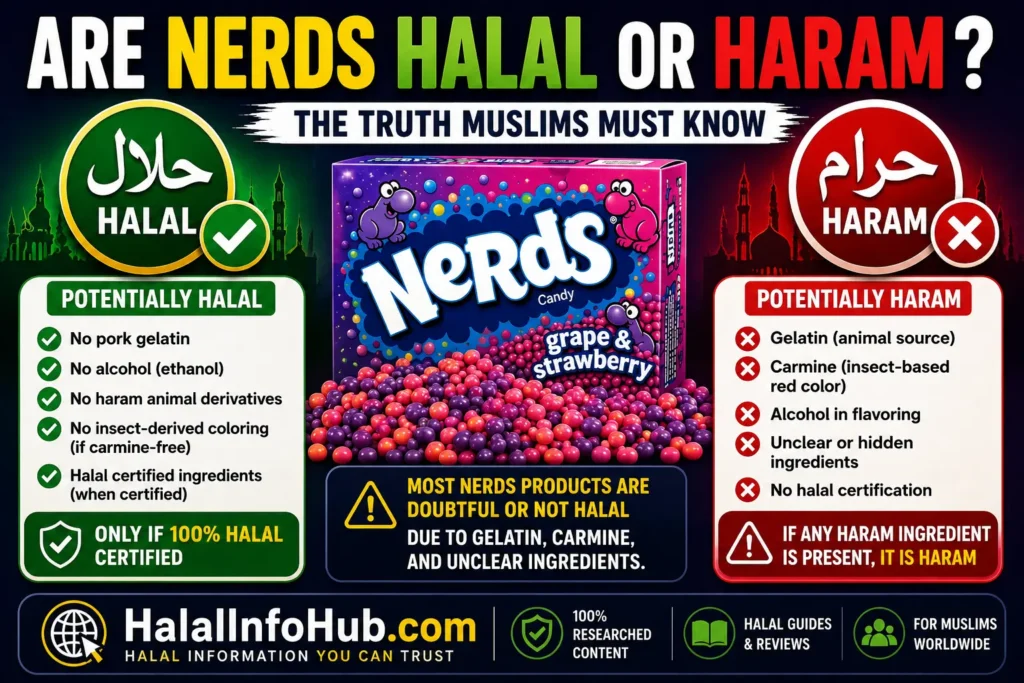
👉 Most Nerds products are doubtful or not halal.

❗ Main Reasons:

  • gelatin (animal source)
  • carmine (insect-based colouring)
  • unclear flavouring sources
  • no halal certification

📊 Nerds Halal Status Table

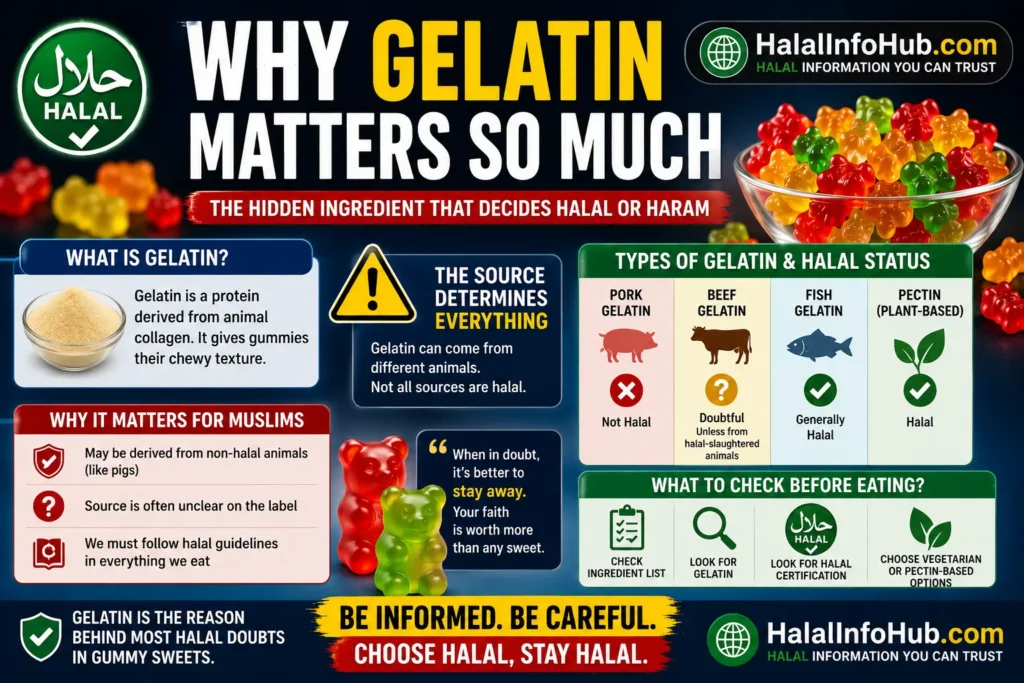
🧪 Why Gelatin Matters So Much

Gelatin is used to give candy:

  • chewiness
  • softness
  • gummy texture

🚨 Gelatin Types

👉 Many Nerds gummy products do not clearly confirm halal gelatin.

🐞 Carmine Explained

Carmine is a red colouring made from crushed insects.

Concerns:

  • insect-based
  • unclear labeling
  • differing scholarly opinions

👉 This makes some Nerds products doubtful.

🧪 Hidden Ingredients Muslims Often Miss

  • Alcohol-based flavour carriers
  • Artificial colourings
  • Shellac coating (insects)
  • Animal-derived emulsifiers

👉 Candy ingredients are often more complex than they look.

Is Nerds Halal in the USA?
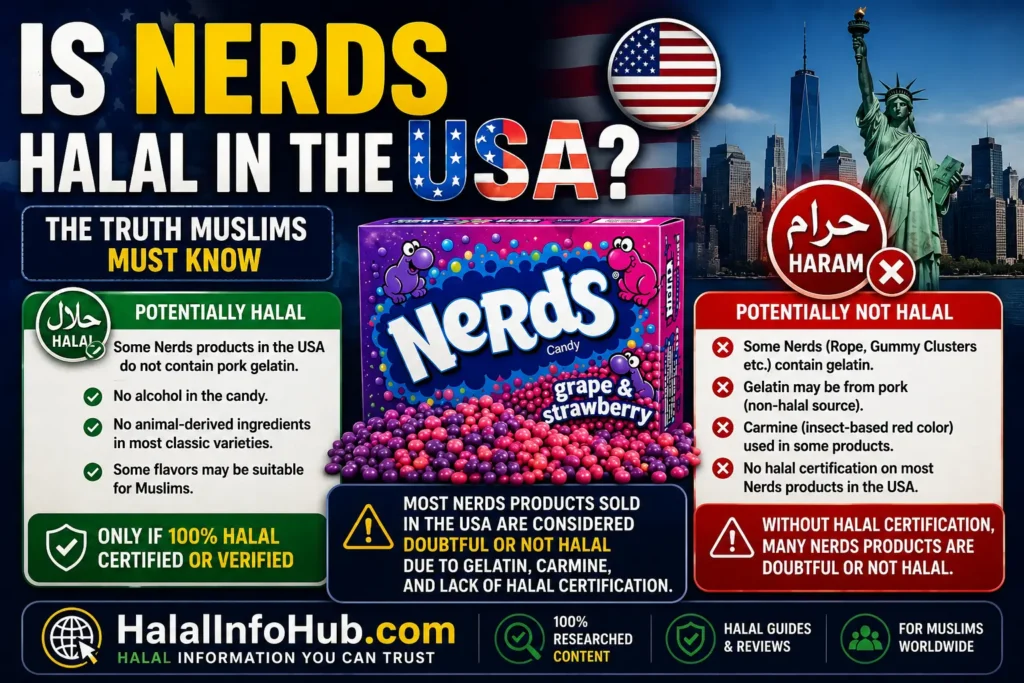
In the United States, most Nerds products are not halal-certified.

Issues:

  • gelatin in gummies
  • carmine colouring
  • unclear sourcing

USA Verdict

👉 ❌ Mostly not halal or doubtful

📊 USA vs UK Table

Is Nerds Halal in the UK?

In the United Kingdom, similar concerns exist.

  • No strong halal certification system for Nerds
  • Ingredient changes possible
  • Some safer versions exist but not guaranteed

UK Verdict

👉 ⚠️ Mostly doubtful

Ingredient Label Problems in USA & UK

In both the United States and the United Kingdom, ingredient labeling laws allow companies to:

  • use broad terms like “flavourings”
  • avoid specifying animal sources
  • change suppliers without notice

⚠️ Why This Matters

This creates a serious issue for Muslims:

👉 You cannot always trace the exact source of ingredients.

For example:

  • “natural flavour” → may contain alcohol carriers
  • “colouring” → may come from insects or animals
  • “gelatin” → source often not specified

🍭 Highest Risk Nerds Products

🛒 How to Check If Nerds Are Halal

✔ Check gelatin source
✔ Look for halal logo
✔ Avoid unclear ingredients
✔ Prefer vegan candy=

🍭 Do Nerds Contain Gelatin in Every Product?

Not all Nerds products contain gelatin, but the problem is that some varieties do and some do not.

This is where confusion starts for Muslims in the United States and the United Kingdom.

⚠️ Important Fact

  • Classic Nerds → usually no gelatin (but still check ingredients)
  • Nerds Rope → may contain gelatin
  • Nerds Gummy Clusters → often contain gelatin

👉 This means halal status depends on the exact product, not the brand name.

💡 Key Insight

👉 Never assume all Nerds are the same — even small product changes can change halal ruling.

🧪 Why Ingredient Labels Are Not Always Enough

Many Muslims think that reading the ingredient list is enough to confirm halal status.

But in reality, it is not always that simple.

⚠️ Hidden Problem

In the United States and United Kingdom, companies are allowed to:

  • use vague terms like “natural flavours”
  • hide processing aids
  • change ingredient suppliers without updating packaging

❗ What This Means

Even if a label looks clean:

  • ingredients may still have unclear sources
  • processing methods may not be disclosed
  • halal risk can still exist

🍬 Are All Candy Brands Like Nerds the Same?

No — not all candy brands work the same way as Nerds.

Some brands:

  • clearly label halal status
  • use vegan ingredients only
  • avoid gelatin completely

But many mainstream candies:

  • change recipes frequently
  • use mixed ingredient sources
  • do not guarantee halal compliance

📊 Safe Candy Alternatives Table

🤯 Why Muslims Get Confused

  • different Nerds products
  • changing ingredients
  • online mixed information
  • candy looks harmless

📊 Halal Comparison Table

👉 This shows Nerds are not the worst, but still not safe by default.

See Also

FAQs

Is Nerds halal?

Mostly doubtful or not halal.

Does Nerds contain gelatin?

Some gummy versions do.

Is Nerds Rope halal?

Usually not halal due to gelatin.

What is carmine?

Insect-based red colouring.

Can Muslims eat Nerds?

Only after checking ingredients.

Are classic Nerds halal?

Some may be safer but not guaranteed.

Are Nerds vegetarian?

Some are, but gummies often are not.

Why is Nerds controversial?

Because ingredients vary.

Conclusion

So, are Nerds halal?

👉 In most cases, the answer is NO.
Most Nerds products are considered doubtful or not halal because they may contain gelatin, carmine colouring, or other ingredients with unclear or non-halal sources in the United States and United Kingdom.

Some specific versions may look safer, but without clear halal certification, it is not possible to confirm them as fully halal.
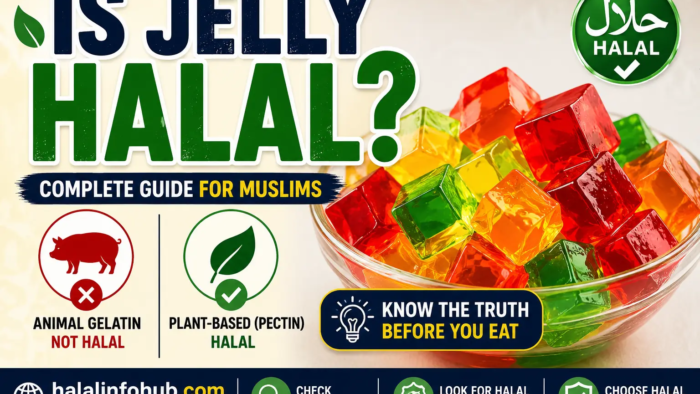
Is Jelly Halal

Is Jelly Halal or Haram?

Jelly is only halal if it is made with halal-certified ingredients or plant-based gelatin like pectin. In most cases in the USA and UK, regular jelly is not halal because it contains animal-derived gelatin.”

If you are searching “is jelly halal”, you are not alone — this is one of the most searched halal food questions among Muslims in the United States and the United Kingdom in 2026.

Jelly is everywhere. From supermarket desserts to candies, cakes, and ready-made snacks, it is a common part of daily food. It looks simple, tastes sweet, and is enjoyed by both children and adults without hesitation.

But here is the truth most people overlook:

👉 Not all jelly is halal.

The real issue is not sugar, colour, or flavour — it is a hidden ingredient called gelatin.

Gelatin is what gives jelly its soft, bouncy texture. But its source is what decides everything. Some gelatin comes from halal-approved sources, while many types come from non-halal animals.

That is why one jelly product can be halal, while another looks identical but is not.

This is where confusion starts for many Muslims shopping in regular supermarkets.

🍬 What Is Jelly?

Jelly is a soft, sweet, and wobbly dessert that is commonly eaten around the world, especially in the United States and the United Kingdom.

It is usually made by mixing a few basic ingredients that give it its taste, colour, and unique texture.

🧾 Main Ingredients in Jelly:

  • Sugar (for sweetness)
  • Flavouring (fruit or artificial taste)
  • Colouring (to make it attractive)
  • Gelling agent (this is the most important part)

👉 The gelling agent is what creates the soft, jelly-like texture — and it is usually either gelatin or pectin.

🍮 Where Jelly Is Commonly Used:

  • Desserts and pudding cups
  • Gummy sweets and candies
  • Cakes and bakery fillings
  • Packaged sweet snacks

⚠️ Important Insight:

The texture of jelly completely depends on the gelling agent used.
👉 If it is gelatin-based, it may not be halal.
👉 If it is pectin-based, it is usually halal-friendly.

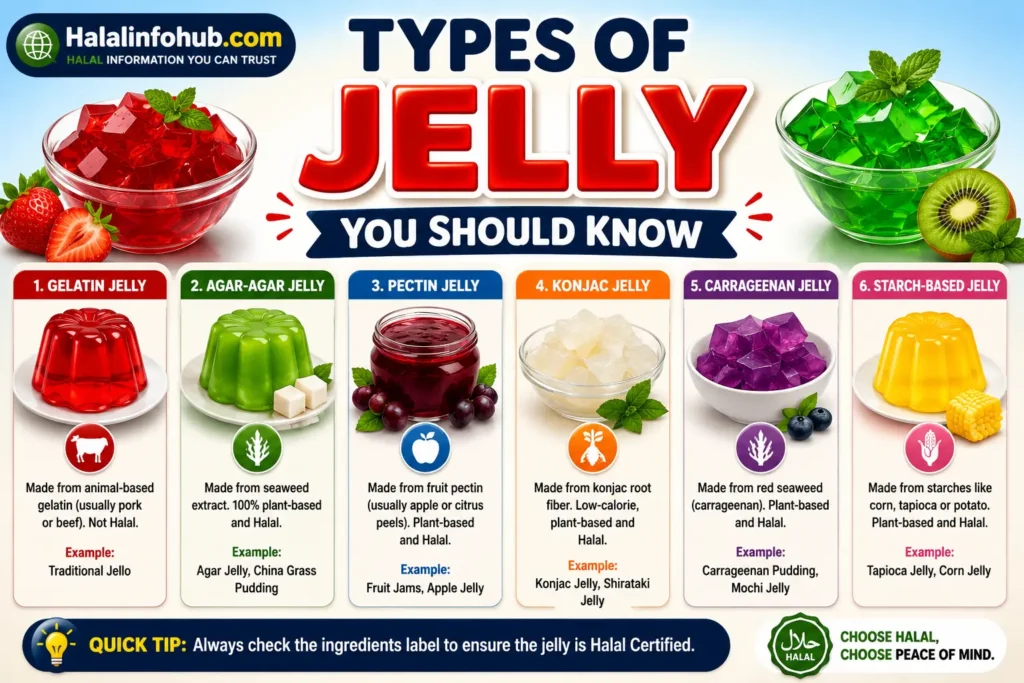
🍮 Types of Jelly You Should Know

Not all jelly is the same. There are different types based on ingredients and usage.

1. Animal-Based Jelly

  • Contains gelatin
  • Made from pork or beef sources
  • ❌ Usually not halal

2. Vegetarian Jelly

  • Made with plant-based ingredients
  • Uses pectin instead of gelatin
  • ✔️ Usually halal

3. Vegan Jelly

  • 100% plant-based
  • No animal ingredients
  • ✔️ Safe halal option

👉 Key Insight:
Most supermarket jelly falls into animal-based categories unless clearly labelled.

Where Jelly Is Commonly Found

📍 Placement:

👉 After “Ingredients Explained” section

🍰 Where You Find Jelly in Daily Life

Jelly is not just a dessert — it is used in many foods:

  • Cakes and pastries
  • Gummies and candies
  • Cheesecakes
  • Ice creams
  • Dessert cups
  • Bakery toppings

👉 This is why halal concern is very important — jelly is everywhere.

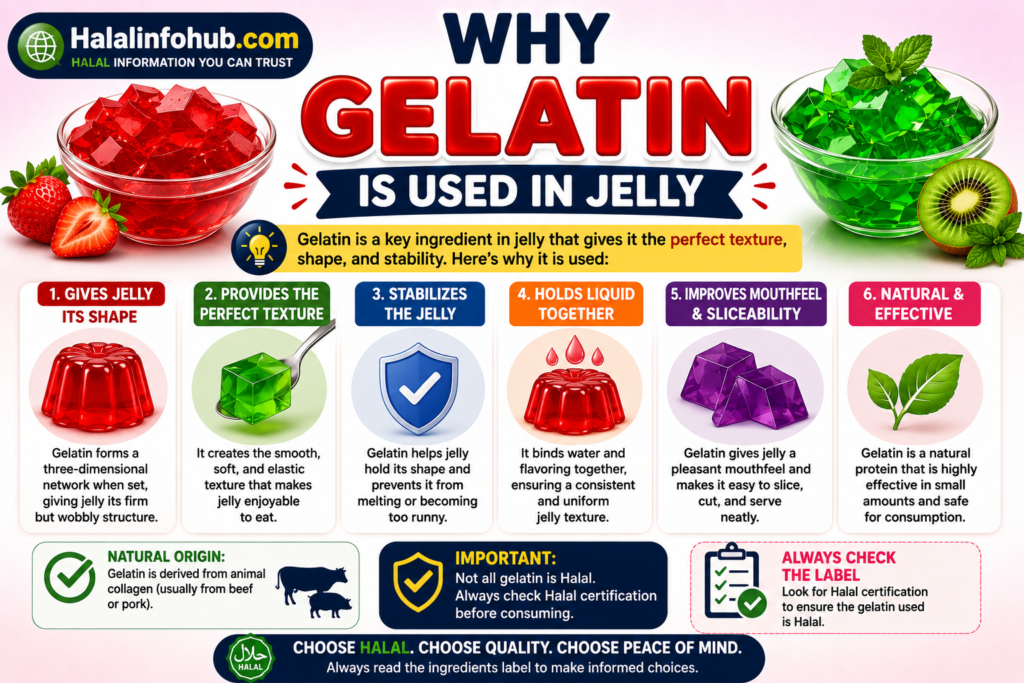
Why Gelatin Is Used in Jelly

📍 Placement:

👉 After “Why Gelatin Matters So Much”

🧪 Why Companies Use Gelatin

Companies use gelatin because it:

  • Gives jelly its shape
  • Makes texture chewy
  • Is cheap and widely available
  • Extends shelf life

But the problem is:

👉 Cheap gelatin is often not halal-friendly.

Health vs Halal Confusion

📍 Placement:

👉 Before “Safe Halal Options”

⚠️ Health vs Halal – Common Confusion

Some people think:

👉 “If it is safe to eat, it must be halal.”

But this is incorrect.

  • Health = nutrition safety
  • Halal = ingredient source + Islamic rules

Even if jelly is healthy, it may still be not halal.

How to Identify Halal Jelly in Stores

📍 Placement:

👉 Before “Smart Buying Checklist”

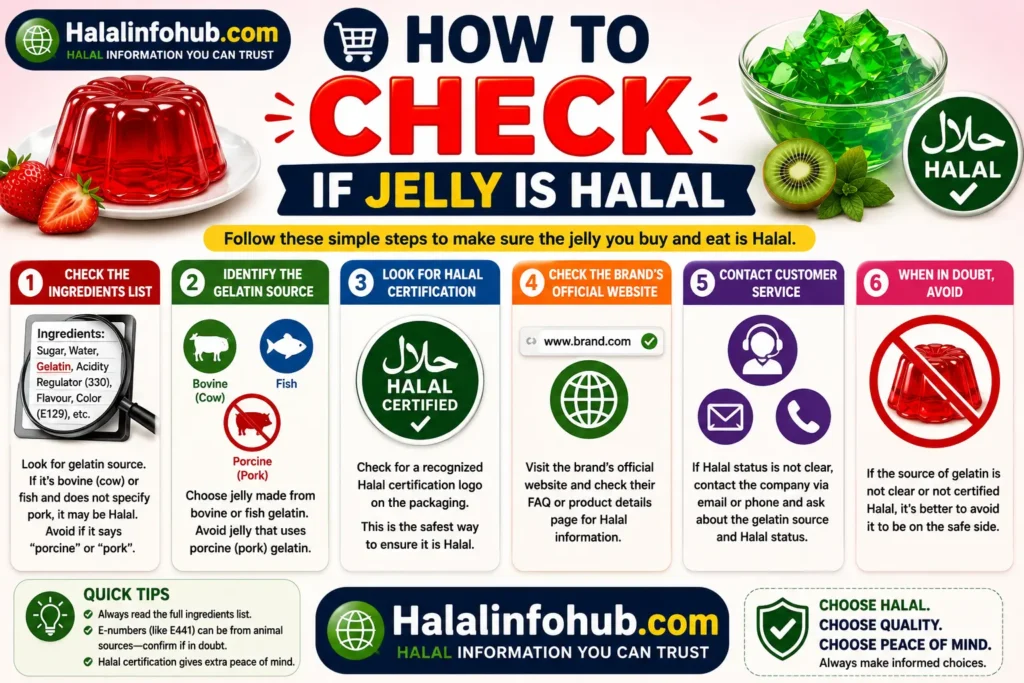
🛒 How to Check If Jelly Is Halal

When buying jelly, always check:

✔️ Ingredient Label

Look for:

  • gelatin (red flag)
  • pectin (safe)

 Halal Certification

  • Look for halal logo
  • If missing → be careful

 “Suitable for Vegetarians” Label

  • Usually safer option
  • But still check ingredients

👉 This 10-second check can save you from doubtful food.

Global Jelly Market Differences

📍 Placement:

👉 Before “Conclusion”

🌍 Why Jelly Is Different Around the World

Jelly products are not the same globally.

  • USA → mostly animal gelatin
  • UK → mixed (vegetarian + gelatin)
  • Middle East → more halal options
  • Asia → varies by brand

👉 That is why confusion exists for Muslims worldwide.

⚖️ Is Jelly Halal or Haram?

The answer depends on one key ingredient:

👉 Gelatin

Simple Rule:

👉 So jelly is not automatically halal or haram — it depends on how it is made.

🧪 Why Gelatin Matters So Much

Gelatin is made from animal collagen. It gives jelly its:

  • shape
  • bounce
  • chewiness

But the source matters.

If gelatin comes from:

  • pork → ❌ not halal
  • non-halal slaughtered animals → ⚠️ doubtful
  • halal-certified animals → ✔️ acceptable

That is why many standard jelly products are not suitable for Muslims.

Is Jelly Halal in the USA?

In the United States, most jelly products are not halal by default.

Why?

  • Many brands use animal gelatin
  • No halal certification on most products
  • Ingredients are not clearly sourced

Result:

👉 ❌ Most jelly in USA is NOT halal
👉 ✔️ Only special halal or vegan jelly is safe

Is Jelly Halal in the UK?

In the United Kingdom, the situation is similar.

Key Points:

  • Many desserts contain gelatin
  • Some vegetarian jelly options exist
  • Halal-certified jelly is limited

Result:

👉 ⚠️ Most jelly is NOT halal
👉 ✔️ Vegetarian jelly is safer option

🍮 Jelly vs Gelatin Confusion

Many people confuse jelly with gelatin.

Difference:

  • Jelly = final product (dessert)
  • Gelatin = ingredient used to make jelly

👉 Jelly becomes halal or haram based on gelatin source.

🚨 Hidden Problem in Jelly Products

Even if jelly looks harmless, it may contain:

  • pork gelatin
  • non-halal beef gelatin
  • unclear flavouring sources

That is why checking ingredients is very important.

🟢 Safe Halal Jelly Options

You can safely eat jelly if it is:

  • ✔️ labeled halal-certified
  • ✔️ made with pectin (plant-based)
  • ✔️ vegan-friendly

🔑 Golden Rule

👉 If jelly contains “gelatin” and has no halal label → avoid it.

🍓 Better Halal Alternatives

Instead of regular jelly, choose:

  • vegan jelly desserts
  • halal-certified sweets
  • pectin-based gummies
  • homemade fruit jelly

These are safer and widely available.

🧠 Why Muslims Should Be Careful

Jelly seems simple, but it can hide:

  • non-halal ingredients
  • unclear sourcing
  • doubtful additives

Being careful ensures halal lifestyle is maintained properly.

🔗 See Also

FAQs

Is jelly halal in the USA?

Most jelly in USA is not halal due to gelatin.

 Is jelly halal in the UK?

Most jelly products are not halal unless vegetarian or certified.

What makes jelly haram?

Animal-derived gelatin, especially from pork.

Is all jelly haram?

No, only jelly with non-halal gelatin is haram.

Is vegan jelly halal?

Yes, vegan jelly made with plant-based ingredients is halal.

 Is gelatin halal?

Only if it is from halal-certified sources.

 Can Muslims eat jelly?

Yes, but only halal-certified or vegan jelly.

 What is jelly made of?

Sugar, flavouring, and a gelling agent like gelatin or pectin.

Is pectin halal?

Yes, it is plant-based and halal.

How to check if jelly is halal?

Check ingredients and halal certification labels.

Conclusion

So, is jelly halal or not?

👉 The clear answer is:

Jelly is only halal if it is made with halal-certified ingredients or plant-based alternatives like pectin.

However, in most supermarket products across the United States and the United Kingdom, regular jelly is not halal because it usually contains gelatin derived from animal sources that are not halal-certified.

👉 This is the main reason why many jelly products are considered doubtful or non-halal for Muslims.

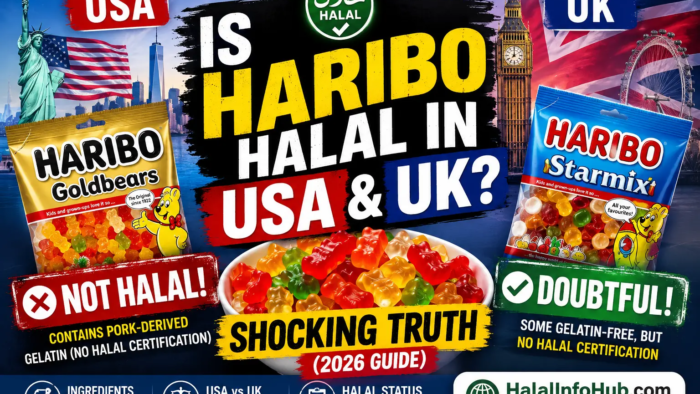
Is Haribo Halal in USA & UK Shocking Truth (2026 Guide)

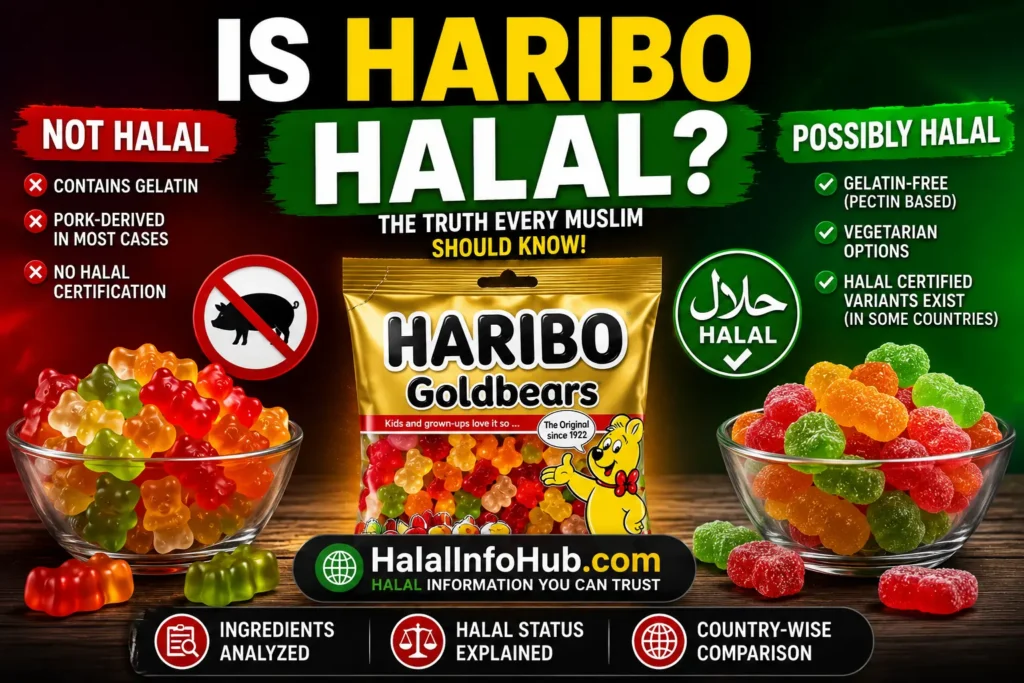
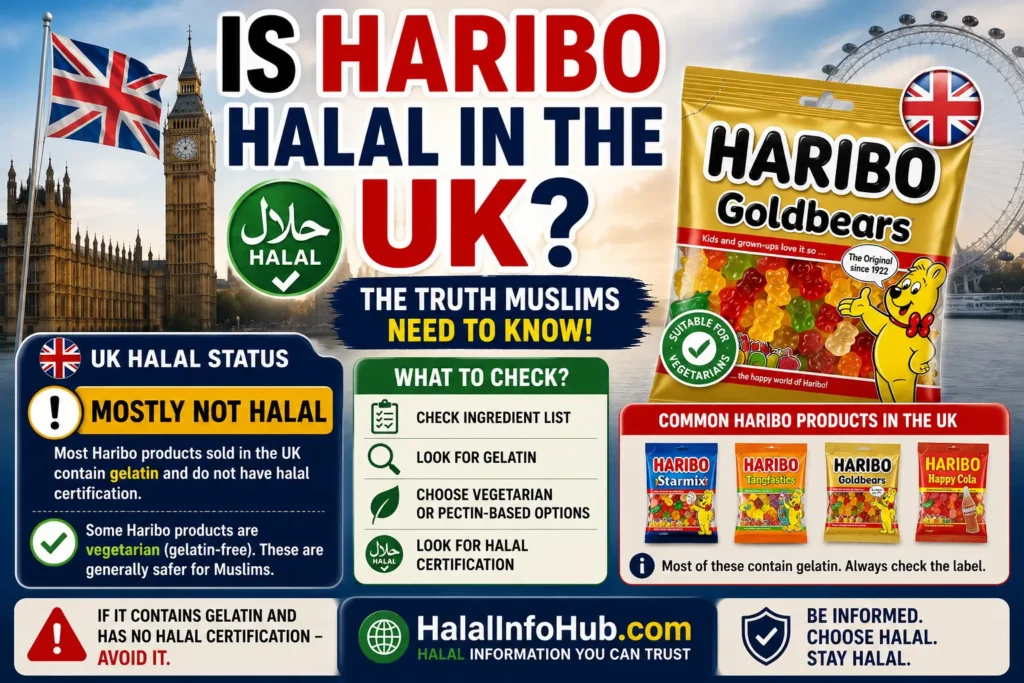
Is Haribo Halal Or Haram?

Haribo is NOT halal in the USA and UK because most products contain gelatin that is not halal-certified and is often pork-derived.
Only gelatin-free, vegetarian, or halal-certified Haribo products may be considered halal.

If you are searching “is Haribo halal”, you are not alone — thousands of Muslims ask this question every month.

Haribo is one of the most popular gummy candy brands in the world. From gummy bears to cola bottles, it is everywhere — supermarkets, convenience stores, cinemas, and online shops in the United States and the United Kingdom.

But here is the problem most people don’t realise:

👉 Not all gummy sweets are halal — and Haribo is one of the most confusing brands.

For Muslims, one simple question matters before buying any sweet:

👉 Is Haribo halal or haram?

The confusion happens because Haribo does not have one single formula worldwide. Some products contain gelatin. Some are vegetarian. Some countries sell halal-certified Haribo, while others do not.

This means one Haribo pack can be halal in one country and not halal in another.

Many people assume all Haribo products are the same — but that is not true.

For Muslims, the most important thing is not the taste or shape.
👉 The most important thing is the source of ingredients — especially gelatin.

👉 By the end, you will have a clear, simple, and confident answer — without any confusion.

What Is Haribo?

Haribo is a famous candy company that started in Germany.

The brand is especially known for chewy gummy sweets.

Popular Haribo products include:

  • Haribo Goldbears
  • Haribo Starmix
  • Haribo Happy Cola
  • Haribo Tangfastics
  • Haribo Twin Snakes

Haribo products are sold in many countries, including the United States and the United Kingdom.

Most Haribo sweets have a soft chewy texture. That texture often comes from one important ingredient:

gelatin

And this is where the halal issue begins.

Is Haribo Halal?

For most Muslims in the USA and UK, the simple answer is:

Haribo is mostly not halal.

Why?

Because many Haribo products contain:

  • gelatin from non-halal animal sources
  • gelatin that is not halal-certified
  • ingredients that do not clearly confirm halal compliance

If gelatin comes from pork, the product is not halal.

If gelatin comes from beef but is not slaughtered according to halal rules, many Muslims also avoid it.

That is why Haribo creates confusion.

Some Haribo products may be suitable.

But most standard Haribo packs sold in USA and UK are not considered halal-friendly.

Is Haribo Halal or Haram?

Let’s make this very clear — no confusion:

👉 Most Haribo products are NOT halal in the USA and UK.

The main reason is simple:

👉 They contain gelatin that is usually not halal-certified and may be pork-derived.

For Muslims, this creates a serious issue.

🔍 Simple Halal Rule You Must Remember

  • ❌ Pork gelatin → NOT HALAL
  • ⚠️ Unknown gelatin source → DOUBTFUL
  • ✅ Halal-certified gelatin → HALAL
  • ✅ Plant-based (pectin) → HALAL

👉 This one rule can help you decide instantly when buying any gummy candy — not just Haribo.

Why Gelatin Matters So Much

Gelatin is what makes gummies chewy.

Without gelatin, many gummy sweets would not have the same soft bounce.

Gelatin usually comes from animal collagen.

That animal source can be:

  • pork
  • beef
  • fish
  • plant alternatives (not true gelatin but substitutes like pectin)

For Muslims, this matters a lot.

If gelatin is from pork:

Not halal

If gelatin is from beef but not halal-certified:

Doubtful for many Muslims

If the product uses pectin or is halal-certified:

Usually safer

This is the main reason people ask:

Is Haribo halal?

Is Haribo Halal in the USA?

If you live in the United States, here is the reality:

👉 Haribo is generally NOT halal.

Why?

  • Most products contain gelatin
  • No official halal certification
  • Ingredient source is unclear

Walk into any supermarket, and you will find products like Goldbears or Happy Cola.
Check the label — you will usually see gelatin listed.

👉 And without halal certification, that is a red flag.

Final Verdict

👉 Avoid regular Haribo in the USA unless it clearly says halal or gelatin-free.

Is Haribo Halal in the UK?

In the United Kingdom, things look slightly better — but don’t get confused.

👉 Haribo is still mostly NOT halal.

What makes the UK different?

  • Some products are labelled vegetarian
  • Some use pectin instead of gelatin
  • Recipes vary between products

But here is the important part:

👉 Most standard Haribo packs still do not have halal certification.

Final Verdict

👉 Only buy if it clearly says vegetarian or halal — otherwise avoid.

Haribo Ingredients

When checking whether Haribo is halal, ingredient labels matter more than brand popularity.

Here are common Haribo ingredients.

Main Ingredient to Watch

If the packet says gelatin, that is where caution starts.

If the packet says pectin, that is often safer.

Haribo Halal Status in USA & UK

🤯 Why Is Haribo So Confusing?

This is the reason why people keep searching:

👉 “Is Haribo halal in the USA and UK?”

1. Different Recipes in Different Countries

A Haribo product in Germany may be completely different from one in the United States.

2. Halal Versions Exist (But Not Everywhere)

Some countries produce halal-certified Haribo — but that does not apply globally.

3. “Vegetarian” Creates Confusion

Many people think vegetarian = halal.

👉 Not always — but it is usually safer.

4. Online Information Is Mixed

Different websites talk about different countries — which confuses readers.

👉 Bottom line:
You cannot assume all Haribo products are halal.

Which Haribo Products May Be Safer?

Some Haribo products may be safer if they are:

  • clearly labelled vegetarian
  • clearly labelled gelatin-free
  • clearly labelled halal-certified

Safe Buying Rule

Before buying Haribo, check for these words:

  • halal certified
  • gelatin free
  • suitable for vegetarians

If none of these appear, caution is better.

Better Halal-Friendly Sweet Options

If you love gummy sweets but want halal peace of mind, better choices include:

  • halal-certified gummy brands
  • pectin-based sweets
  • vegetarian gummies
  • clearly halal-labelled confectionery

Many Muslims prefer buying sweets that make halal status simple instead of doubtful.

That avoids confusion every time.

🧠 Why Muslims Should Be Careful

This is not just about candy.

It is about:

  • making halal choices
  • avoiding doubtful ingredients
  • staying conscious about what you eat

Even a small sweet matters when it comes to halal.

👉 Being careful is always better than being unsure.

How Muslims Can Check If Haribo Is Halal

A simple 5-step method:

1. Read the ingredient list

Check if gelatin is listed.

2. Look for halal certification

If there is none, be careful.

3. Check if it says vegetarian

Vegetarian products may be safer.

4. Do not rely only on online opinions

Recipes change.

5. Check every pack every time

Different products can differ.

Is Haribo Halal or Haram?

If you are buying ordinary Haribo from regular stores in the United States or United Kingdom, the safest answer is:

Treat it as not halal unless clearly proven otherwise.

That is the simplest and safest rule.

🔗 See Also

FAQs

1. Is Haribo halal in the USA in 2026?

No, most Haribo products in the United States are not halal because they contain gelatin that is not halal-certified.

2. Is Haribo halal in the UK in 2026?

Most Haribo products in the United Kingdom are not halal, but some vegetarian or gelatin-free options may be suitable.

3. Why is Haribo not considered halal?

Because many products contain gelatin derived from animals, and the source is often not halal-certified or not clearly stated.

4. Does Haribo contain pork gelatin?

Some Haribo products may contain pork-derived gelatin, while others may use beef gelatin or other sources — but most are not halal-certified.

5. Are all Haribo sweets haram?

Not all, but most standard Haribo products sold in the USA and UK are considered non-halal or doubtful due to gelatin.

6. Is vegetarian Haribo halal?

Vegetarian Haribo is usually safer because it does not contain animal gelatin, but Muslims should still check labels for confirmation.

7. Can Muslims eat Haribo gummies?

Only if the specific product is clearly halal-certified or gelatin-free. Otherwise, it is better to avoid.

8. Is Haribo Goldbears halal?

In most cases, Haribo Goldbears are not halal in the USA and UK due to gelatin content.

Conclusion

So, is Haribo halal in the USA and UK?

For most Muslims, the safest answer is no.

Many Haribo sweets sold in the United States and the United Kingdom contain gelatin that is not clearly halal-certified, and that makes them doubtful or unsuitable.

That does not mean every Haribo product is automatically haram everywhere.

But it does mean one important thing:

Never assume all Haribo is halal.

Always check:

  • the ingredient list
  • gelatin source
  • vegetarian label
  • halal certification

If there is no clear proof, many Muslims choose to avoid it.

That is usually the safest path.

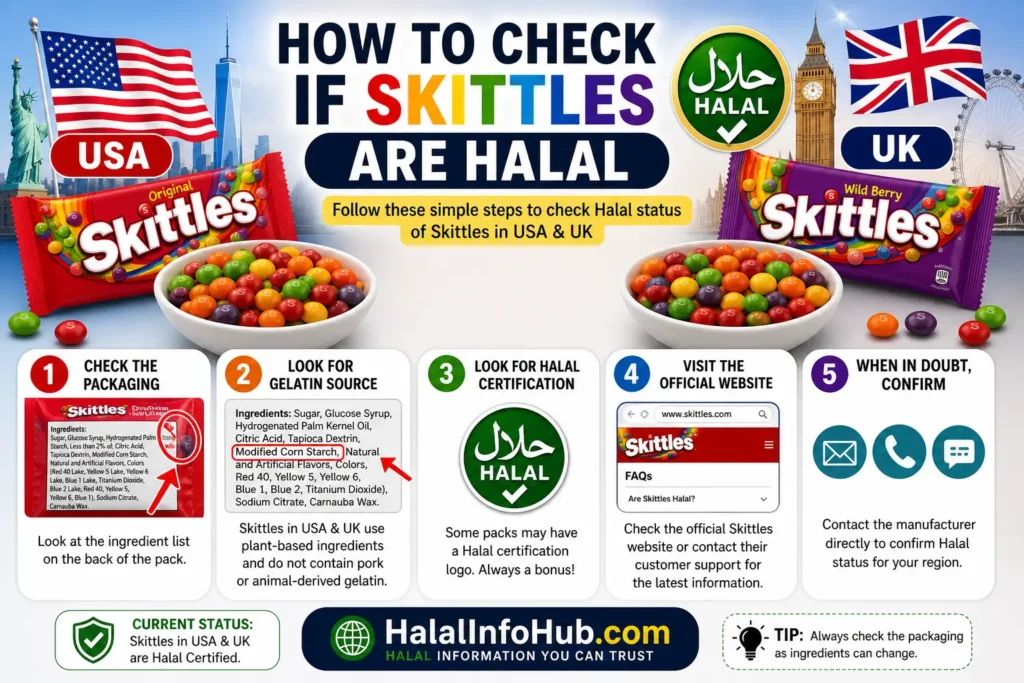
Is Skittles Halal in USA & UK

Are Skittles Halal or Haram?

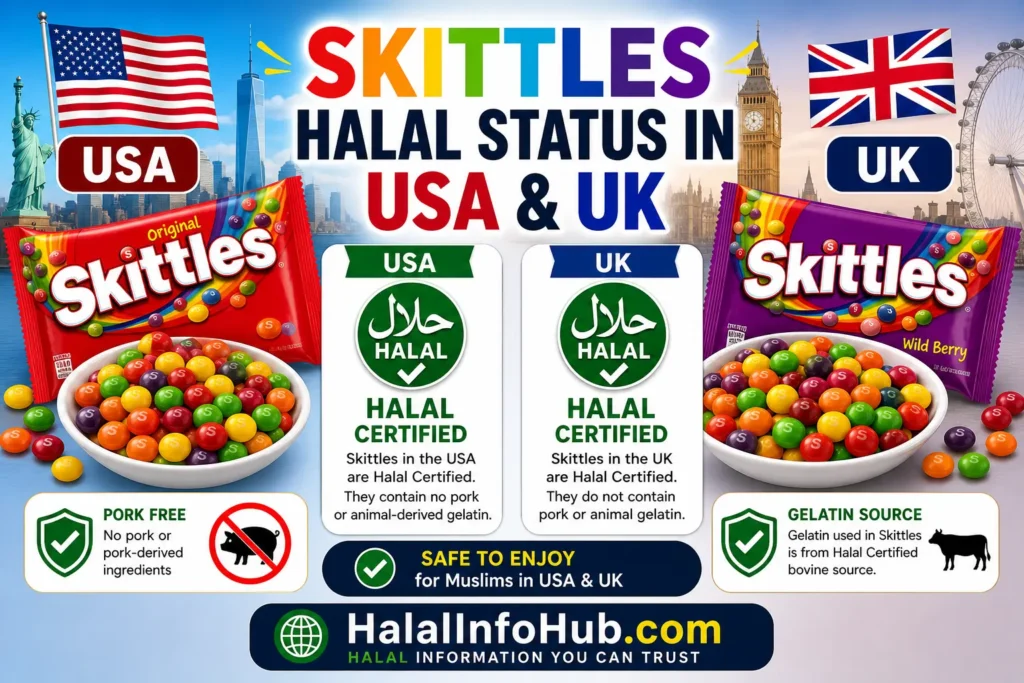
Skittles are generally considered halal in both the USA and UK because they do not contain gelatin, pork-derived ingredients, or alcohol in their formulation.

However, since Skittles are not officially halal-certified, some Muslims still choose to avoid them for extra caution and stricter dietary practice. 

Skittles are one of the most widely recognized fruit-flavoured candies in the world, especially in the United States and the United Kingdom. They are colourful, sweet, and enjoyed daily by millions of people across different age groups.

Because of their global popularity, Skittles are often discussed in Muslim communities in the USA and UK, where halal food awareness and ingredient transparency are very important in daily consumption.

This leads to a very common and important question:

👉 Is Skittles halal in the USA and UK?

This question matters because many popular candies may contain hidden ingredients such as gelatin, alcohol-based flavourings, or animal-derived emulsifiers. Even products that look simple or vegetarian-friendly can sometimes include unclear ingredients, which makes halal verification essential for Muslims living in non-Muslim countries.

📊 Skittles Halal Status

🍭 What Are Skittles?

Skittles are small, chewy fruit candies with a hard sugar shell and a soft, chewy inside. They are manufactured by Mars Wrigley, one of the largest confectionery companies in the world.

🌈 Popular Flavours:

  • Strawberry
  • Orange
  • Lemon
  • Grape
  • Green Apple

🍬 Variants Available:

  • Original Skittles
  • Sour Skittles
  • Tropical Skittles
  • Wild Berry Skittles
  • Skittles Gummies
  • Skittles Chewies

Each variation can have slightly different formulations depending on the country.

Skittles Halal Status in USA & UK

Skittles in the USA

In the United States, Skittles are generally considered halal-friendly because their standard ingredients do not include gelatin, pork-derived substances, or alcohol.

Most USA Skittles products are made using:

  • Sugar and glucose syrup
  • Plant-based oils
  • Artificial and natural flavourings
  • Food colourings

👉 Because of this ingredient profile, Skittles in the USA are widely accepted by many Muslims as permissible to eat, especially when no haram ingredients are present.

However, it is important to note that Skittles are not officially halal-certified in the USA, so some Muslims still prefer to avoid them for extra caution.

Skittles in the UK

In the United Kingdom, Skittles are also considered halal-friendly in most cases, as they follow a similar formula to the USA version and do not contain gelatin or pork-based ingredients.

Many UK Skittles products are even labelled as suitable for vegetarians, which further supports their halal-friendly nature.

However:

  • There is no official halal certification
  • Ingredient sourcing for flavourings is not fully disclosed

👉 Therefore, Skittles in the UK are generally considered halal-friendly but not certified halal, meaning they are acceptable for many Muslims but still debated among stricter consumers.

📊 USA vs UK Deep Comparison

🧪 Ingredients Deep Analysis

Main Ingredients:

  • Sugar
  • Corn syrup
  • Hydrogenated palm kernel oil
  • Citric acid
  • Natural flavours
  • Artificial flavours
  • Food colourings

🔎 How to Check if Skittles Are Halal

If you are unsure about Skittles or any candy, follow this simple halal-check method:

✔ Step 1: Check Ingredients List

Look for:

  • Gelatin ❌
  • Alcohol ❌
  • Animal fat ❌

Skittles generally do NOT contain these.

✔ Step 2: Look for Certification

Check for:

  • Halal logo ✔
  • Vegetarian logo ✔

Skittles usually has no halal certification, but often has vegetarian labeling.

✔ Step 3: Check Country Version

  • USA version ingredients
  • UK version ingredients

👉 Small differences can exist depending on region.

✔ Step 4: When in Doubt

If ingredients are unclear → avoid or choose certified halal candy.

⚠️ Common Misconceptions About Skittles

Many people get confused about Skittles. Let’s clear it:

❌ Myth 1: Skittles contain gelatin

✔ Reality: Modern Skittles do NOT contain gelatin.

❌ Myth 2: All candies are haram

✔ Reality: Many candies are halal if they have no haram ingredients.

❌ Myth 3: Vegan = Halal

✔ Reality: Vegan does NOT always mean halal-certified.

Why Skittles Are Considered Halal-Friendly

Skittles are often considered safe because:

  • No animal gelatin used
  • No pork-derived ingredients
  • No alcohol in formulation
  • Mostly plant-based additives
  • Widely accepted by halal communities

👉 This is why they are classified as halal-friendly (not certified halal)

🍬 Skittles vs Other Popular Candies

👉 Skittles is one of the safer mainstream candies

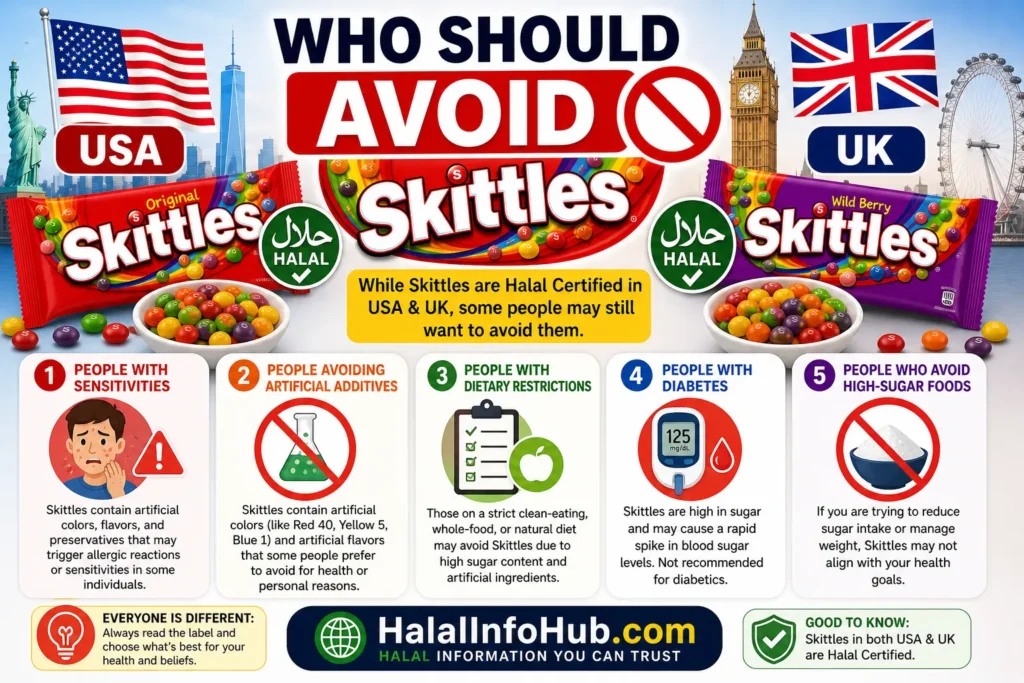
🧭 Who Should Avoid Skittles?

You should avoid Skittles if:

  • You only consume halal-certified products
  • You follow strict halal certification rules
  • You avoid all non-certified processed foods
  • You prefer maximum religious caution

👉 Otherwise, Skittles is widely accepted as halal-friendly.

⚠️ Key Concern: Natural Flavours

“Natural flavours” is the most discussed ingredient in halal analysis.

What it means:

  • Plant-based extracts ✔
  • Chemical processing ✔
  • Rare animal-derived sources ⚠️

👉 However, no confirmed haram source has been found in Skittles.

Why Skittles Are Widely Considered Halal-Friendly

Skittles are often consumed by Muslims because:

  • No gelatin present
  • No pork-based ingredients
  • Widely accepted by halal communities
  • Certified vegan in many regions (indirect halal support)
  • Easy availability in USA & UK

👉 This makes them one of the “safe mainstream candies”

Islamic Scholarly Opinion

Majority View:

✔ Permissible (halal-friendly)

Reason:

  • No explicit haram ingredients
  • No intoxicants
  • No gelatin or animal fat

Minority View:

⚠️ Avoid due to lack of certification

👉 Difference is based on caution level, not prohibition

Skittles vs Other Popular Candies

 Hidden Risks Muslims Should Know

Even though Skittles are safe, consider:

  • No halal certification logo
  • Possible factory cross-processing
  • “Natural flavour” ambiguity
  • Different regional formulas

👉 These are caution factors, not confirmed issues

 Are Skittles Gummies Halal?

Skittles Gummies are slightly different:

  • Mostly gelatin-free
  • Similar ingredients
  • No pork-based components
  • No halal certification

👉 Verdict: Halal-friendly but check label

 Are Skittles Safe for Kids?

Yes 👍

  • No alcohol
  • No gelatin
  • No harmful ingredients

👉 Safe for children in USA & UK

 When Should Muslims Avoid Skittles?

Avoid only if:

  • You strictly require halal certification
  • You avoid all non-certified products
  • You follow ultra-conservative dietary rules

🧮 Halal Confidence Score

🍬 Can Muslims Eat Skittles?

Yes — Skittles are widely considered permissible for Muslims in both USA and UK because they do not contain gelatin, pork-derived ingredients, or alcohol.

However, because Skittles are not officially halal-certified, some Muslims still prefer to avoid them for extra precaution.

🥗 Safe Halal Alternatives

  • Halal-certified gummies
  • Vegan fruit chews
  • Gelatin-free sweets
  • Certified Middle Eastern candies

FAQs

1. Is Skittles halal in USA?

Yes, generally halal-friendly.

2. Is Skittles halal in UK?

Yes, but not certified.

3. Do Skittles contain gelatin?

No.

4. Are Skittles vegan?

Yes, mostly.

5. Are Skittles haram?

No haram ingredients found.

6. Can Muslims eat Skittles?

Yes, generally allowed.

7. Why do some avoid Skittles?

Due to lack of certification.

8. Are Skittles gummies halal?

Mostly yes.

9. Do Skittles contain alcohol?

No.

10. Are Skittles safe for kids?

Yes.

Conclusion

So, is Skittles halal in the USA and UK?

Skittles are generally considered halal-friendly in both the USA and UK because they do not contain gelatin, pork-derived ingredients, or alcohol. This makes them one of the safer mainstream candy options for Muslim consumers looking for simple ingredient-based foods.

However, since Skittles are not officially halal-certified, there is still a level of caution among some Muslims who prefer to avoid all non-certified processed foods for stricter dietary practice.

👉 Final Verdict: Skittles are widely accepted as halal-friendly, but not certified halal.

If you want 100% certainty and complete peace of mind, always choose halal-certified candies that clearly display a halal logo on the packaging.

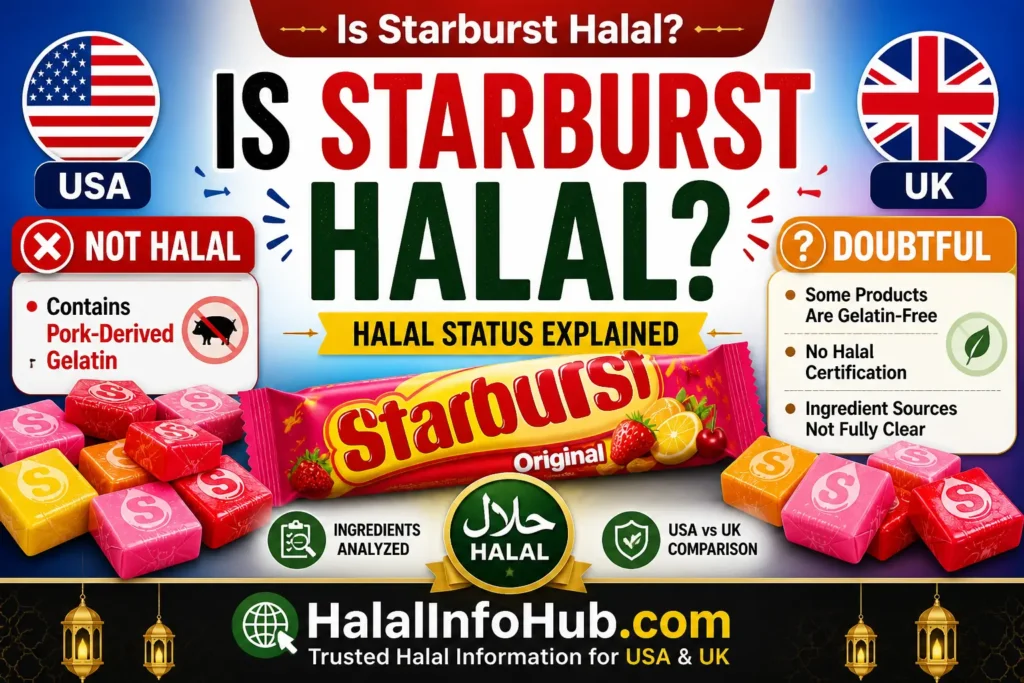
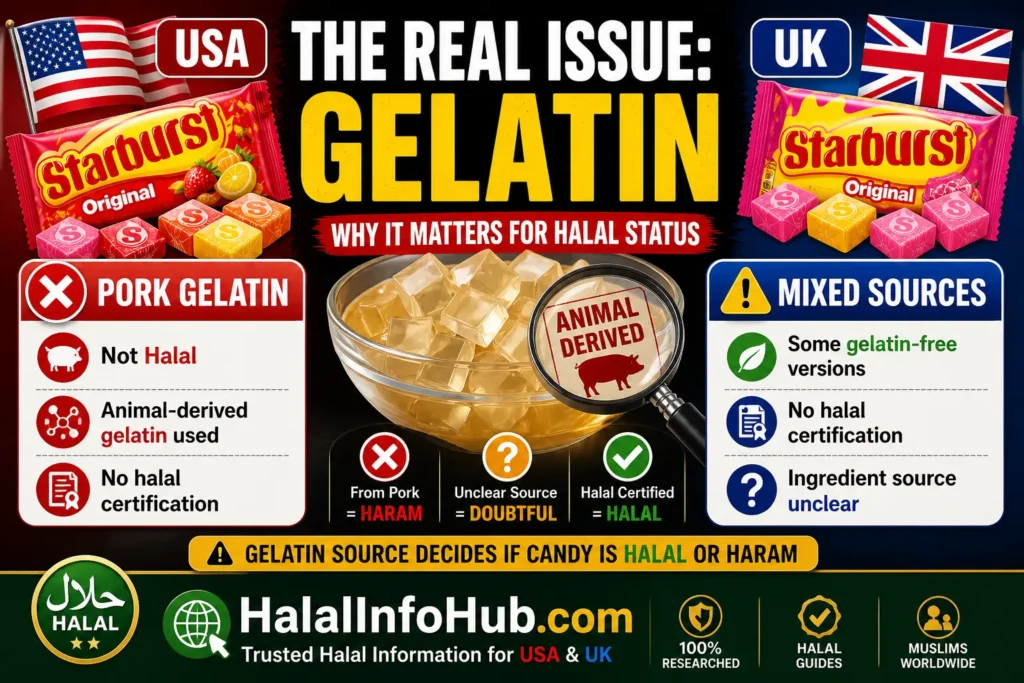
Is Starburst Halal in USA & UK?

Is Starburst Halal Or Haram?

Starburst is not halal in the USA as it contains pork-based gelatin and has no halal certification.

In the United Kingdom, some Starburst products do not contain gelatin, but without halal certification, they remain doubtful (mashbooh) for Muslim consumers. 

Starburst is one of the most popular chewy candies in the world, especially in the United States and the United Kingdom. Known for its fruity flavours, bright colours, and soft texture, it is a favourite sweet for both kids and adults.

You can easily find Starburst in supermarkets, convenience stores, and online shops across the USA and UK. However, for Muslims, enjoying candy is not always simple. Before eating any sweets, an important question comes up: Is Starburst halal in the USA and UK?

This question is important because many candies contain hidden ingredients such as gelatin, flavourings, or additives that may not be halal. Even products that look harmless can include animal-derived ingredients or be processed in ways that make them doubtful.

In this guide, we will clearly explain the halal status of Starburst, its ingredients, and whether Muslims in the USA and UK can safely consume it.

What Is Starburst?

Starburst is a soft, chewy fruit candy made by the company Mars. It was originally launched many years ago and quickly became popular because of its juicy taste and smooth texture.

Each piece of Starburst is small, square-shaped, and wrapped individually. When you eat it, it feels soft and slightly sticky, which is why many people love it.

Popular Flavours

  • Strawberry
  • Lemon
  • Orange
  • Cherry

Over time, the brand has introduced many variations to attract different customers.

Different Types of Starburst

  • Original chewy cubes
  • Starburst Gummies
  • Starburst Jelly Beans
  • Tropical mixes
  • Minis and fun-size packs

Each type may have slightly different ingredients. This is very important because halal status depends on what is inside.

Is Starburst Halal?

The answer is not the same everywhere. It depends on:

  • The country where it is made
  • The ingredients used
  • Whether it has halal certification

Let’s look at both countries clearly.

Starburst Halal in the USA

In the United States, Starburst is not halal.

Why?

1. Contains Gelatin

The biggest issue is gelatin. In the USA, gelatin used in candy is usually made from pork.

👉 Pork is not halal, so this makes the product haram.

2. No Halal Certification

Starburst products in the USA do not have halal certification.

👉 This means there is no official confirmation that the product follows halal standards.

3. Mixed Production Facilities

Factories may produce other non-halal products on the same machines.

👉 This creates risk of cross-contamination.

✅ Final USA Verdict

Not Halal

Starburst Halal in the UK

The situation in the United Kingdom is different.

What’s Different?

  • Many products are gelatin-free
  • Some are labeled vegetarian
  • Ingredients are slightly cleaner

This makes people think Starburst might be halal in the UK.

⚠️ But There Is a Problem

Even without gelatin:

  • No halal certification
  • Flavouring sources are unclear
  • Processing methods are not confirmed

✅ Final UK Verdict

Doubtful (Mashbooh)

USA vs UK Comparison Table

Ingredients Breakdown

Understanding ingredients is the most important step in halal checking.

Common Ingredients

  • Sugar
  • Corn syrup
  • Palm oil
  • Citric acid
  • Fruit juice concentrate
  • Artificial flavours
  • Colouring agents

Most of these are generally halal.

The Real Issue: Gelatin

Gelatin is used to give candy its chewy texture.

Sources of Gelatin

  • Pork → Haram
  • Beef → Halal only if certified
  • Fish → Halal
  • Plant-based → Halal

👉 In the USA, Starburst uses pork gelatin, which clearly makes it haram.

👉 In the UK, gelatin is often removed, but that alone does not guarantee halal status.

Other Hidden Ingredients

Even if gelatin is removed, there are still possible issues:

1. Natural Flavours

  • Source not always clear
  • Can come from animals

2. Emulsifiers

  • May be plant-based or animal-based

3. Colouring Agents

  • Usually safe, but sometimes questionable

👉 This is why certification matters, not just ingredient lists.

Why There Is So Much Confusion

Many Muslims get confused about Starburst. Here’s why:

1. Different Recipes by Country

USA and UK versions are not the same.

2. “Vegetarian” Label

People think vegetarian = halal (which is not always true)

3. Lack of Clear Information

Brands do not always explain ingredient sources.

4. Social Media Misinformation

Different opinions spread without proper research.

Is Starburst Vegan or Vegetarian?

USA Version

  • ❌ Not vegan
  • ❌ Not vegetarian

UK Version

  • ✔ Some are vegetarian
  • ✔ Some may be vegan

👉 Important:
Vegan or vegetarian does NOT automatically mean halal

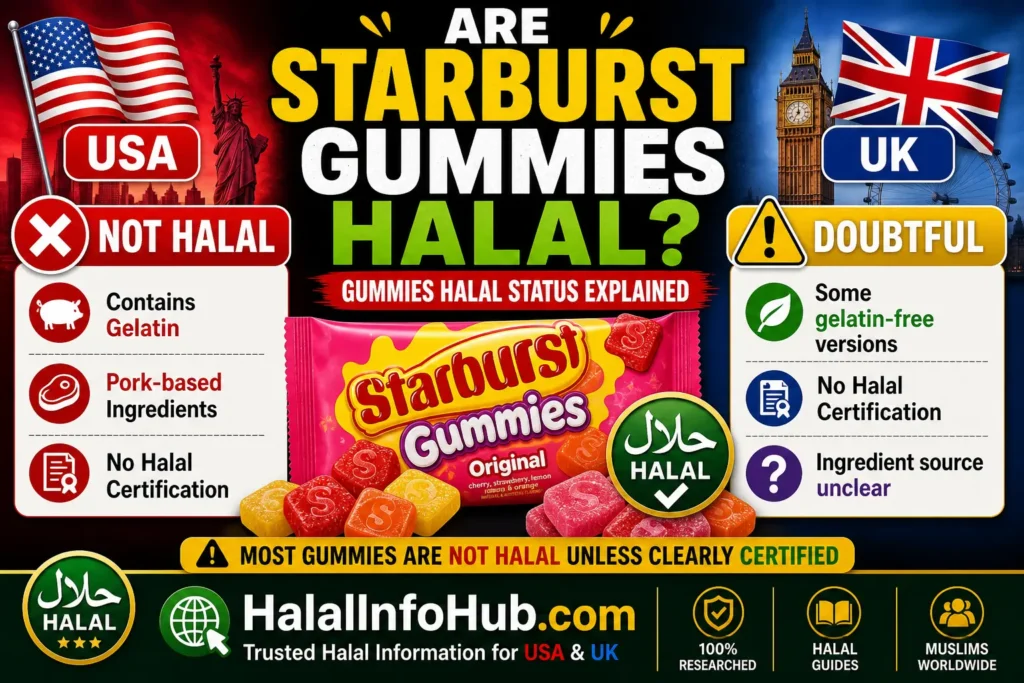
Are Starburst Gummies Halal?

Starburst Gummies are a different product.

  • Usually contain gelatin
  • No halal certification
  • Ingredient sources unclear

👉 Verdict: Not Halal

Can Muslims Eat Starburst?

USA

❌ No — clearly not halal

UK

⚠️ Only if fully verified (which is difficult)

👉 Best choice: avoid doubtful products

How to Check Halal Candy

If you live in the USA or UK, follow this:

Step-by-step:

  1. Read ingredients carefully
  2. Look for gelatin
  3. Check gelatin source
  4. Look for halal certification
  5. Avoid if unsure

👉 Golden Rule:
When in doubt, leave it out

Safe Halal Alternatives to Starburst

You don’t have to stop enjoying sweets.

Better Options:

  • Halal-certified fruit chews
  • Vegan gummies
  • Gelatin-free candies

What to Look For:

  • Halal logo
  • Vegan label
  • Gelatin-free claim

These options are much safer.

Why This Matters in USA & UK

Muslims living in Western countries face challenges:

  • Ingredients are complex
  • Halal options are limited
  • Labels are confusing

That’s why awareness is important.

Quick Summary Table

FAQs

1. Is Starburst halal in USA?

No, it contains pork gelatin.

2. Is Starburst halal in UK?

Some are gelatin-free but not certified halal.

3. Does Starburst contain pork?

Yes, in USA versions.

4. Are Starburst gummies halal?

No.

5. Is Starburst vegetarian?

Only some UK versions.

6. Is gelatin always haram?

Only if from non-halal sources.

7. Can Muslims eat Starburst UK?

Only if fully verified.

8. Is there halal Starburst?

No official version.

9. Why different ingredients?

Different food laws.

10. Are all candies haram?

No.

11. What is the safest option?

Halal-certified candy.

12. How to check quickly?

Look for gelatin and halal logos.

13. Is Starburst safe for kids?

Not in USA (halal-wise).

14. What does doubt mean?

Better to avoid.

Conclusion

So, is Starburst halal in the USA and UK?

The clear answer is no. Starburst is not halal in the USA because it contains pork-derived gelatin, which makes it unsuitable for Muslims. In the United Kingdom, some Starburst products may be gelatin-free and appear safer, but due to the lack of official halal certification, they are still considered doubtful (mashbooh).

For Muslims living in the USA and UK, the safest approach is to avoid Starburst unless it is clearly certified halal. Instead, choose halal-certified or vegan candies that are free from gelatin and other questionable ingredients.

Making informed food choices is important, especially when living in non-Muslim countries where ingredient transparency is not always clear. Always check labels, understand ingredients, and avoid doubtful products to stay on the safe side.

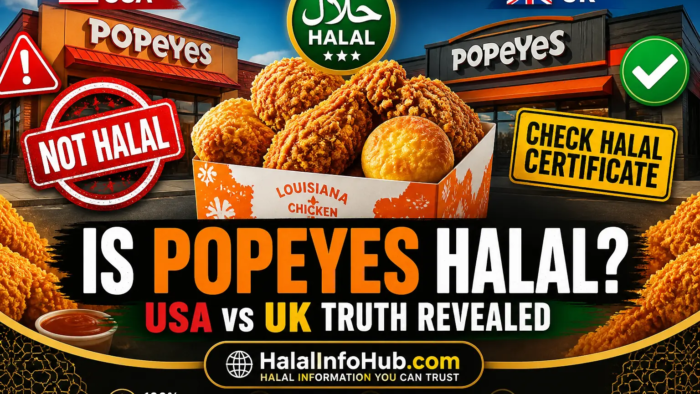
Is Popeyes Halal

Is Popeyes Halal Or Haram?

Popeyes is not fully halal in USA and UK.
USA is generally non-halal, while UK has only selected halal-certified branches that must be individually verified.

Popeyes is one of the most popular fried chicken fast food chains in the world, widely known for its crispy chicken, spicy flavor, and Louisiana-style recipes. It operates in many countries including the USA and UK, and is especially popular among young customers and fast food lovers.

However, for Muslim consumers, popularity is not the deciding factor. The most important question is whether the food is halal or not according to Islamic dietary laws. This is where confusion starts, because fast food chains often use different suppliers, different kitchens, and different preparation systems in each country.

In the case of Popeyes, there is no single global halal system. Instead, each country — and sometimes each individual branch — operates under different food sourcing rules. This creates inconsistency in halal status.

In the USA, most branches use standard industrial chicken supply chains that are not halal-certified. In the UK, some branches do offer halal-certified chicken, but this is not nationwide and must always be verified.

📊 POPEYES HALAL STATUS COMPARISON (USA vs UK)

 WHAT IS POPEYES?

Popeyes was founded in Louisiana in 1972 and has become a global fast food brand known for its fried chicken, sandwiches, wings, and Southern-style meals.

The brand operates under a franchise model, meaning individual store owners run branches under the Popeyes name. This is important because it means:

  • Food suppliers can differ by country
  • Cooking methods can vary
  • Certification is not globally controlled

The menu mainly focuses on chicken-based items, which makes halal status even more important. Unlike vegetarian food, chicken must follow strict Islamic slaughter rules to be considered halal.

Because of its franchise structure, Popeyes does not have one fixed halal policy worldwide. This is why halal status must be checked country by country.

WHAT MAKES FOOD HALAL?

To understand Popeyes properly, we must understand halal requirements in modern food systems.

For food to be halal, it must follow these rules:

✔️ Islamic Requirements:

  • Animal must be slaughtered according to zabiha method
  • Allah’s name must be mentioned during slaughter
  • Blood must be completely drained
  • No cross-contamination with haram food
  • Clean preparation system

❌ Modern Fast Food Challenges:

  • Industrial machine slaughter systems
  • Shared kitchen equipment
  • Large-scale processing plants
  • Multiple supplier chains
  • Lack of full transparency

Even if food looks “normal chicken,” it does not automatically mean it is halal. Certification is the only reliable proof.

POPEYES HALAL STATUS IN USA

❌ FINAL VERDICT: NOT HALAL

In the United States, Popeyes is generally not halal.

🚫 MAIN REASONS:

1. No halal certification system

There is no nationwide halal control or verification system for Popeyes in the USA.

2. Non-halal chicken sourcing

Chicken is sourced from industrial suppliers that do not follow Islamic slaughter rules.

3. Machine slaughter process

Most poultry in the USA is processed using automated systems.

4. Shared kitchen environment

Same fryers, oil, and equipment are used for multiple menu items.

5. No separation system

No distinction between halal and non-halal preparation areas.

👉 Result: USA Popeyes is considered non-halal for Muslim consumers.

POPEYES HALAL STATUS IN UK

⚠️ FINAL VERDICT: PARTIAL / BRANCH DEPENDENT

In the UK, the situation is more flexible but not fully uniform.

✔️ HALAL BRANCHES:

Some UK locations:

  • Use halal-certified chicken
  • Display halal certificates in-store
  • Follow approved halal suppliers

❌ NON-HALAL BRANCHES:

Other branches:

  • Do not display certification
  • Use standard chicken supply
  • Follow non-halal systems

📍 IMPORTANT:

Even in cities like London or Birmingham, halal status depends on the specific branch, not the brand.

👉 Result: UK Popeyes is only halal if officially certified branch is confirmed.

USA VS UK HALAL COMPARISON

HALAL CERTIFICATION AUTHORITY ISSUE

One of the biggest reasons for confusion in Popeyes is the lack of a unified halal certification authority.

In the UK, halal certification may come from different organizations, and not all carry the same strict standards. Some branches display certificates that may not be recognized universally.

In the USA, most branches do not display any halal certification at all.

👉 This means even if a store “claims halal,” the authority behind that claim matters more than the label itself.

Muslims should always verify:

  • Certification body name
  • Expiry date
  • Supplier verification

MENU ITEM RISK BREAKDOWN

Not all items at Popeyes carry the same risk level.

🍗 Chicken Items:

Highest risk because sourcing is not guaranteed halal in USA.

🍟 Fries:

Generally vegetarian but risk exists due to shared fryers.

🥤 Drinks:

Usually halal-safe but depends on additives.

🧂 Sauces:

Some sauces may contain unclear flavor enhancers or processing agents.

👉 Conclusion: Even “safe-looking items” may still carry contamination risk.

FAST FOOD INDUSTRY PROBLEM

Modern fast food chains like Popeyes face structural issues for halal compliance.

MAIN ISSUES:

  • Global supply chain complexity
  • High-speed production systems
  • Cost-cutting in ingredient sourcing
  • Shared equipment across menu items

This makes full halal compliance difficult unless the brand builds a dedicated halal-only supply system — which Popeyes has not done globally.

MUSLIM CONSUMER BEHAVIOR

Many Muslims consume fast food without checking halal certification due to:

  • Brand trust
  • Social influence
  • Lack of awareness
  • Assumption that chicken = halal

However, Islamic dietary law requires verification, not assumption.

👉 This is why halal verification education is important in Western countries like USA and U

INGREDIENT ANALYSIS

Popeyes uses multiple processed ingredients across its menu.

🍗 Chicken:

Main concern due to sourcing differences.

🧂 Seasonings:

Spice blends and flavor enhancers are used for taste consistency.

🛢️ Cooking Oil:

Vegetable oil is generally halal, but shared frying increases risk.

🍞 Coating:

Flour-based breading with additives and stabilizers.

👉 Overall risk comes from processing system, not just ingredients.

CROSS-CONTAMINATION RISK

Fast food kitchens are high-risk environments for cross-contamination.

Risks include:

  • Shared fryers for chicken and other items
  • Same oil used multiple times
  • Shared utensils and preparation areas
  • High-volume cooking systems

Even if halal chicken is used in some UK branches, contamination risk still exists if separation is not strict.

WHY CONFUSION EXISTS

Confusion around Popeyes happens due to:

  • Mixed halal status in UK branches
  • Social media claims without proof
  • Franchise-based system differences
  • Assumption that all chicken is halal
  • Lack of official global policy

This leads to incorrect assumptions among customers.

HOW TO VERIFY HALAL STATUS

Before eating at Popeyes:

✔ Check halal certificate in-store
✔ Ask staff about chicken sourcing
✔ Confirm halal authority name
✔ Check official branch listings
✔ Avoid assumptions based on brand name

👉 No proof = avoid consumption

SAFE HALAL ALTERNATIVES

Muslims can choose:

  • Certified halal fried chicken restaurants
  • Muslim-owned fast food chains
  • Verified halal-certified outlets
  • Local halal diners

These options remove all uncertainty.

SEE ALSO

FAQ

Is Popeyes halal in USA?

No, it is generally not halal.

Is Popeyes halal in UK?

Only selected certified branches are halal.

Can Muslims eat Popeyes?

Only if the branch is verified halal.

Is Popeyes chicken halal everywhere?

No, it depends on location.

CONCLUSION

Popeyes is not consistently halal across USA and UK, and its status depends entirely on location and certification.

In the USA, most branches are non-halal due to non-zabiha sourcing, industrial chicken supply chains, and lack of official halal certification. This makes it unsafe for Muslims who follow strict halal dietary rules.

In the UK, the situation is mixed. Some branches may offer halal-certified chicken, but this is not uniform across all locations. Each outlet must be individually verified because certification, suppliers, and kitchen practices can differ from branch to branch.

For Muslim consumers, the key takeaway is that brand name alone is not enough to determine halal status. In modern fast food systems, verification is more important than assumptions.

👉 The safest approach is to only consume from clearly certified halal branches or choose fully verified halal restaurants where sourcing and preparation are transparently controlled.

Is Big Mac Sauce Halal in USA & UK?

Is Big Mac Sauce Halal Or Haram?

Big Mac Sauce is not officially halal-certified in the USA and UK.
It may contain ingredients or processing methods that make it doubtful for strict halal consumers.

Big Mac Sauce is one of the most iconic fast food sauces in the world, used in the famous Big Mac burger from McDonald’s. Millions of people in the USA and UK enjoy it daily, but for Muslim consumers, one important question always comes up: is it actually halal?

The concern is not just about taste, but about hidden ingredients, unclear flavouring processes, and lack of halal certification. In modern food production, even small sauces can include complex processing methods that are not always transparent to consumers.

In this detailed guide, we will break down everything about Big Mac Sauce in a very simple way so you can clearly understand its halal status in the USA and UK.

What is Big Mac Sauce?

Big Mac Sauce is a creamy, tangy, slightly sweet dressing used mainly in McDonald’s Big Mac burger.

It is designed to:

  • Add flavour balance to beef and bun
  • Create signature “Big Mac taste”
  • Differentiate McDonald’s burgers from competitors

Although it is often compared to Thousand Island dressing, the exact recipe is not fully public, which creates confusion for halal-conscious consumers.

Big Mac Sauce Ingredients

The ingredients vary slightly by country, but generally include:

🧴 Base Ingredients:

  • Mayonnaise (egg, oil, vinegar base)
  • Pickle relish
  • Mustard

🌿 Flavour Components:

  • Onion powder
  • Garlic powder
  • Spices blend

🧪 Acid & Preservatives:

  • Vinegar (acidifying agent)
  • Preservatives (E-numbers in some regions)

⚠️ Important Hidden Concern:

Some flavourings may be processed using alcohol-based carriers, even if alcohol is not listed as a final ingredient.

Does Big Mac Sauce Contain Alcohol?

There is no official listing of direct alcohol in Big Mac Sauce.

However, halal concern arises from three areas:

1. Flavour Processing

Some natural flavours in processed foods may use alcohol as a solvent during extraction.

2. Vinegar Production

Vinegar comes from fermentation. While most vinegar is halal, industrial processing methods can vary.

3. Cross-Ingredient Processing

Factories may handle multiple flavour systems, making trace contamination possible.

👉 Conclusion: No visible alcohol, but processing uncertainty exists.

Is Big Mac Sauce Halal in USA?

In the United States, Big Mac Sauce is:

  • ❌ Not halal-certified
  • ❌ Not independently verified by halal bodies
  • ⚠️ Subject to regional ingredient variation

Key USA Reality:

McDonald’s in the USA uses centralized supply chains but allows regional ingredient sourcing. This means:

  • Ingredients can vary by supplier
  • No unified halal policy for sauces
  • Cross-contact in kitchens is possible

👉 Result: Most Muslim consumers in the USA consider it doubtful (mashbooh).

Is Big Mac Sauce Halal in UK?

In the United Kingdom:

  • ❌ Not officially halal-certified
  • ⚠️ Ingredients are standardized but not halal-verified
  • ⚠️ Some McDonald’s branches serve halal meat, but sauces remain unchanged

UK Reality:

Even in halal-friendly locations:

  • Sauce recipes are global
  • No separate halal certification for condiments
  • Shared processing systems

👉 Result: UK situation is similar — not confirmed halal.

USA vs UK Comparison

Why Big Mac Sauce is Not Halal Certified

There are several practical reasons:

1. Global Supply Chain

McDonald’s operates worldwide, making unified halal certification difficult.

2. Cost of Certification

Certifying every sauce in every region is expensive and complex.

3. Shared Equipment

Factories often produce multiple sauces on shared lines.

4. Ingredient Complexity

Flavor systems include multiple sub-ingredients that vary globally.

Hidden Ingredient Concerns

🧪 E-Numbers & Additives

Some regions use preservatives and stabilizers that may come from unknown sources.

🍶 Flavour Carriers

Natural flavours can sometimes be dissolved in alcohol during production.

🧂 Acid Regulators

Vinegar and acids are generally halal, but processing matters.

👉 This is why halal scholars often classify such products as uncertain rather than clearly halal.

How McDonald’s Sauce Supply Chain Works

Knowing  Big Mac Sauce halal status requires knowing how McDonald’s supplies its ingredients globally.

McDonald’s does not prepare all sauces in one kitchen. Instead:

  • Sauces are produced in regional food factories
  • Ingredients come from multiple international suppliers
  • Each country has different food safety laws
  • Final products are shipped to restaurants

👉 This means Big Mac Sauce in the USA is NOT always identical to the UK version.

⚠️ Halal Impact:

Because of this system:

  • No single halal certification can cover all regions
  • Ingredient tracing becomes difficult
  • Muslim consumers face uncertainty

Industrial Flavouring Process Explained

Many people don’t realise how “natural flavour” is made.

In food manufacturing:

  • Flavour extracts are created using solvents
  • Some solvents may include alcohol-based carriers
  • After processing, alcohol may evaporate or remain in trace form

👉 This is one of the biggest halal concerns in sauces like Big Mac Sauce.

🧠 Key Point:

Even if alcohol is not listed, processing method matters in halal rulings.

E-Numbers in Fast Food Sauces

Some McDonald’s sauces include additives known as E-numbers.

Common types include:

  • E202 (Preservatives)
  • E211 (Sodium benzoate)
  • E415 (Thickener – Xanthan gum)

Why this matters:

  • Some additives come from synthetic sources
  • Some may be derived from animal-based or alcohol-based processing
  • Not all E-numbers are automatically halal or haram

👉 Without certification, full clarity is not available.

Cross-Contamination in Fast Food Kitchens

Even if Big Mac Sauce ingredients were halal-safe, the preparation environment matters.

In many USA and UK outlets:

  • Same kitchen handles beef, chicken, fries, sauces
  • Shared utensils and surfaces are used
  • Oil fryers are not separated in most branches

⚠️ Risk Level:

  • Low for sauce alone
  • Medium when combined with full meal preparation

McDonald’s Halal Policy Differences 

Different countries have different rules:

USA:

  • No nationwide halal program
  • Ingredients are standardized but not halal-certified
  • Muslim customers rely on personal judgment

UK:

  • Some branches serve halal meat only
  • Sauces remain unchanged globally
  • No full halal kitchen certification system

🌍 Global Reality:

Even in Muslim-majority countries:

  • McDonald’s sometimes uses separate halal-certified suppliers
  • But sauces still follow global recipes

Why Big Mac Sauce Is Not Individually Certified

There are practical business reasons:

1. High Cost of Certification

Every ingredient + supplier would need auditing.

2. Global Standardization Model

McDonald’s keeps sauce recipes consistent worldwide.

3. Supplier Complexity

Different countries supply different components.

4. Low Demand Pressure

Most consumers do not demand halal certification for sauces.

Muslim Consumer Decision Guide

If you are unsure about Big Mac Sauce:

✔ Safe Approach:

  • Choose halal-certified restaurants
  • Avoid unknown sauces
  • Ask staff about ingredients (if available)

⚠ Moderate Approach:

  • Eat in countries with partial halal systems
  • Accept uncertainty in sauces

❌ Strict Approach:

  • Avoid all non-certified sauces completely
  • Use homemade alternatives only

Why Muslims Are Confused

There are 4 main reasons:

1. No Clear Labeling

Most fast food sauces do not show full processing details.

2. Global Brand Variation

Same product name ≠ same recipe everywhere.

3. Marketing Assumption

People assume “beef burger = halal-safe sauce” (not always true).

4. Lack of Certification Awareness

Consumers often check meat but ignore sauces.

Ingredient Safety Table

Cross-Contamination Risk

Even if ingredients seem halal-friendly, risk exists due to:

  • Shared fryer/oil systems
  • Same kitchen utensils
  • Mixed ingredient storage
  • Bulk sauce production lines

👉 This is especially important in USA fast food outlets.

Safe Alternatives for Muslims

If you want 100% safe options:

  • Ask for burger without sauce
  • Use ketchup (if verified locally)
  • Choose halal-certified restaurants
  • Make homemade Big Mac-style sauce

Homemade Halal Big Mac Sauce Idea

You can easily recreate a halal-safe version using:

  • Mayo (certified)
  • Pickle relish
  • Mustard
  • Vinegar (verified source)
  • Onion powder
  • Garlic powder

👉 This gives same taste without uncertainty.

Common Myths

❌ Big Mac Sauce is halal worldwide
✔ False — certification is missing

❌ No alcohol = automatically halal
✔ False — processing matters

❌ UK McDonald’s is fully halal
✔ Only some meat items, not sauces

❌ Same recipe globally
✔ Not true

FAQs

1. Is Big Mac Sauce halal in USA?

No, it is not certified halal.

2. Is Big Mac Sauce halal in UK?

No official halal certification exists.

3. Does Big Mac Sauce contain alcohol?

No direct alcohol is listed, but processing concerns exist.

4. Is Big Mac Sauce vegetarian?

Sometimes, but not halal-certified.

5. Can Muslims eat Big Mac Sauce?

Many avoid it due to uncertainty.

6. Is McDonald’s Big Mac halal overall?

Depends on country and branch policy.

7. What makes Big Mac Sauce doubtful?

Flavour processing and lack of certification.

8. Is vinegar halal in Big Mac Sauce?

Generally yes, but source matters.

9. Is McDonald’s sauce halal in USA?

Most sauces are not certified.

10. What is the safest option?

Avoid sauce or use homemade versions.

Conclusion

Big Mac Sauce from McDonald’s is one of the most popular fast food sauces in the world, but in both the USA and UK, it is not officially halal-certified.

While there is no confirmed direct alcohol content, the uncertainty comes from flavour processing methods, global ingredient sourcing, and lack of transparency in production.

For Muslims who follow strict halal guidelines, the safest choice is either to avoid it or use homemade alternatives. In modern fast food systems, even small sauces can have complex production methods, so awareness is key.

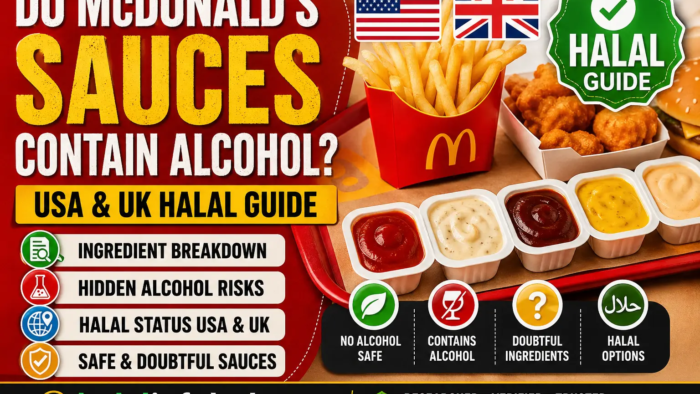
Do McDonald’s Sauces Contain Alcohol?

Do McDonald’s Sauces Contain Alcohol? USA & UK Guide

McDonald’s sauces do not include alcohol as a direct ingredient, but alcohol may be used in flavour extraction, fermentation, and processing stages in food manufacturing. Because there is no halal certification in the United States and United Kingdom, most sauces remain doubtful (mashbooh).

Do McDonald’s sauces contain alcohol? This is not just a food question — it is a halal awareness issue that affects millions of Muslims worldwide.

Fast food is deeply integrated into modern life in the United States and United Kingdom. McDonald’s is one of the most consumed fast food chains globally, and sauces are a key part of the experience. People use them daily without thinking about ingredients, processing, or sourcing.

But behind the flavour lies a complex industrial system. Modern sauces are created using food science techniques involving emulsification, flavour extraction, chemical stabilisation, and fermentation processes.

Some of these processes may involve alcohol at different stages — even when alcohol is not present in the final product or listed on packaging.

This creates a grey area for halal-conscious consumers:
👉 “Is what we are eating truly permissible or just assumed safe?”

What Are McDonald’s Sauces?

McDonald’s sauces are industrial food products designed for mass production consistency, not traditional cooking.

They are engineered for:

  • Long shelf stability
  • Global taste uniformity
  • Cost efficiency
  • Fast production cycles
  • Supply chain scalability

Sauce Engineering System

Most sauces are built using:

  • Water-based emulsions
  • Sweeteners (sugar, corn syrup)
  • Acid regulators (vinegar, citric acid)
  • Oils and fats
  • Thickening agents
  • Flavour compounds (natural & artificial)
  • Preservatives

Full Sauce Categories

1. Simple Base Sauces

  • Ketchup
  • Mustard
  • Salt-based dips

👉 Minimal processing, lowest concern level

2. Acid & Fermentation Sauces

  • BBQ sauce
  • Sweet & sour
  • Vinegar-based dips

👉 Fermentation + flavour layering involved

3. Cream Emulsion Sauces

  • Big Mac sauce
  • Garlic mayo
  • Tartar sauce

👉 Highest chemical complexity

4. Specialty Regional Sauces

  • Spicy buffalo
  • Limited edition sauces

👉 Advanced flavour engineering systems

Do McDonald’s Sauces Contain Alcohol?

1. Ethanol in Food Flavour Extraction

Food-grade ethanol is widely used in industry to extract flavour compounds from:

  • Herbs
  • Spices
  • Fruits
  • Plant-based materials

Even when removed later, it plays a functional role in production.

2. “Natural Flavour” Label Problem

The term “natural flavour” legally allows:

  • Plant extracts
  • Synthetic flavour compounds
  • Processing aids
  • Carrier solvents (sometimes alcohol-based)

👉 This is one of the biggest transparency gaps in global food labelling.

3. Vinegar Production Chain

Vinegar is created through a biological process:

  1. Sugar fermentation → alcohol
  2. Alcohol oxidation → acetic acid

Even though final vinegar contains no intoxicating alcohol, the process involves alcohol stages.

4. Processing Aid Rule

In food manufacturing:

  • Alcohol may be used as a processing aid
  • If removed, it is not required to be declared in many regions

👉 This creates hidden complexity for consumers.

5. Trace Residue Reality

Even after processing:

  • Extremely small residues may remain
  • Usually below regulatory thresholds
  • Still debated in strict dietary interpretations

✔️ Final Scientific Conclusion

McDonald’s sauces do not intentionally contain alcohol, but alcohol-related processes are widely used in industrial food production systems.

How McDonald’s Sauces Are Actually Manufactured

McDonald’s sauces are not mixed in restaurants. They are produced in large-scale food factories under strict industrial systems.

🏭 Production Process Steps

1. Ingredient Sourcing

Raw materials are collected globally:

  • Tomato paste
  • Oils
  • Sweeteners
  • Flavour compounds

2. Industrial Mixing

Ingredients are blended using:

  • High-speed mixers
  • Temperature-controlled systems

3. Flavour Engineering

This is where complexity increases:

  • Natural flavour compounds are added
  • Emulsifiers stabilize texture
  • Acid regulators balance taste

4. Preservation Stage

To ensure long shelf life:

  • Preservatives are added
  • pH is adjusted
  • Heat treatment is used

👉 Key Insight:
Alcohol (if used) is usually part of flavour extraction stage, not final product.

Why “Alcohol-Free” Claims Can Be Misleading

Many people assume:

👉 “If alcohol is not listed, it does not exist.”

But in food science, this is not always true.

Reasons Why It’s Complicated:

1. Processing Aid Rule

Alcohol can be used and removed without label disclosure.

2. Flavour Carrier System

Alcohol is sometimes used to carry flavour molecules.

3. Regulatory Loopholes

Food laws in USA/UK allow:

  • Non-disclosure of processing aids
  • Vague “natural flavour” labelling

👉 Conclusion:
Label reading alone is not enough to fully understand sauce composition.

Global Fast Food Industry Standard

McDonald’s sauces are not unique — they follow global fast food standards.

Industry-Wide Practices:

  • Centralised food factories
  • Shared ingredient suppliers
  • Standardised flavour systems
  • Cost-driven formulations

👉 This means:
Even other brands use similar processes:

  • Burger chains
  • Chicken chains
  • Pizza chains

So the issue is industry-wide, not McDonald’s-only.

Ingredient Transparency Problem

One of the biggest issues is lack of full transparency.

 What Companies Do NOT Disclose:

  • Exact flavour compound sources
  • Carrier solvents used
  • Processing aids
  • Micro-level ingredient origins

What They DO Disclose:

  • Basic ingredient list
  • Nutrition facts
  • Allergens

👉 This gap creates uncertainty for halal-conscious consumers.

Muslim Consumer Reality in USA & UK

In both regions, Muslims face a practical challenge:

USA Reality:

  • Fast food is widely consumed
  • Halal options are limited
  • Ingredient awareness varies

UK Reality:

  • More halal restaurants exist
  • But fast food sauces still uncertified
  • Mixed consumer awareness

👉 Result:
Most people rely on assumption instead of verification

Risk-Based Eating Framework

Instead of guessing halal/haram, use a risk-based approach:

 LOW RISK FOODS

  • Simple ingredients
  • Minimal processing
  • No flavour systems

MEDIUM RISK FOODS

  • Sauces with vinegar or emulsifiers
  • Mild processing

HIGH RISK FOODS

  • Cream sauces
  • Signature sauces
  • Multi-flavour engineered sauces

👉 This approach is more practical than strict guessing.

Hidden Fast Food Marketing Strategy

Fast food companies design sauces for:

  • Addiction-based taste balance
  • Repeat consumption
  • Emotional satisfaction

How they do it:

  • Sugar + salt combination
  • Fat-based texture enhancement
  • Artificial flavour layering

USA vs UK Deep Halal Reality

United States

  • No halal certification for sauces
  • Ingredients sourced globally
  • Mixed supplier systems
  • Limited transparency on flavour processing

👉 Final Verdict: Doubtful (Mashbooh)

United Kingdom

  • Similar global supply structure
  • No official halal labeling for sauces
  • Slight recipe variations only

👉 Final Verdict: Doubtful

Muslim Consumption Reality

In both regions:

  • Muslims rely on ingredient assumptions
  • No official verification system exists for sauces
  • Awareness varies widely among consumers

Expanded Ingredient Risk Analysis

McDonald’s Sauce Risk Matrix

Hidden Alcohol in Food Industry

Alcohol is not only found in drinks — it is widely used in:

  • Flavour extraction systems
  • Baking flavour enhancers
  • Dessert syrups
  • Food stabilisers

👉 Key insight:
Alcohol is often a processing tool, not a final ingredient.

Why Fast Food Creates Confusion

1. Global Ingredient Sourcing

Ingredients come from multiple countries with different laws.

2. Labelling Laws

Companies can legally use vague terms like “flavourings”.

3. Industrial Food Engineering

Multiple chemical steps hide ingredient origin.

4. Processing Aid Rule

Some ingredients are not required to be declared.

5. No Halal Verification System

No universal certification for sauces.

Safe Consumption Strategy

 Safest Choices

  • Ketchup
  • Mustard

Moderate Zone

  • Honey mustard
  • Mild vinegar sauces

High Risk

  • BBQ sauces
  • Cream-based sauces
  • Signature sauces

Golden Rule

If source is unclear → avoid or limit usage

FAQs

1. Do McDonald’s sauces contain alcohol?

No direct alcohol, but processing may involve it.

2. Are McDonald’s sauces halal in USA?

No certification available.

3. Are McDonald’s sauces halal in UK?

No official halal verification.

4. Is vinegar halal in sauces?

Generally yes, but the process is debated.

5. Can alcohol be used in flavouring?

Yes, widely used in industry.

6. Which McDonald’s sauce is safest?

Ketchup.

7. Do creamy sauces contain alcohol?

Not directly, but processing is complex.

8. Can trace alcohol remain?

Yes, very small amounts possible.

9. Are natural flavours halal?

The source is unclear.

10. Should Muslims avoid sauces?

Depends on the strictness level.

11. Is BBQ sauce halal?

Usually doubtful.

12. Are preservatives halal?

Depends on origin.

13. Do fast food sauces all have this issue?

Many do due to industrial processing.

14. What is the safest approach?

Stick to simple sauces or avoid doubtful ones.

Conclusion

McDonald’s sauces do not contain alcohol as a direct ingredient, but alcohol-related processes are commonly used in modern food manufacturing systems.

Because McDonald’s does not provide halal certification in the United States and United Kingdom, most sauces remain in the doubtful category (mashbooh).

Do Fast Food Sauces Contain Alcohol

Do Fast Food Sauces Contain Alcohol in USA & UK? Guide

Yes, some fast food sauces in the USA and UK may contain small amounts of alcohol through flavourings, extracts, or processing methods, but this is not always clearly mentioned, making many sauces doubtful for Muslims.

Fast food is a daily part of life in the United States and the United Kingdom. People eat burgers, fries, nuggets, wraps, and drinks very often. Sauces are a big part of this experience. They make food taste better and more enjoyable. From ketchup with fries to creamy dips with chicken, sauces are everywhere.

But for Muslims, one important question always comes up: do fast food sauces contain alcohol? This question is very important because alcohol is not allowed in a halal diet. The problem is that in many cases, alcohol is not written clearly on the label, but it can still be present in hidden ways.

In this detailed guide, you will learn how alcohol can be present in sauces, which ingredients are risky, what happens in the USA and UK, and which sauces are safer to choose.

What Are Fast Food Sauces?

Fast food sauces are dips, spreads, or toppings served with meals. They are made using a mix of simple and complex ingredients.

Common ingredients include:

  • Vinegar
  • Sugar or corn syrup
  • Salt and spices
  • Vegetable oils
  • Flavourings
  • Preservatives and stabilisers

Popular sauces include:

  • Ketchup
  • BBQ sauce
  • Sweet and sour sauce
  • Garlic mayo
  • Special burger sauces

Some sauces are simple, while others are highly processed with many ingredients.

Do Fast Food Sauces Contain Alcohol?

The simple answer is: sometimes yes, but often indirectly.

In most cases:

  • Alcohol is not listed clearly
  • It is used during processing
  • It is part of another ingredient

Because of this, many sauces become doubtful (mashbooh) instead of clearly halal or haram.

How Alcohol Can Be Present in Sauces

Alcohol usually does not appear as a direct ingredient. Instead, it comes from hidden sources.

1. Flavour Extracts

Many sauces use flavour extracts such as:

  • Vanilla extract
  • Smoke flavour
  • Artificial flavouring

These extracts are often made using alcohol as a solvent. Even if the final amount is small, the source still creates doubt.

2. Natural Flavours

“Natural flavours” is one of the most confusing ingredients.

  • It can come from plants or animals
  • It may use alcohol during extraction
  • It is not explained clearly on labels

👉 This is one of the biggest reasons why sauces are doubtful.

3. Vinegar and Fermentation

Vinegar is used in many sauces. It is made from fermented alcohol.

Types include:

  • White vinegar
  • Malt vinegar
  • Apple cider vinegar

In many cases, vinegar is considered safe after full fermentation. However, the source and process are not always clear in fast food.

4. Cooking and Processing Methods

Some sauces are cooked or processed using alcohol-based ingredients.

  • Alcohol may evaporate during cooking
  • But traces can still remain

This makes the halal status unclear.

Emulsifiers and Additives

Some sauces contain:

  • Emulsifiers
  • Stabilisers
  • Preservatives

These can sometimes be processed using alcohol or come from unclear sources.

Fast Food Sauces in USA vs UK

United States

In the United States:

  • Most fast food chains are not halal-certified
  • Ingredients like “natural flavours” are common
  • Alcohol-based processing is possible

Food laws focus on safety, not halal status. So ingredients may be legal but still doubtful for Muslims.

United Kingdom

In the United Kingdom:

  • Similar situation as the USA
  • No halal certification for most major chains
  • Ingredient labels are slightly clearer but still not fully detailed

👉 Result: Sauces are still not clearly halal.

Key Difference

  • UK sometimes provides better allergen info
  • USA has less detailed public ingredient breakdowns

👉 But in both countries, sauces remain not halal-certified

Ingredients Deep Dive (USA & UK)

Here are some ingredients that may involve alcohol:

1. Flavouring Agents

  • Often made using alcohol solvents

2. Extracts

  • Vanilla, smoke, spice extracts

3. Preservatives

  • Some use alcohol during production

4. Colouring Agents

  • May involve alcohol in processing

5. E-Numbers (UK)

  • Some additives may come from unclear sources

👉 These ingredients are not always haram, but they create uncertainty

Common Sauces and Alcohol Risk Table

Why Is There So Much Confusion?

There are several reasons:

1. Hidden Ingredients

Alcohol is often not listed directly.

2. Complex Food Processing

Many ingredients are processed in ways that are not transparent.

3. No Halal Certification

Most fast food chains in USA & UK do not certify sauces as halal.

4. Supply Chain Changes

Ingredients may change depending on the supplier.

5. Labelling Limitations

Labels do not always show full ingredient details.

Are All Sauces Haram?

No, not all sauces are haram.

👉 Categories:

✅ Likely Safe:

  • Ketchup
  • Basic mustard

⚠️ Doubtful:

  • BBQ sauces
  • Creamy sauces
  • Special dips

❌ High Risk:

  • Complex sauces with multiple flavourings

👉 The issue is uncertainty, not always confirmed haram.

Safe Options for Muslims

If you want to stay on the safe side:

Choose:

  • Simple sauces with few ingredients
  • Plant-based options

Avoid:

  • Creamy sauces
  • Special or secret sauces
  • Unknown flavour mixes

Tips:

  • Check official ingredient lists
  • Prefer halal-certified brands
  • When unsure, avoid

How to Check If a Sauce Contains Alcohol

  1. Read ingredient list carefully
  2. Look for words like “extract” or “flavouring”
  3. Check for “natural flavours”
  4. Search brand ingredient details online
  5. Avoid if information is unclear

Real Fast Food Examples (USA & UK)

Most major chains in the USA and UK:

  • Do not confirm sauces as alcohol-free
  • Use flavouring systems that may include alcohol
  • Do not provide halal certification

👉 This includes sauces used in burgers, nuggets, and dips.

Better Alternatives

For complete peace of mind:

  • Use halal-certified sauces
  • Carry your own sauces
  • Eat at halal-certified restaurants

FAQs

1. Do fast food sauces contain alcohol?

Some sauces may contain alcohol through flavouring or processing.

2. Is alcohol listed on sauce labels?

Not always. It can be hidden in other ingredients.

3. Are sauces in USA halal?

Most are not halal-certified.

4. Are sauces in UK halal?

Most are also not halal-certified.

5. Is BBQ sauce made with alcohol?

Sometimes due to smoke flavouring.

6. Are natural flavours halal?

Not always, as their source is unclear.

7. Is vinegar alcohol?

It comes from alcohol but is usually considered safe.

8. Can Muslims eat fast food sauces?

Only simple ones are relatively safer.

9. Which sauces are safest?

Ketchup and mustard.

10. Do sauces contain hidden alcohol?

Yes, especially in extracts.

11. Are creamy sauces risky?

Yes, due to complex ingredients.

12. Are UK and USA sauces different?

Slightly, but both are not halal-certified.

13. How to avoid alcohol in sauces?

Choose simple ingredients and avoid complex ones.

14. Are all sauces haram?

No, but many are doubtful.

15. What is the safest option?

Use halal-certified sauces.

Conclusion

Fast food sauces in the USA and UK can sometimes contain alcohol, but it is usually hidden in flavour extracts, natural flavours, or processing methods. Because of this, many sauces are not clearly halal and are considered doubtful.

Simple sauces like ketchup and mustard are generally safer, while complex sauces like BBQ, garlic mayo, and special burger sauces carry more risk.

👉 The safest approach is to avoid doubtful sauces and choose halal-certified alternatives whenever possible.

Are McDonald’s Sauces Halal in USA & UK

Are McDonald’s Sauces Halal Or Haram?

Most McDonald’s sauces are not officially halal in the USA and UK because they are not halal-certified and may contain unclear ingredients, making them doubtful for Muslims.

McDonald’s is one of the most widely visited fast food chains in the United States and the United Kingdom, and sauces are a big part of the overall experience. From ketchup with fries to dips for nuggets, these small additions can completely change the taste of a meal.

For Muslims living in the USA and UK, the question is not just about taste—it is about whether these sauces are halal. Many people assume sauces are always safe because they do not contain meat, but this assumption is not always correct.

This guide is specifically written for Muslims in the United States and the United Kingdom who want a clear, simple, and honest answer. So, are McDonald’s sauces halal in USA and UK, or should they be avoided?

If you are also wondering about other menu items, you can read our detailed guide on whether McDonald’s overall menu is halal in the USA and UK. 

What Are McDonald’s Sauces Made Of?

McDonald’s sauces are made using a combination of ingredients such as oils, vinegar, sugar, spices, and flavorings. At first glance, these ingredients seem harmless.

However, in processed foods, the source of ingredients matters just as much as the ingredient itself. For example, emulsifiers and flavorings can be derived from different sources, and this is not always clearly mentioned.

Because of this, when people search for “McDonald’s sauces halal USA” or “McDonald’s sauces halal UK”, they often find mixed answers. The ingredients look simple, but the details are not always fully transparent.

Are McDonald’s Sauces Halal?

McDonald’s sauces are not considered fully halal in the USA and UK.

This does not mean every sauce is definitely haram. Instead, the issue is uncertainty. Without halal certification and clear ingredient sourcing, most sauces fall into the doubtful category.

For example, many people also question fries. You can check our full breakdown on McDonald’s fries halal in the USA and UK.

Why McDonald’s Sauces Are Considered Doubtful

There are a few key reasons behind this uncertainty.

The first issue is the lack of halal certification. McDonald’s in the USA and UK does not officially label its sauces as halal, which means there is no verified assurance.

The second issue is ingredient transparency. Some sauces contain complex additives like emulsifiers, stabilizers, and flavorings. These may be plant-based, but their exact source is not always confirmed.

The third issue is the preparation environment. Sauces are handled in the same kitchens where non-halal food is prepared, which can lead to cross-contact.

Because of these combined factors, sauces are generally considered doubtful rather than clearly halal.

Are McDonald’s Sauces Halal in the USA?

In the United States, McDonald’s sauces are not officially halal.

Ingredient lists are sometimes available, but they do not always explain the source of certain additives. Without this information, it becomes difficult to confirm whether everything meets halal standards.

There is also no halal certification system in place for sauces in McDonald’s USA. Because of this, Muslims who search “are McDonald’s sauces halal in USA” usually conclude that they are doubtful. Similarly, if you are unsure about meat options, our guide on McDonald’s chicken halal in the USA and UK explains everything in detail.

Are McDonald’s Sauces Halal in the UK?

In the United Kingdom, the situation is very similar.

McDonald’s UK provides ingredient information, but like in the USA, it does not clearly confirm halal sourcing for all components. There is also no nationwide halal certification for sauces.

Because of this, when people ask “McDonald’s sauces halal UK”, the answer remains the same—they are not fully halal and should be treated as doubtful unless verified. The same confusion also applies to other items, which is why many people read our full guide on is McDonald’s halal in the UK before deciding.

Ingredient-Level Insight

To understand this better, it helps to look at common sauce components.

Vegetable oils are usually halal, but their processing is not always explained in detail. Vinegar is generally considered safe, although its production process can vary.

The biggest uncertainty comes from emulsifiers and flavorings. These ingredients can be derived from either plant or animal sources, and without clear labeling, it is difficult to confirm their origin.

This is why sauces that look simple can still raise questions about halal status.

Cross-Contact in Preparation

Even if ingredients appear safe, the environment in which sauces are handled also matters.

In McDonald’s kitchens in the USA and UK, sauces are stored, handled, and served alongside non-halal food. There is no dedicated halal preparation system.

Because of this, even a sauce that seems halal in ingredients may still fall into the doubtful category due to handling conditions. This is the same issue that affects other menu items like fries, which you can read about in our McDonald’s fries halal guide for the USA and UK.

Why Many People Get Confused

One of the biggest reasons for confusion is that sauces do not contain visible meat. This leads many people to assume they are automatically halal.

Another reason is the lack of clear labeling. Fast food chains often provide general ingredient lists, but not detailed sourcing information.

This combination of simple appearance and unclear details is what makes sauces confusing for many Muslims in the USA and UK.

📊 Common Sauces Halal Status

👉 Even “safe-looking” sauces are not officially halal-certified.

Practical Advice for Muslims in USA & UK

For Muslims living in the United States and the United Kingdom, dealing with fast food can be challenging.

When there is no clear halal certification, the safest approach is to treat the item as doubtful. Many people choose to avoid such food and instead go for options that provide certainty.

This does not mean every sauce is haram, but it does mean that caution is needed when there is no clear confirmation.

When Should You Avoid These Sauces?

If you are trying to strictly follow halal guidelines, it is better to avoid sauces that do not have verified halal certification.

This is especially important in the USA and UK, where halal labeling is not standard in mainstream fast food chains.

If there is doubt and no clear answer, avoiding it is usually the safest choice.

Safer Alternatives

Instead of relying on uncertain options, many Muslims prefer safer alternatives.

Homemade sauces are one of the best choices because you control the ingredients completely. Halal-certified brands also provide more confidence.

In many cities in the USA and UK, halal restaurants offer similar sauces prepared under halal guidelines. Before making a decision, it is also helpful to review other related items such as fries, chicken, and the full menu to get a complete picture of halal options at McDonald’s in the USA and UK.

🔎 You May Also Like

FAQs

Are McDonald’s sauces halal in the USA?

They are generally considered doubtful due to lack of certification and unclear ingredients.

Are McDonald’s sauces halal in the UK?

They are also doubtful for similar reasons.

Is McDonald’s ketchup halal?

It is usually considered safe, but not officially halal-certified.

Do McDonald’s sauces contain alcohol?

Some flavorings may involve alcohol during processing, but this is not always clearly stated.

Are sauces safer than meat items?

Yes, but they are still not fully halal.
Can Muslims eat McDonald’s sauces?

It is better to avoid them if you want to stay on the safe side.

Are ingredients clearly explained?

Not always in full detail.

What is the safest option?

Choose halal-certified sauces or make your own.

Conclusion

So, are McDonald’s sauces halal in the USA and UK? The most accurate answer is that they are not officially halal and should be considered doubtful due to unclear ingredients, lack of certification, and shared preparation environments.

For Muslims living in the United States and the United Kingdom, the safest approach is to avoid doubtful items and choose food that is clearly verified as halal.
When it comes to halal food, clarity matters—and when there is no clear answer, choosing certainty is always the better option.