
E471 can be halal or haram depending on its source. If it is made from plant-based oils or halal-certified animal fat, it is considered halal. However, if it comes from pork or non-halal animal fat, it becomes haram or doubtful (mashbooh). In USA and UK foods, most E471 is plant-based but not always clearly verified.
Is E471 halal or haram? This question has become extremely important for Muslims living in the USA, UK, Canada, and other Western countries because E471 is found in thousands of everyday processed foods.
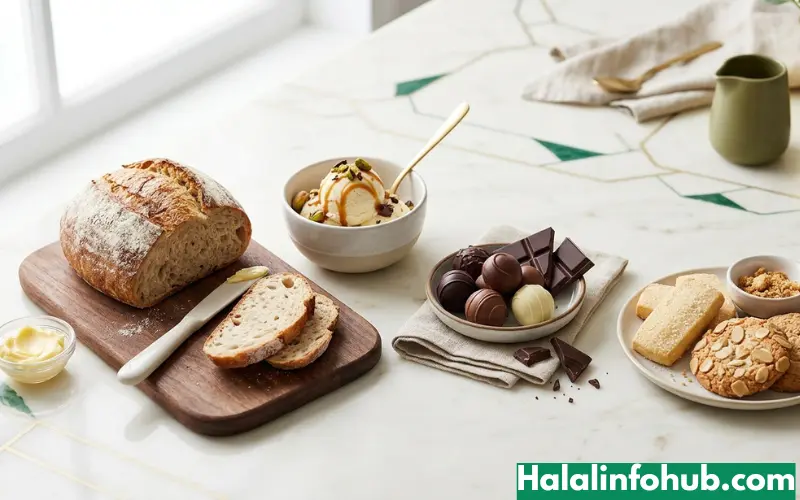
From bread in supermarkets to cakes, biscuits, chocolate, margarine, ice cream, and even fast-food desserts — E471 is everywhere.
The confusion comes from one major issue: E471 is not a single ingredient — it is a category of emulsifiers. This means its source can change depending on the manufacturer, country, and production method.
In 2026, halal consumers will no longer only check meat products. They are now carefully analyzing:
- E-number ingredients
- emulsifiers and stabilizers
- food chemistry codes
- hidden animal derivatives
- processed bakery ingredients
This makes E471 one of the most searched and most confusing halal food topics today.
Related Post: Is Rennet Halal or Haram?
What is E471?
E471 stands for:
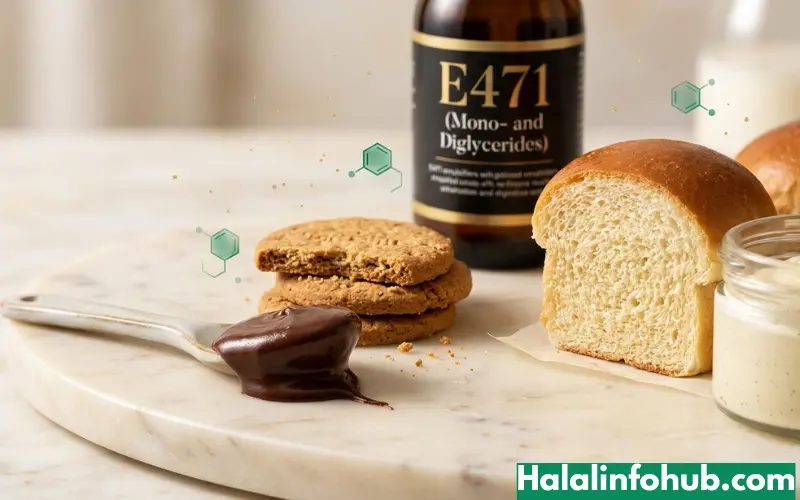
Mono- and diglycerides of fatty acids
It is used as a food emulsifier.
What does it do?
E471 helps:
- Mix oil and water
- Improve texture
- Extend shelf life
- Make food soft and creamy
- Stabilize processed foods
Common foods containing E471:
E471 is widely used in:
- Bread and burger buns
- Cakes and pastries
- Cookies and biscuits
- Chocolate products
- Ice cream
- Margarine and spreads
- Instant noodles
- Packaged desserts
- Frozen bakery products
Why E471 is Confusing for Muslims
The main issue is not the chemical, but the source of fatty acids.
E471 can be derived from:
1. Plant-based oils
- Palm oil
- Soybean oil
- Sunflower oil
✔ Usually halal
2. Animal fats
- Beef fat
- Pork fat
- Mixed animal sources
❌ Can be haram if not halal-slaughtered
3. Mixed or unknown sources
- Not clearly labeled
- Industrial blending
- Cross-production systems
⚠ Considered doubtful (mashbooh)
Is E471 Halal or Haram?
Islamic ruling depends on the source transformation principle.
✔ If E471 is plant-based:
- Derived from vegetable oils
- No animal contamination
✔ Halal
✔ If E471 is from halal animal fat:
- From halal-slaughtered cattle
- Proper processing
✔ Halal
❌ If E471 is from pork or non-halal animals:
- Pork-derived emulsifiers
- Non-zabiha animal fat
❌ Haram
⚠ If source is unknown:
- No disclosure on packaging
- Mixed factory production
⚠ Mushbooh (doubtful)
Is E471 Halal in the USA?
In the United States:
- Large food companies prefer vegetable oils
- Cost efficiency makes plant-based emulsifiers common
- Many industrial baked goods use palm oil derivatives
Reality in the USA:
✔ Most E471 is plant-based
❗ But labeling is not transparent
❗ Halal certification is not always present
Conclusion:
E471 is generally safe but not guaranteed halal unless certified.
Is E471 Halal in the UK?
In the United Kingdom:
- The bakery industry heavily uses emulsifiers
- Supermarket cakes and biscuits often contain E471
- Vegetarian labeling is more common than halal certification
Reality in the UK:
✔ Vegetarian E471 = usually safe
⚠ Mixed-source imported foods = risk
❗ Some bakery chains do not disclose sources
Conclusion:
E471 is more transparent in vegetarian products, but still uncertain overall.
Hidden Risk Factors Muslims Don’t Notice
1. “Vegetable emulsifier” labeling trick
Sometimes companies write:
- vegetable emulsifiers
- plant-based fats
But processing may still involve shared equipment.
2. Cross-contamination risk
Factories often handle:
- dairy
- meat derivatives
- animal fats
3. Hidden animal derivatives
Some emulsifiers may come from:
- animal tallow
- industrial by-products
4. Lack of E-code transparency
Unlike gelatin, E471 does NOT specify:
- animal source
- slaughter method
- processing origin
Scholarly Figure out
Most halal certification bodies agree:
✔ Plant-based E471 = halal
✔ Halal animal-based E471 = halal
❌ Non-halal animal-based = haram
⚠ Unknown = avoid or verify
USA vs UK Comparison
| Factor | USA | UK |
| Plant-based usage | High | Medium |
| Label transparency | Low | Medium |
| Vegetarian labeling | Medium | High |
| Halal certification | Medium | Medium |
| Risk level | Lower | Moderate |
Foods Most Likely to Contain E471
High-risk processed foods:
- supermarket bread
- donuts
- packaged cakes
- cheap chocolate
- frozen pastries
- cookies and biscuits
- instant desserts
Industrial Manufacturing Process of E471
Why this matters
Most articles E471 ko sirf define karte hain, lekin real manufacturing process explain nahi karte — yahi gap tum fill kar sakte ho.
How E471 is actually made
E471 is produced through a process called glycerol esterification, where fats are broken down into mono- and diglycerides.
Step-by-step simplified process:
- Fats are extracted (plant or animal source)
- Fat molecules are broken down using heat
- Glycerol is added
- Chemical reaction forms emulsifiers
- Final product = E471 stabilizer
Why does this create halal uncertainty
- Same chemical process for all sources
- Final product looks identical
- No visual difference between halal and haram origin
- Food labels do not disclose the raw fat source
👉 This is why E471 is considered technically ambiguous in halal rulings
Hidden “E471 Name Variations” in Food Labels
Many users don’t realize E471 is NOT always written clearly.
Alternative names used on packaging:
- Mono- and diglycerides
- Fatty acid esters
- Emulsifiers (E471)
- Vegetable emulsifier (generic label)
- Stabilizer (unspecified)
Why this is important
Sometimes E471 is:
- hidden under “E numbers.”
- or grouped under “emulsifiers.”
👉 Muslims often miss it while shopping in the USA/UK supermarkets.
Ultra-Processed Food Risk
E471 is part of a bigger problem: the ultra-processed food system
Where E471 is commonly found:
- Fast food buns
- Mass-produced bakery items
- Industrial chocolate
- Frozen desserts
- Cheap supermarket snacks
Health + halal overlap issue
Even if halal:
- Highly processed foods may contain unknown additives
- Multiple emulsifiers mixed
- cross-industry sourcing
👉 This makes “ingredient awareness” essential for Muslims in Western countries.
“Vegetarian Label ≠ Always Halal” Clarification
Many users assume:
Vegetarian = automatically halal ❌ (not always true)
Reality check:
Vegetarian E471:
- usually plant-based ✔
- BUT may be processed in shared facilities
- may include alcohol-based processing aids in some cases
- No Islamic certification guarantee
Safe approach:
- Vegetarian + halal certification = safest
- Vegetarian only = moderate safety
- Unknown source = avoid if strict halal
Real-Life Products Containing E471
This section increases ranking + engagement massively.
Common USA & UK products:
- Burger buns (McDonald’s style bakery items)
- Supermarket white bread
- Cake mixes
- Chocolate bars
- Ice cream brands
- Biscuits and cookies
Why this matters
Muslims often eat these daily without knowing:
👉 E471 is inside almost every processed bakery item
“Should Muslims Avoid E471 Completely?”
This is a high conversion SEO section that competitors miss.
✔ Practical Islamic guidance:
- If plant-based → safe
- If halal-certified → safe
- If unknown → avoid or verify
- If pork-derived → strictly haram
Final practical rule:
If you cannot verify the source, treat E471 as doubtful (mashbooh)
“How to Check E471 While Shopping in USA & UK”
🛍️ Simple checklist:
- Look for the halal certification logo
- Check the “vegetarian” label
- Read the ingredient detail section
- Avoid vague “emulsifiers” listing
- Prefer trusted halal brands
Safe Strategy for Muslims
✔ Best approach:
- Buy halal-certified products
- Prefer vegetarian-labeled foods
- Avoid unclear bakery items
- Check ingredient transparency apps
See Also
FAQs
Is E471 halal?
Yes, if plant-based or halal-certified; otherwise doubtful.
Is E471 halal or haram?
It depends on the source of fatty acids used.
Is E471 halal in the USA?
Mostly yes, but not always certified.
Is E471 halal in the UK?
Often vegetarian-based but still requires verification.
What is E471 made from?
It is made from plant oils or animal fats.
Is E471 safe for Muslims?
Only safe when the source is verified or certified halal.
Conclusion
So, is E471 halal or haram?
The answer is not absolute. E471 itself is not inherently haram — its ruling depends completely on its origin. If it is derived from plant oils or halal-certified animal sources, it is permissible. However, if it comes from non-halal animal fats or unknown sources, it becomes doubtful or haram.
For Muslims in the USA and UK, the safest approach is to choose products with halal certification or vegetarian labeling to avoid uncertainty in processed foods.