


A driver opening the Cadillac Lyriq drive-mode screen sees four choices: Tour, Sport, Snow/Ice, and a customizable setting called My Mode. If Sport makes the accelerator sharper and Snow/Ice changes traction behavior, it seems reasonable to ask whether one mode also travels farther on a charge than another, or uses the battery differently.
The answer has two parts. Cadillac’s own material settles the first: the battery does not change size when a mode is selected, and EPA-estimated range is published by vehicle configuration, not by drive mode. The second part is real-world driving, where speed, acceleration, temperature, and terrain change how much energy a trip uses. Cadillac publishes no fixed per-mode figure for that part, and this article does not invent one.
Direct answer
No. Cadillac does not publish a different EPA-estimated range or a different battery capacity for Tour, Sport, Snow/Ice, or My Mode. The published EPA-estimated range is set by vehicle configuration, such as rear-wheel drive or all-wheel drive, and the battery stays the same whichever mode is selected.
What changes between modes is the driving experience: accelerator response, steering feel, suspension behavior where equipped, and traction management on slippery roads. Those changes can coincide with different energy use in real driving, because harder acceleration and higher speeds use more energy, but Cadillac assigns no separate range number or percentage to any mode. Any page quoting an exact per-mode difference is stating its own claim, not a Cadillac figure.
Tour is the normal default. Sport is for a more controlled, responsive feel on dry pavement. Snow/Ice is for slippery surfaces, where traction matters more than efficiency. My Mode combines individual settings to personal taste. None installs a larger battery or rewrites the published EPA-estimated range.
See Also: how to verify information before acting on it
What the four driving modes are
Driver Mode Control in the Lyriq allows the driver to adjust the overall driving experience by selecting different modes. According to the 2024 and 2025 Lyriq owner’s manuals, the modes that may be equipped are Tour, Sport, Snow/Ice, and one customizable mode, My Mode. Mode availability and the subsystems affected depend on trim level, region, and optional features, so a mode described in a manual may not be equipped, or may behave slightly differently, on a particular vehicle.
Modes are selected through the Drive Mode app on the infotainment home screen, and a unique indicator is displayed in the instrument cluster. Tour, My Mode, and Sport stay selected through future on/off cycles, while any other mode returns to Tour on restart, according to the 2024 manual. A driver who selects Snow/Ice for a winter trip should therefore not assume it is still selected after a restart.
The manuals describe each mode in terms of driving feel and vehicle response, not energy or range. They mention pedal tuning, steering, suspension, sound, and traction, but promise no range figure, battery-saving setting, or efficiency rating for any mode.
| Mode | What Cadillac’s manual states | Published range effect |
|---|---|---|
| Tour | Normal city and highway driving, smooth ride, balance of comfort and handling; default mode | No separate EPA figure published |
| Sport | More controlled response, improved handling and acceleration on dry pavement; modifies steering, pedal tuning, sound enhancement, adaptive cruise control, and suspension where equipped | No separate EPA figure published |
| Snow/Ice | Improves acceleration on snow-covered roads; adjusts pedal tuning for traction on slippery surfaces; modifies electric all-wheel drive and steering where equipped | No separate EPA figure published |
| My Mode | Personalized combination of Acceleration Feel, Brake Feel, Steering, Suspension, and Motor Sound where equipped; persists across on/off cycles | No separate EPA figure published |
Tour Mode: the everyday default
Tour Mode is described in the manual as the setting for normal city and highway driving, providing a smooth ride and a balance between comfort and handling. It is the default and the sensible starting point.
Sport Mode: sharper response on dry pavement
Sport Mode is for situations where road conditions or personal preference demand a more controlled response, according to the manual. On dry pavement, Sport improves handling and acceleration. When active, Sport modifies steering efforts, pedal tuning, electric vehicle sound enhancement, adaptive cruise control, and suspension tuning, where equipped.
That list explains why Sport feels different, and why it can coincide with higher energy use: a sharper accelerator response makes harder acceleration easier, and harder acceleration uses more energy. But the manual does not state that selecting Sport alone consumes a fixed extra amount of energy, and it gives no Sport range figure. Sport Mode is also not a trim name: selecting it does not turn a standard Lyriq into a Lyriq-V.
Snow/Ice Mode: traction first, not efficiency
Snow/Ice Mode is described in the manual as the setting for snow-covered roads, used to improve acceleration on slippery surfaces. When active, it adjusts pedal tuning for traction, and modifies electric all-wheel drive and steering, where equipped. The manual adds a caution: the setting can compromise acceleration on dry asphalt, and it is not intended for use when the vehicle is stuck in sand, mud, ice, snow, or gravel.
Snow/Ice is therefore a traction tool, not an efficiency tool. The manual gives no Snow/Ice range figure, and no percentage penalty should be quoted for it.
Related Post: comparing verified and unverified claims about an unfamiliar platform
My Mode: a personal combination, not a fifth battery
My Mode is the customizable setting for personalizing everyday driving, allowing the driver to configure subsystem settings to personal preferences. It remains active across on/off cycles, unlike Snow/Ice, which returns to Tour on restart.
The subsystems that may be available for customization are Acceleration Feel (Relaxed, Tour, Sport), Brake Feel (Tour, Sport), Steering (Tour, Sport), Suspension (Tour, Sport), and Motor Sound (Tour, Sport). Availability depends on trim and equipment, so the exact list on a particular vehicle may differ.
Two points are often misunderstood. Combining a relaxed acceleration feel with another setting does not create a new official range rating; Cadillac publishes no My Mode range figure. The manual’s My Mode list also does not include a climate-control setting, a regenerative-braking strength setting, or a battery-capacity setting, so drivers should not assume My Mode changes those systems.
Battery capacity, EPA-estimated range, and real-world use are three different things
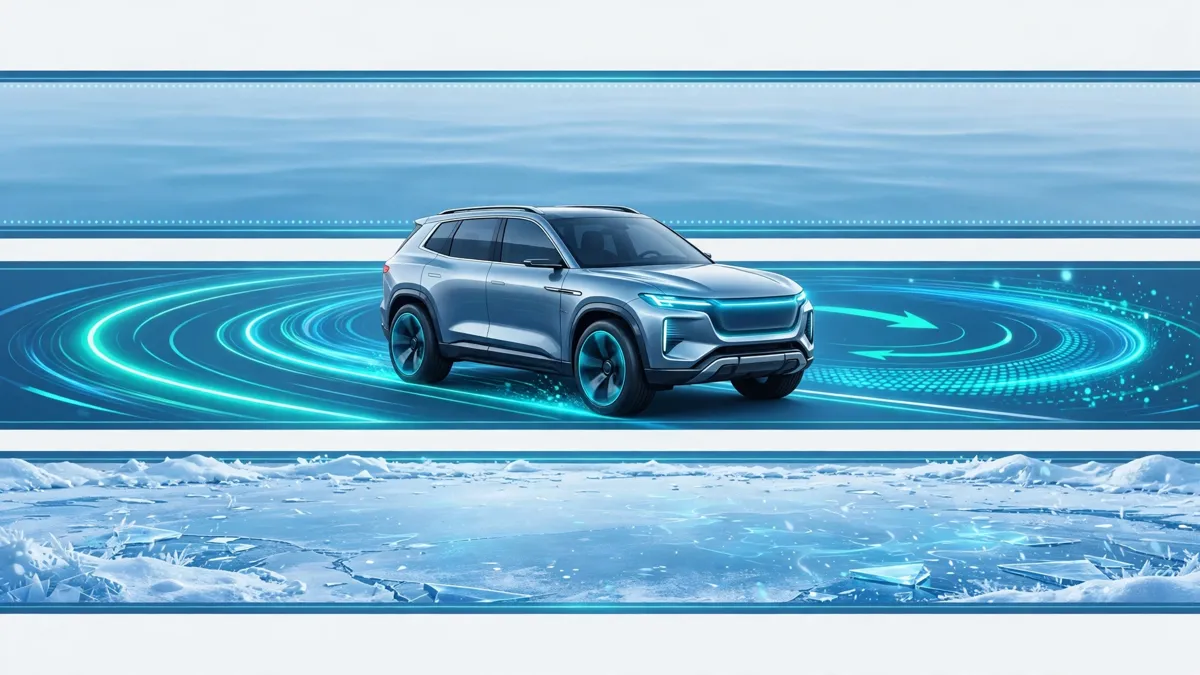
Much confusion comes from treating three different ideas as one. Battery capacity is the energy the pack can store. EPA-estimated range is a published test-based figure for a vehicle configuration. Real-world range is what a particular trip actually achieves. Driving modes do not change the first, are not separately rated for the second, and can only indirectly coincide with differences in the third.
Cadillac’s published EPA-estimated range figures for the Lyriq are given by configuration. For the 2026 Lyriq, Cadillac lists 326 miles for single-motor rear-wheel drive, 319 miles for dual-motor all-wheel drive with standard 11.5 kW onboard charging, and 303 miles for dual-motor all-wheel drive with available 19.2 kW onboard charging. The high-performance 2026 Lyriq-V is listed at 285 miles EPA-estimated range, with Cadillac-estimated 615 horsepower in Velocity Max. Cadillac’s Lyriq-V press material also lists a 102 kWh battery pack for that model. These figures are configuration figures, and no separate figure is published for Tour, Sport, Snow/Ice, or My Mode.
Cadillac’s footnote to those figures states that actual range may vary with temperature, terrain, battery age, loading, and how the vehicle is used and maintained. Cadillac does not rank the modes against each other for energy use.
The table below keeps the three ideas separate. The first column names the idea, the second column states what Cadillac publishes, and the third column states what a drive mode does to it.
| Idea | What Cadillac publishes | What a drive mode does |
|---|---|---|
| Battery capacity | A fixed pack for the configuration; Cadillac’s Lyriq-V press material lists a 102 kWh pack for that model | Nothing; selecting a mode does not change the pack |
| EPA-estimated range | One figure per configuration: 326 miles RWD, 319 miles AWD with 11.5 kW charging, 303 miles AWD with 19.2 kW charging, 285 miles Lyriq-V (2026) | Nothing published; no separate per-mode figure |
| Real-world range | Actual range varies with temperature, terrain, battery age, loading, use, and maintenance | No published per-mode rating; energy use varies with driving behavior and conditions |
See Also: how to read an ambiguous update when the facts are uncertain
Why no per-mode range figure exists in official material
A reader who searches this exact question will find pages quoting precise per-mode differences, sometimes claiming Sport reduces range by a stated percentage or Tour adds one. Those numbers were not found in Cadillac’s official Lyriq specifications, features pages, press material, or owner’s manuals during research, and should not be treated as Cadillac figures. Some pages describe their numbers as owner reports or estimates, which is different evidence from a manufacturer specification.
There is a structural reason for the absence: EPA-estimated range is a single rating per configuration, not a set of ratings for each selectable mode. A page inventing a per-mode table with exact percentages fills a gap the official material leaves open, rather than reporting a manufacturer rating. That gap should not be filled by guessing.
Regenerative braking is a separate control, not a mode setting
Regenerative braking is often described online as if it were part of the drive-mode system, but the owner’s manual handles it through separate controls: One-Pedal Driving and the Regen on Demand steering-wheel paddle. One-Pedal Driving allows the accelerator pedal to control deceleration to a complete stop, with moderate or strong levels, and uses regenerative braking to slow the vehicle for energy efficiency where possible. The Regen on Demand paddle requests additional regenerative deceleration.
The drive-mode descriptions do not list regenerative-braking strength among the systems changed by any mode, and the My Mode list does not include a regen setting, so regen should be treated as a separate choice. Selecting Sport does not, according to the official descriptions found during research, switch off energy recovery, and selecting Tour adds no special regen bonus. Regenerative power may also be limited when the high-voltage battery is near full charge or cold, and friction brakes may be used when regenerative braking is reduced.
What the official sources do not say
The gaps deserve the same clarity as the findings. The official sources found during research do not state a per-mode range figure, a per-mode percentage change, or a per-mode battery-usage rating. They do not state that any mode changes climate-control behavior, and they do not list climate control among the My Mode customizable subsystems. They do not state that the remaining-range display changes by a fixed amount when a mode is selected, and they do not describe a mode multiplier for the range estimate.
Those silences rule out several common claims: that Sport Mode reduces climate output, that Tour Mode increases regenerative-braking strength, or that switching modes instantly adds or removes a stated number of miles. None can be supported from the official mode descriptions found during research. If a future Cadillac document states such a behavior for a particular model year or trim, that document would be the source to cite.
Related Post: troubleshooting connectivity issues step by step
Five checks before choosing a mode
Five checks help a driver use the modes as Cadillac describes them, without expecting an unpublished range result.
- Match the mode to the condition. Use Tour for normal driving, Sport for a more controlled response on dry pavement, and Snow/Ice for slippery roads. Do not select a mode for an efficiency benefit Cadillac has not stated.
- Check the manual for the specific vehicle. Confirm which modes are equipped and which subsystems they affect on that trim and model year, because availability depends on trim, region, and optional features.
- Remember the restart behavior. Tour, My Mode, and Sport persist across on/off cycles, while other modes return to Tour on restart. After a restart, confirm the selected mode before assuming a previous choice is still active.
- Treat regen as a separate setting. Set One-Pedal Driving and Regen on Demand according to preference and conditions, and do not assume that a drive mode has changed regen strength, because the official mode descriptions do not list that change.
- Judge a trip by its conditions, not by its mode label. Speed, acceleration, temperature, terrain, load, and battery condition all affect actual range, according to Cadillac’s footnote.
See Also: verifying software before downloading it
What this means for United States readers
Readers in the United States face the same question in practical form: the Lyriq is sold there with EPA-estimated figures in miles, and winter driving, long highway trips, and mountain routes test range differently. The figures quoted here are Cadillac’s United States configuration figures, to be read as configuration ratings, not promises for a particular trip in a particular mode.
Winter driving deserves special care: cold temperature reduces actual range according to Cadillac’s footnote, and Snow/Ice Mode is a traction aid, not a winter range solution. A winter trip should be planned around cold-weather conditions and the actual route, not a mode label. A mode comparison has no published figures, and any page offering one offers its own estimate, not a Cadillac rating.
Related Post: how gamification and payments work together
Conclusion
Cadillac Lyriq driving modes do not offer different published ranges or battery usages in the sense the question asks. The battery stays the same, EPA-estimated range is published by configuration, and Cadillac publishes no per-mode figure, gain, or penalty. Tour, Sport, Snow/Ice, and My Mode change response, feel, and slippery-surface handling, and those differences can coincide with different real-world energy use, because behavior and conditions change energy use. A mode is a response setting, not a battery setting. For the best trip result, choose the mode that fits the road, drive steadily, and plan charging around speed, temperature, terrain, and load.
Frequently asked questions
Do Cadillac Lyriq driving modes offer different ranges?
No, not in published terms. Cadillac publishes EPA-estimated range by configuration, and no separate figure for Tour, Sport, Snow/Ice, or My Mode.
Does changing the drive mode change the battery size or capacity?
No. Selecting a different mode does not change the battery pack, and the published EPA-estimated range for the configuration stays the same.
What is the EPA-estimated range of the Cadillac Lyriq?
For the 2026 Lyriq: 326 miles single-motor rear-wheel drive, 319 miles dual-motor all-wheel drive with standard 11.5 kW charging, 303 miles with available 19.2 kW charging, and 285 miles for the Lyriq-V.
Does Sport Mode use more battery than Tour Mode?
Cadillac publishes no fixed Sport penalty or Tour bonus. Sport makes the accelerator and steering more responsive, which can coincide with harder acceleration and higher energy use, but the manual gives no percentage figure.
Does Snow/Ice Mode save battery in winter?
No such benefit is stated in the official mode descriptions. Snow/Ice Mode is a traction setting for slippery roads, and cold temperature itself reduces actual range, according to Cadillac’s footnote.
Does My Mode change regenerative braking or climate control?
The manual’s My Mode list covers Acceleration Feel, Brake Feel, Steering, Suspension, and Motor Sound, where equipped. It does not list regenerative-braking strength or climate control, and regen is controlled separately through One-Pedal Driving and Regen on Demand.