
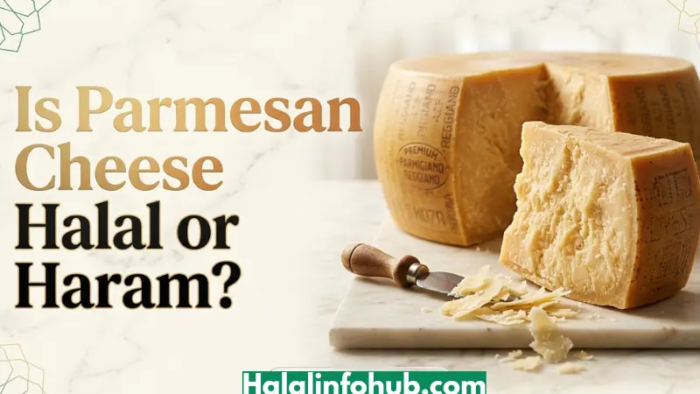
Traditional Parmesan cheese is usually considered doubtful (mashbooh) or haram by many Muslims because it commonly uses animal rennet sourced from non-halal calves. However, some modern parmesan-style cheeses use microbial or vegetarian rennet, making them potentially halal-friendly when all ingredients and production processes meet halal requirements.
Is Parmesan cheese halal? This is one of the most confusing halal food questions among Muslims living in the USA and UK.
Parmesan cheese is one of the world’s most famous cheeses and is commonly used in:
- pizza,
- pasta,
- fast food,
- salads,
- sauces,
- frozen meals.
Many Muslims assume cheese is automatically halal because it is made from milk. However, Parmesan cheese is much more complicated than regular cheese.
The biggest issue is:
rennet.
Traditional Parmesan cheese usually contains:
- animal rennet,
- enzymes,
- bacterial cultures,
- ageing systems that may not be halal-friendly.
In 2026, Muslim consumers are paying closer attention to:
- cheese enzymes,
- rennet sources,
- microbial alternatives,
- halal certification,
- cross-contamination,
- industrial cheese processing.
Related Post
What Is Parmesan Cheese?
Parmesan is a hard-aged cheese traditionally made in Italy.
Authentic Parmesan (Parmigiano Reggiano) is known for:
- hard texture,
- salty flavour,
- long ageing process,
- Strong umami taste.
It is widely used in:
- Italian food,
- pizza toppings,
- pasta dishes,
- Caesar salads,
- snack foods.
Why Muslims Ask “Is Parmesan Cheese Halal?”
The confusion mainly comes from:
- animal rennet,
- enzyme sourcing,
- Calf stomach extraction methods.
Many Muslims discover that Parmesan cheese is not just:
milk + salt.
Traditional Parmesan production often uses:
- enzymes from calf stomach lining,
- non-halal slaughter sources,
- animal-derived processing agents.
Is Parmesan Cheese Halal?
Common Parmesan Ingredients
Typical ingredients include:
- milk,
- salt,
- starter cultures,
- rennet,
- enzymes.
Ingredient-by-Ingredient Halal Table
| Ingredient | Halal Status | Notes |
| Milk | Halal | Safe |
| Salt | Halal | Safe |
| Starter cultures | Usually halal | Low risk |
| Animal rennet | Often doubtful/haram | Depends on the source |
| Microbial rennet | Halal-friendly | Preferred |
| Enzymes | Mushbooh | Source may vary |
What Is Rennet?
This is where most competitor articles are weak.
Rennet explained simply
Rennet is an enzyme used to:
- coagulate milk,
- separate curds,
- create cheese texture.
Without rennet:
- Most hard cheeses cannot form properly.
Types of Rennet
| Type | Source | Halal Status |
| Animal rennet | Calf stomach | Often doubtful |
| Microbial rennet | Fungus/bacteria | Usually halal |
| Vegetable rennet | Plants | Halal |
| Synthetic rennet | Lab-produced | Usually halal |
Why Traditional Parmesan Is Problematic
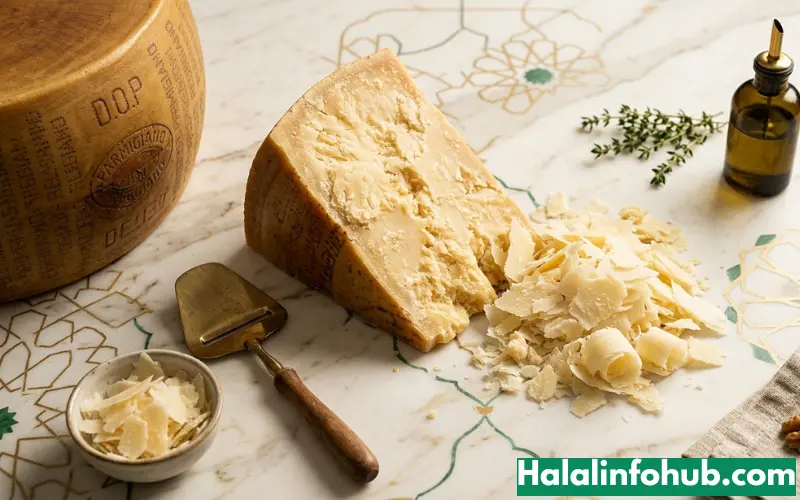
Authentic Parmigiano Reggiano traditionally uses:
calf-derived animal rennet.
This is the main halal issue.
Why Parmigiano Reggiano Is Usually NOT Halal-Friendly
Most competitors fail badly here.
Important industry fact
Authentic Italian Parmigiano Reggiano follows strict traditional production laws.
These laws require:
- traditional animal rennet,
- traditional cheese ageing methods.
This means:
Authentic Parmigiano Reggiano usually cannot use microbial rennet.
Why this matters for Muslims
If the calf:
- was not slaughtered Islamically,
Then many scholars classify the rennet as:
⚠ doubtful or haram.
Is Parmesan Cheese Halal in the USA?
In the USA:
- Many Parmesan products are NOT authentic Italian Parmesan.
- Some brands use microbial enzymes,
- Others still use animal rennet.
This means:
USA Parmesan halal status varies by brand.
Important USA Cheese Reality
Many supermarket Parmesan cheeses:
- are industrially produced,
- use cheaper enzyme systems,
- sometimes use microbial rennet.
This creates:
✔ more halal-friendly possibilities
than traditional Italian Parmesan.
Parmesan Cheese vs “Parmesan Style” Cheese
This is a HUGE competitor weakness.
Authentic Parmesan
Usually:
- Parmigiano Reggiano,
- Italian protected cheese,
- Animal rennet is required.
Parmesan-style cheese
May use:
- microbial enzymes,
- vegetarian rennet,
- synthetic cultures.
Why this matters
Many Muslims accidentally confuse:
- authentic Italian Parmesan ❌
with - halal-friendly parmesan-style cheese ✔
Is Parmesan Cheese Haram?
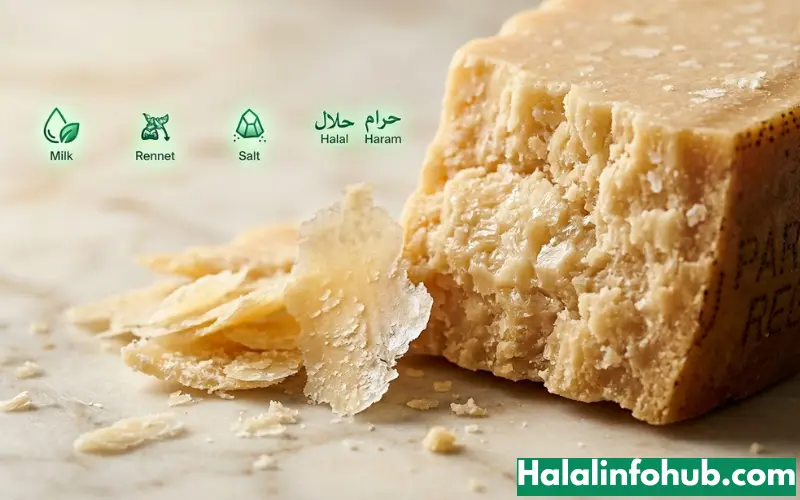
Short answer:
Traditional Parmesan is often considered:
⚠ haram or doubtful.
But some Parmesan-style cheeses may be:
✔ halal-friendly.
Scholarly Opinions on Parmesan Cheese
Strict opinion
Many scholars say:
- non-halal animal rennet is impermissible,
- Traditional Parmesan should be avoided.
More flexible opinion
Some scholars permit rennet because:
- enzyme transformation occurs,
- Only small amounts remain in cheese.
Practical Muslim reality
This creates three groups:
| Muslim approach | View |
| Strict | Avoid parmesan |
| Moderate | Check rennet source |
| Flexible | Some allow doubtful rennet |
Why Cheese Is One of the Most Confusing Halal Foods
Most Muslims think:
Cheese is automatically halal ❌
But cheese manufacturing may involve:
- animal enzymes,
- bacterial fermentation,
- mould cultures,
- ageing chemicals,
- processing agents.
This makes cheese one of the most complex halal food categories globally.
Why Authentic Italian Parmesan Is Hard for Muslims to Eat
This is one of the strongest authority sections that competitors completely miss.
Protected Italian cheese laws
Authentic Parmigiano Reggiano is protected under strict Italian production regulations.
Manufacturers must follow:
- traditional ageing methods,
- traditional milk sourcing,
- traditional enzyme systems.
One major requirement is:
animal rennet.
Why this matters for halal consumers
Even if the cheese itself contains no pork:
- The enzyme source still matters in Islam.
Because authentic Parmesan traditionally uses calf rennet from non-halal slaughter systems, many Muslims avoid it completely.
Important takeaway
The more “authentic” the Parmesan is:
The higher the halal concern usually becomes.
Ironically, cheaper supermarket Parmesan-style cheeses may sometimes be safer because they often use microbial enzymes.
Why Parmesan Cheese Is More Problematic Than Mozzarella
Many Muslims compare all cheeses equally, but halal risk differs massively.
| Cheese Type | Common Rennet Type | Halal Risk |
| Mozzarella | Often microbial | Lower |
| Cheddar | Mixed | Medium |
| Parmesan | Usually animal | Higher |
| Parmigiano Reggiano | Traditional calf rennet | Very high |
Why Parmesan creates bigger concerns
Parmesan is:
- aged longer,
- more traditional,
- more protected by old production laws.
This makes halal-friendly substitutions less common compared to mozzarella or processed cheese.
Why Restaurant Parmesan Is Usually Riskier
This is a highly practical section that competitors ignore.
Restaurants rarely verify rennet sources
Most restaurants:
- buy cheese in bulk,
- use commercial suppliers,
- Do not track halal enzyme details.
This means workers often:
❌ cannot confirm if Parmesan is halal.
High-risk foods containing Parmesan
Muslims often unknowingly consume Parmesan in:
- Caesar salad,
- Alfredo pasta,
- garlic bread toppings,
- pizza crust seasoning,
- pasta sauces,
- snack chips.
Practical halal advice
When eating outside:
Parmesan cheese is usually one of the hardest ingredients to verify.
Why “Enzymes” on Cheese Labels Can Be Misleading
This section adds major EEAT authority.
The hidden labeling issue
Many cheese labels simply say:
“enzymes”
without explaining:
- animal source,
- microbial source,
- synthetic source.
Why does this create halal confusion?
Two Parmesan cheeses may both say:
“enzymes”
But one may use:
✔ microbial rennet
while the other uses:
❌ calf stomach enzymes.
Important lesson for Muslims
Never assume:
“Enzymes” automatically means halal.
Why Microbial Parmesan Is Growing in the USA Markets
This is a very modern industry trend that competitors rarely mention.
Cheese industry shift
Many USA manufacturers now use:
- microbial enzymes,
- fermentation-produced chymosin,
- vegetarian rennet systems.
Why?
- lower cost,
- vegetarian demand,
- easier mass production,
- stable supply chains.
Why does this help Muslims
This trend creates:
✔ more halal-friendly parmesan options
✔ easier vegetarian cheese access
✔ safer supermarket choices
especially in the USA.
Why Halal-Certified Cheese Is Becoming More Important
Muslim consumers in the USA and UK are now paying closer attention to:
- cheese enzymes,
- hidden animal ingredients,
- imported European cheeses.
This is why halal-certified cheese demand is rapidly increasing in:
- supermarkets,
- pizza chains,
- fast-food restaurants,
- frozen meals.
The biggest halal cheese concern today
The issue is no longer just:
pork.
Now Muslims also investigate:
- rennet source,
- slaughter method,
- bacterial cultures,
- enzyme processing systems.
Why Parmesan Confuses Even Practising Muslims
Parmesan is one of the most misunderstood halal foods because:
- it looks vegetarian,
- it comes from milk,
- it contains no visible meat.
However, hidden enzyme systems make it much more complicated.
This is why many practising Muslims accidentally consume doubtful Parmesan without realising:
- calf enzymes were involved;
- Traditional non-halal production systems were used.
The Difference Between Halal-Friendly and Fully Halal Parmesan
This distinction is VERY powerful for SEO + trust.
| Type | Meaning |
| Halal-friendly parmesan | Appears safe by ingredients |
| Halal-certified parmesan | Officially verified halal |
| Traditional parmesan | Often uses animal rennet |
Why this matters
Many Muslims are comfortable with:
✔ halal-friendly cheese
while others only trust:
✔ fully halal-certified products.
Why Some Scholars Still Permit Animal Rennet Cheese
This balanced section increases trust massively.
Some scholars argue that:
- Rennet transforms,
- The enzyme amount is extremely small,
- Cheese processing changes the original substance.
Because of this, some scholars permit certain cheeses even if:
- Animal rennet was originally used.
However
Other scholars strongly disagree and say:
- Non-halal slaughter makes the enzyme impermissible.
This is why:
Parmesan cheese remains one of the most debated halal dairy products today.
Best Parmesan Options for Muslims in the USA
Lowest-risk options
✔ Halal-certified parmesan
✔ Vegetarian parmesan
✔ Microbial rennet parmesan
✔ Vegan parmesan alternatives
Higher-risk options
Parmigiano Reggiano
Imported Italian Parmesan
Restaurant Parmesan blends
Unlabeled “enzyme” cheese
Final Practical Advice for Muslims
Safe approach for strict Muslims
Avoid:
- traditional parmesan,
- unlabeled enzyme cheese,
- restaurant parmesan unless verified.
Safe approach for moderate Muslims
Choose:
- microbial parmesan,
- vegetarian-certified cheese,
- transparent USA brands.
Best rule to follow
If the Parmesan does not clearly mention microbial or vegetarian rennet, treat it as doubtful until verified.
Hidden Cheese Industry Facts Competitors Ignore
1. Enzyme labels are often vague
Cheese labels may simply say:
“enzymes”
without revealing:
- animal source,
- microbial source,
- halal status.
2. Restaurants rarely disclose the rennet source
Pizza restaurants often:
- do not know enzyme details,
- use bulk cheese suppliers.
3. Imported cheeses vary heavily
European cheeses often use:
- traditional animal enzymes,
- stricter heritage production systems.
Why Pizza Cheese Creates Halal Problems
Many Muslims unknowingly consume Parmesan through:
- pizza toppings,
- pasta sauces,
- Caesar dressing,
- fast-food cheese blends.
Even if pizza meat is halal:
⚠ Parmesan topping may still create halal concerns.
USA vs UK Parmesan Differences
| Factor | USA | UK |
| Microbial rennet availability | More common | Moderate |
| Traditional imports | Moderate | Higher |
| Vegetarian cheese labeling | Improving | Better |
| Halal-certified cheese access | Growing | Easier |
How Muslims Can Check Parmesan Cheese
Simple halal cheese checklist
Safer terms:
✔ microbial enzymes
✔ vegetarian rennet
✔ microbial rennet
✔ halal-certified cheese
Higher-risk terms:
animal enzymes
traditional parmesan
Parmigiano Reggiano
Best Halal Alternatives to Parmesan Cheese
Muslims looking for safer options should choose:
- halal-certified parmesan,
- vegetarian parmesan,
- microbial rennet cheese,
- vegan parmesan alternatives.
Parmesan Cheese and Cross-Contamination
Strict Muslims may also investigate:
- shared cheese processing,
- mixed dairy facilities,
- animal ingredient handling systems.
This matters more in:
- industrial cheese factories,
- imported cheese systems.
Why “Suitable for Vegetarians” Matters
This is a VERY important shortcut many Muslims miss.
If Parmesan says:
“Suitable for Vegetarians”
it usually means:
✔ no animal rennet used.
This often makes the product:
safer for halal-conscious Muslims.
See Also
FAQs
Is Parmesan cheese halal?
Traditional Parmesan is usually doubtful because it often contains animal rennet from non-halal calves.
Is Parmesan cheese halal in the USA?
Some USA Parmesan products may be halal-friendly if they use microbial or vegetarian rennet.
Is Parmesan cheese halal or haram?
It depends on the rennet source. Traditional Parmesan is often considered doubtful or haram.
Does Parmesan contain animal rennet?
Authentic Parmigiano Reggiano usually uses calf-derived animal rennet.
Is vegetarian Parmesan halal?
Usually, yes, because vegetarian Parmesan avoids animal rennet.
Is Parmesan on pizza halal?
Not always. Many pizza chains use cheese blends containing doubtful enzymes.
Can Muslims eat Parmesan cheese?
Muslims should verify:
- rennet source,
- enzyme type,
- halal certification.
Conclusion
So, is Parmesan cheese halal or haram in 2026?
Traditional, authentic Parmesan cheese is usually considered doubtful or haram by many Muslims because it commonly uses animal rennet from non-halal calves. However, some modern Parmesan-style cheeses made with microbial or vegetarian rennet can be halal-friendly.
For Muslims living in the USA and UK, the safest approach is to:
✔ check enzyme labels
✔ choose vegetarian parmesan
✔ Select halal-certified cheese whenever possible.
Because cheese manufacturing is complex, ingredient verification remains extremely important for halal-conscious Muslims today.