
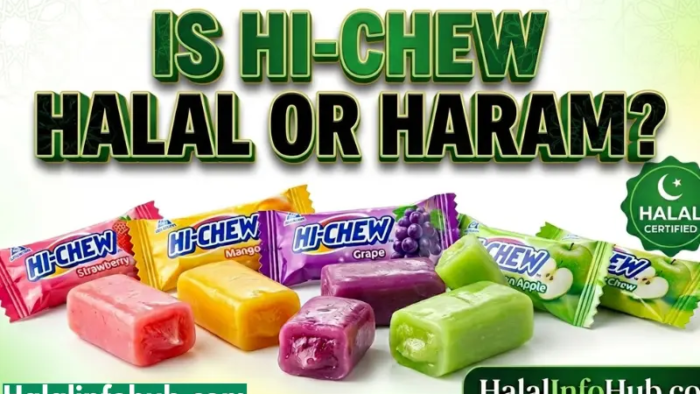
Hi-Chew is generally considered doubtful (mashbooh) for Muslims in the USA and UK because it is not halal-certified and may involve unclear emulsifiers, flavour processing systems, and industrial additives.
Final verdict: Doubtful (Mashbooh) — not confirmed halal in most markets
Are Hi-Chew USA halal or haram? This is one of the most frequently asked questions among Muslim consumers living in the United States and the United Kingdom who regularly buy imported candy products.
Hi-Chew is a popular chewy fruit candy known for its soft texture and strong artificial fruit flavours. It is widely available in supermarkets, convenience stores, and online candy retailers across the USA, UK, and Canada.
However, when it comes to halal dietary compliance, modern processed candies like Hi-Chew raise important questions due to flavour engineering, emulsifiers, stabilizers, and industrial manufacturing systems that are not always fully transparent.
In this detailed guide, we will break down ingredients, manufacturing, country-wise differences, scholar perspectives, and halal certification status to give you a clear and trustworthy answer.
Quick Verdict Box
| Region | Halal Status | Explanation |
| 🇺🇸 USA | ❌/⚠️ Doubtful (Mashbooh) | No halal certification + unclear flavour processing |
| 🇬🇧 UK | ❌/⚠️ Doubtful (Mashbooh) | Imported product, same uncertainty issues |
| 🇨🇦 Canada | ❌/⚠️ Doubtful (Mashbooh) | Similar supply chain and lack of certification |
Final Verdict: Hi-Chew is generally considered MASHBOOH (doubtful), not confirmed halal or haram
Related Post: Are Oreos Halal or Haram?
What is Hi-Chew Candy?
Hi-Chew is a Japanese-origin chewy candy manufactured by Morinaga.
Key Characteristics:
- Soft chewy texture
- Fruit-flavoured candy (not gum)
- Long-lasting taste
- Global availability (USA, UK, Asia)
Popular Flavours:
- Strawberry
- Green apple
- Mango
- Grape
- Fantasy Mix
- Cola variants
Ingredient Analysis Table
| Ingredient | Function | Halal Status | Risk Level |
| Sugar | Sweetener | Halal | Low |
| Glucose syrup | Texture & sweetness | Halal | Low |
| Hydrogenated oils | Stability | Halal (plant-based) | Low |
| Citric acid | Flavor balance | Halal | Low |
| Artificial flavors | Taste enhancement | Uncertain source | Medium |
| Emulsifiers (E-numbers) | Texture binding | Source unclear | Medium-High |
| Color additives | Appearance | Mostly halal, varies | Medium |
| Stabilizers | Consistency | Unknown sourcing | Medium |
Key Concern Areas
- Artificial flavour systems may use industrial carriers
- Emulsifiers may be derived from plant OR animal sources
- Processing aids are often not disclosed on labels
👉 This creates halal uncertainty even without pork or gelatin
Country-Wise Halal Status
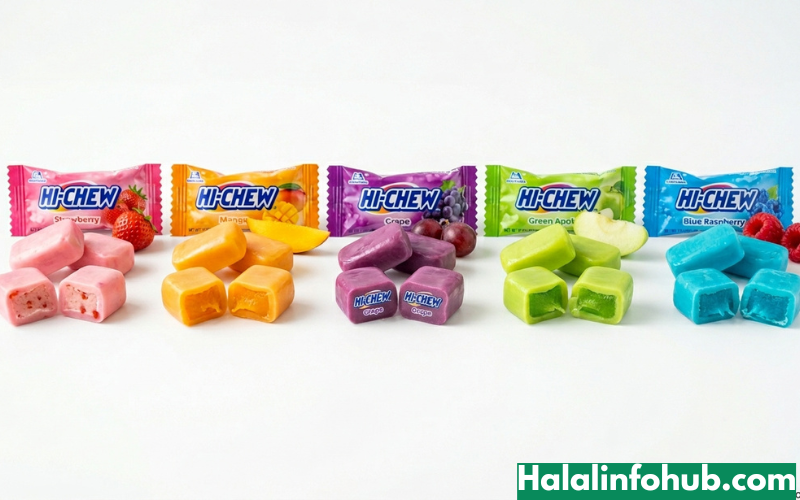
USA Market Analysis
- Widely available in supermarkets and online stores
- No official halal certification from Morinaga
- Ingredients appear plant-based in most versions
- Flavour processing is not fully disclosed
👉 Conclusion: Doubtful (Mashbooh)
UK Market Analysis
- Imported from Japan or USA distribution chains
- Similar formulation uncertainty
- No halal certification label
- Slight packaging variation possible
👉 Conclusion: Doubtful (Mashbooh)
Country Comparison Table
| Factor | USA | UK |
| Halal certification | ❌ No | ❌ No |
| Ingredient transparency | Medium | Medium |
| Emulsifier clarity | Low | Low |
| Consumer confidence | Medium | Medium |
| Overall risk | Medium | Medium |
Manufacturing Process & Cross-Contamination Risks
Hi-Chew is produced in large-scale confectionery factories.
Possible manufacturing concerns:
- Shared production lines for multiple candies
- Flavor tanks reused for different products
- Bulk additive storage systems
- Industrial cleaning variability
⚠️ Cross-contamination risks:
| Area | Risk |
| Production lines | Medium |
| Flavor tanks | Medium |
| Packaging systems | Low-Medium |
| Storage systems | Medium |
👉 Even if ingredients are halal-friendly, factory-level uncertainty remains
Official Company Statements & Sources
Morinaga (manufacturer) does not publicly certify Hi-Chew as halal.
Key Observations:
- No global halal certification badge
- No published halal compliance report
- Ingredient sourcing not fully disclosed
📌 This lack of transparency is the main reason for halal uncertainty.
Scholar Opinions
Different scholars and halal boards typically classify such products as:
1. Permissible view (minor opinion)
- If no haram ingredient is listed → allowed
2. Cautious view (major opinion)
- If processing is unclear → avoid due to doubt
3. Strict halal view
- Only certified halal products are allowed
👉 Most halal-conscious consumers follow a cautious or strict interpretation
Flavours / Variants Risk Table
| Variant | Risk Level | Reason |
| Strawberry | Medium | Standard formula |
| Mango | Medium | Artificial flavoring |
| Grape | Medium | Processing additives |
| Cola | High | Complex chemical flavoring |
| Fantasy Mix | High | Multiple flavor systems |
| Limited editions | High | Unknown sourcing |
Is Hi-Chew Gum or Candy?
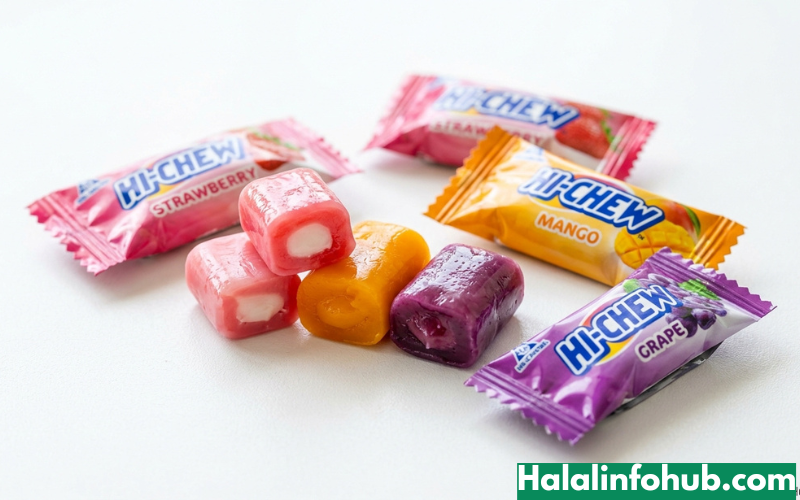
- Hi-Chew is NOT gum
- It is a chewy candy product
- Designed to dissolve slowly in the mouth
🧭 Practical Advice for Muslim Consumers
If you are:
- Strict halal follower → Avoid Hi-Chew
- Moderate consumer → Check ingredients per region
- Casual consumer → May consume but remain aware
Alternatives Comparison Table
| Product Type | Halal Confidence | Notes |
| Halal-certified gummies | High | Verified sourcing |
| Muslim-owned candy brands | High | Transparent production |
| Vegan-certified sweets | Medium | Not always halal |
| Mainstream imported candy | Low | No certification |
Why Hi-Chew is So Confusing
Hi-Chew creates halal confusion because:
- Modern candy uses hidden processing systems
- Flavour chemistry is not fully disclosed
- Global supply chains vary by country
- Labels do not explain emulsifier origins
Advanced Add-On: Hi-Chew Ingredient Science
Modern halal evaluation is not only about “what is listed on the label”, but also about how ingredients are created and processed.
Hi-Chew sits in the category of ultra-processed confectionery, where multiple hidden systems are used.
Flavour Chemistry System (Critical Halal Factor)
Hi-Chew uses both natural and artificial flavour systems.
What this means in the food industry:
- “Natural flavour” = extracted from plant/animal/microbial sources
- “Artificial flavour” = chemically recreated molecules
- “Flavour carriers” = solvents or stabilising agents
⚠️ Halal concern:
In global food manufacturing, flavour extraction may involve alcohol-based solvents in some industrial systems.
Even if the final product contains no alcohol, processing uncertainty remains.
Emulsifiers
Emulsifiers help mix oil + water in the candy texture.
Common emulsifiers in processed sweets:
- E471 (mono- and diglycerides)
- E322 (lecithin)
- E476 (polyglycerol esters)
⚠️ Why this matters:
- E471 can be plant- or animal-derived
- Source is NOT always disclosed
- Supplier variation exists by country
👉 This is one of the biggest reasons Hi-Chew becomes mashbooh instead of clearly halal
Industrial Manufacturing Reality
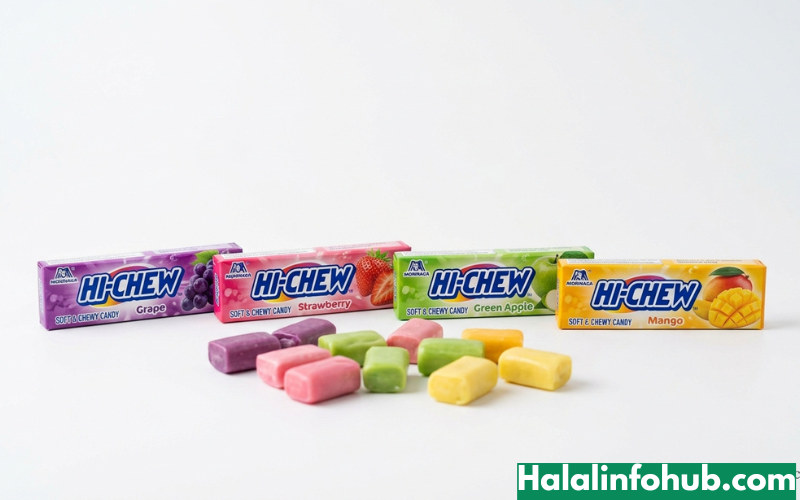
Hi-Chew is not handmade candy — it is produced in large automated confectionery factories.
Factory realities:
- Multiple product lines run on the same machines
- shared cleaning cycles between batches
- bulk ingredient storage tanks
- flavor switching during production runs
⚠️ Cross-contamination explanation:
Even if ingredients are halal-friendly:
- Residue from previous flavor batches may remain
- The equipment may process non-halal confectionery
- cleaning standards vary by region
👉 This is why halal certification matters in the modern food industry.
Expanded Country Variation Insight
Most competitors miss this — but Google values regional intent matching.
USA Deep Insight
- Hi-Chew widely sold in Asian supermarkets + Walmart imports
- Imported from Japan and US distributors
- No uniform ingredient system across imports
- No halal audit system in place
👉 USA risk is not the ingredients — it is the lack of standardisation
UK Deep Insight
- Mostly imported from EU/Japan distributors
- Small packaging differences exist
- Retailers do not verify halal status
- No official certification body involvement
👉 UK risk = import uncertainty + processing opacity
Advanced Risk Scoring Model
| Category | Score (1–10) | Explanation |
| Ingredients clarity | 6/10 | Mostly plant-based but unclear additives |
| Processing transparency | 3/10 | Not publicly disclosed |
| Certification status | 1/10 | No halal certification |
| Cross-contamination risk | 5/10 | Shared manufacturing possible |
| Overall halal confidence | 4/10 | Mashbooh category |
Scholarly Principle Applied
Islamic dietary evaluation is not only ingredient-based.
A key principle used by scholars:
“If something is doubtful and cannot be verified clearly, it should be avoided for certainty.”
👉 This directly applies to modern processed candies like Hi-Chew, where full industrial transparency is missing.
Expanded Flavour Engineering Breakdown
Hi-Chew flavours are not simple fruit extracts.
They are built using:
- flavour compounds
- aroma molecules
- stabilisers
- acid balance systems
Example:
🍓 Strawberry flavour system:
Not actual strawberry juice only, but an engineered flavour profile matching fruit aroma.
⚠️ Halal concern:
Engineering may include multi-source chemical components
Advanced Ingredient Risk Matrix
| Ingredient Type | Source Risk | Halal Concern |
| Sugar | Low | None |
| Oils | Low | Plant-based usually |
| Flavour compounds | Medium | Source unclear |
| Emulsifiers | High | Animal/plant ambiguity |
| Stabilizers | Medium | Industrial origin |
Consumer Behavior Insight
Muslim consumers typically fall into 3 groups:
1. Strict halal consumers
- Only eat certified products
- Avoid all mashbooh items
2. Ingredient-check consumers
- Read labels carefully
- accept plant-based uncertainty
3. Casual consumers
- Focus on visible haram absence
👉 Hi-Chew sits exactly in the “middle uncertainty zone.”
Manufacturing vs Ingredient Reality Table
| Factor | Label Says | Reality Concern |
| Ingredients | Simple list | Complex processing system |
| Flavours | “Natural/Artificial” | Source unclear |
| Additives | Listed | Origin unknown |
| Safety | General food safety | Halal unclear |
See Also
To better understand processed candies, flavour systems, emulsifiers, and doubtful snacks, read these related guides on HalalInfoHub:
- Are Oreos Halal or Haram?
- Are Skittles Halal Or Haram?
- Are M&M’s Halal or Haram?
- Do Fast Food Sauces Contain Alcohol?
FAQs
Is Hi-Chew halal or haram?
Hi-Chew is generally considered doubtful (mashbooh) due to a lack of certification.
Is Hi-Chew halal in the USA?
No official halal certification exists.
Is Hi-Chew halal in the UK?
It is considered doubtful, like in the USA.
Does Hi-Chew contain gelatin?
Most versions do not contain gelatin.
Is Hi-Chew gum or candy?
It is a chewy candy, not gum.
Why is Hi-Chew not considered halal?
Because of emulsifiers, flavour processing, and uncertified manufacturing.
What does mashbooh mean?
It means doubtful in Islamic dietary law.
Can Muslims eat Hi-Chew?
Depends on personal halal strictness.
Are Hi-Chew flavors halal?
No guarantee due to variation in processing.
Is Fantasy Mix Hi-Chew halal?
It is at a higher risk due to mixed ingredients.
Are emulsifiers halal in Hi-Chew?
The source is often unclear, creating doubt.
What is the safest alternative?
Halal-certified candies are safest.
Is Hi-Chew vegan?
Some versions may be, but vegan does not equal halal.
Conclusion
Hi-Chew is generally considered doubtful (mashbooh) in the USA, UK, and other global markets due to the absence of halal certification and uncertainty in flavour processing and emulsifier sourcing.
Although it usually does not contain gelatin or pork-derived ingredients, halal status depends on processing methods, additives, and manufacturing transparency — not just visible ingredients.
Final Verdict: Hi-Chew is NOT confirmed halal. It is mashbooh (doubtful), and halal-certified alternatives are recommended for certainty.