
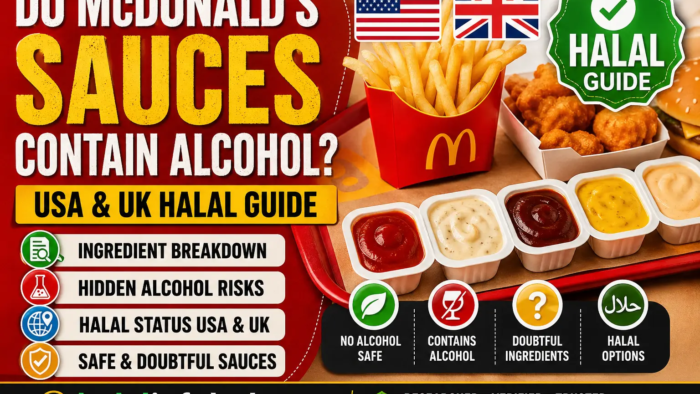
McDonald’s sauces do not include alcohol as a direct ingredient, but alcohol may be used in flavour extraction, fermentation, and processing stages in food manufacturing. Because there is no halal certification in the United States and United Kingdom, most sauces remain doubtful (mashbooh).
Do McDonald’s sauces contain alcohol? This is not just a food question — it is a halal awareness issue that affects millions of Muslims worldwide.
Fast food is deeply integrated into modern life in the United States and United Kingdom. McDonald’s is one of the most consumed fast food chains globally, and sauces are a key part of the experience. People use them daily without thinking about ingredients, processing, or sourcing.
But behind the flavour lies a complex industrial system. Modern sauces are created using food science techniques involving emulsification, flavour extraction, chemical stabilisation, and fermentation processes.
Some of these processes may involve alcohol at different stages — even when alcohol is not present in the final product or listed on packaging.
This creates a grey area for halal-conscious consumers:
👉 “Is what we are eating truly permissible or just assumed safe?”
What Are McDonald’s Sauces?
McDonald’s sauces are industrial food products designed for mass production consistency, not traditional cooking.
They are engineered for:
- Long shelf stability
- Global taste uniformity
- Cost efficiency
- Fast production cycles
- Supply chain scalability
Related Post: Do Fast Food Sauces Contain Alcohol in USA & UK?
Sauce Engineering System
Most sauces are built using:
- Water-based emulsions
- Sweeteners (sugar, corn syrup)
- Acid regulators (vinegar, citric acid)
- Oils and fats
- Thickening agents
- Flavour compounds (natural & artificial)
- Preservatives
Full Sauce Categories
1. Simple Base Sauces
- Ketchup
- Mustard
- Salt-based dips
👉 Minimal processing, lowest concern level
2. Acid & Fermentation Sauces
- BBQ sauce
- Sweet & sour
- Vinegar-based dips
👉 Fermentation + flavour layering involved
3. Cream Emulsion Sauces
- Big Mac sauce
- Garlic mayo
- Tartar sauce
👉 Highest chemical complexity
4. Specialty Regional Sauces
- Spicy buffalo
- Limited edition sauces
👉 Advanced flavour engineering systems
Do McDonald’s Sauces Contain Alcohol?
1. Ethanol in Food Flavour Extraction
Food-grade ethanol is widely used in industry to extract flavour compounds from:
- Herbs
- Spices
- Fruits
- Plant-based materials
Even when removed later, it plays a functional role in production.
2. “Natural Flavour” Label Problem
The term “natural flavour” legally allows:
- Plant extracts
- Synthetic flavour compounds
- Processing aids
- Carrier solvents (sometimes alcohol-based)
👉 This is one of the biggest transparency gaps in global food labelling.
3. Vinegar Production Chain
Vinegar is created through a biological process:
- Sugar fermentation → alcohol
- Alcohol oxidation → acetic acid
Even though final vinegar contains no intoxicating alcohol, the process involves alcohol stages.
4. Processing Aid Rule
In food manufacturing:
- Alcohol may be used as a processing aid
- If removed, it is not required to be declared in many regions
👉 This creates hidden complexity for consumers.
5. Trace Residue Reality
Even after processing:
- Extremely small residues may remain
- Usually below regulatory thresholds
- Still debated in strict dietary interpretations
✔️ Final Scientific Conclusion
McDonald’s sauces do not intentionally contain alcohol, but alcohol-related processes are widely used in industrial food production systems.
How McDonald’s Sauces Are Actually Manufactured
McDonald’s sauces are not mixed in restaurants. They are produced in large-scale food factories under strict industrial systems.
🏭 Production Process Steps
1. Ingredient Sourcing
Raw materials are collected globally:
- Tomato paste
- Oils
- Sweeteners
- Flavour compounds
2. Industrial Mixing
Ingredients are blended using:
- High-speed mixers
- Temperature-controlled systems
3. Flavour Engineering
This is where complexity increases:
- Natural flavour compounds are added
- Emulsifiers stabilize texture
- Acid regulators balance taste
4. Preservation Stage
To ensure long shelf life:
- Preservatives are added
- pH is adjusted
- Heat treatment is used
👉 Key Insight:
Alcohol (if used) is usually part of flavour extraction stage, not final product.
Why “Alcohol-Free” Claims Can Be Misleading
Many people assume:
👉 “If alcohol is not listed, it does not exist.”
But in food science, this is not always true.
Reasons Why It’s Complicated:
1. Processing Aid Rule
Alcohol can be used and removed without label disclosure.
2. Flavour Carrier System
Alcohol is sometimes used to carry flavour molecules.
3. Regulatory Loopholes
Food laws in USA/UK allow:
- Non-disclosure of processing aids
- Vague “natural flavour” labelling
👉 Conclusion:
Label reading alone is not enough to fully understand sauce composition.
Global Fast Food Industry Standard
McDonald’s sauces are not unique — they follow global fast food standards.
Industry-Wide Practices:
- Centralised food factories
- Shared ingredient suppliers
- Standardised flavour systems
- Cost-driven formulations
👉 This means:
Even other brands use similar processes:
- Burger chains
- Chicken chains
- Pizza chains
So the issue is industry-wide, not McDonald’s-only.
Ingredient Transparency Problem
One of the biggest issues is lack of full transparency.
What Companies Do NOT Disclose:
- Exact flavour compound sources
- Carrier solvents used
- Processing aids
- Micro-level ingredient origins
What They DO Disclose:
- Basic ingredient list
- Nutrition facts
- Allergens
👉 This gap creates uncertainty for halal-conscious consumers.
Muslim Consumer Reality in USA & UK
In both regions, Muslims face a practical challenge:
USA Reality:
- Fast food is widely consumed
- Halal options are limited
- Ingredient awareness varies
UK Reality:
- More halal restaurants exist
- But fast food sauces still uncertified
- Mixed consumer awareness
👉 Result:
Most people rely on assumption instead of verification
Risk-Based Eating Framework
Instead of guessing halal/haram, use a risk-based approach:
LOW RISK FOODS
- Simple ingredients
- Minimal processing
- No flavour systems
MEDIUM RISK FOODS
- Sauces with vinegar or emulsifiers
- Mild processing
HIGH RISK FOODS
- Cream sauces
- Signature sauces
- Multi-flavour engineered sauces
👉 This approach is more practical than strict guessing.
Hidden Fast Food Marketing Strategy
Fast food companies design sauces for:
- Addiction-based taste balance
- Repeat consumption
- Emotional satisfaction
How they do it:
- Sugar + salt combination
- Fat-based texture enhancement
- Artificial flavour layering
USA vs UK Deep Halal Reality
United States
- No halal certification for sauces
- Ingredients sourced globally
- Mixed supplier systems
- Limited transparency on flavour processing
👉 Final Verdict: Doubtful (Mashbooh)
United Kingdom
- Similar global supply structure
- No official halal labeling for sauces
- Slight recipe variations only
👉 Final Verdict: Doubtful
Muslim Consumption Reality
In both regions:
- Muslims rely on ingredient assumptions
- No official verification system exists for sauces
- Awareness varies widely among consumers
Expanded Ingredient Risk Analysis
| Ingredient | Function | Risk Level | Explanation |
| Natural Flavours | Taste | High | Unknown sourcing |
| Vinegar | Acid balance | Medium | Fermentation involves alcohol stage |
| Emulsifiers | Texture | Medium | Plant/animal ambiguity |
| Preservatives | Shelf life | Low-Medium | Chemical sourcing varies |
| Modified Starch | Stability | Low | Generally plant-based |
McDonald’s Sauce Risk Matrix
| Sauce | Complexity | Alcohol Risk | Halal Status | Risk Score |
| Ketchup | Low | None | Safe | 1/10 |
| Mustard | Low | Very Low | Mostly Safe | 2/10 |
| BBQ Sauce | High | Medium | Doubtful | 7/10 |
| Sweet & Sour | High | Medium | Doubtful | 7/10 |
| Big Mac Sauce | Very High | Medium | Doubtful | 8/10 |
| Garlic Mayo | Very High | Medium | Doubtful | 8/10 |
| Tartar Sauce | Very High | Medium | Doubtful | 8/10 |
| Spicy Buffalo | High | Medium | Doubtful | 7/10 |
Hidden Alcohol in Food Industry
Alcohol is not only found in drinks — it is widely used in:
- Flavour extraction systems
- Baking flavour enhancers
- Dessert syrups
- Food stabilisers
👉 Key insight:
Alcohol is often a processing tool, not a final ingredient.
Why Fast Food Creates Confusion
1. Global Ingredient Sourcing
Ingredients come from multiple countries with different laws.
2. Labelling Laws
Companies can legally use vague terms like “flavourings”.
3. Industrial Food Engineering
Multiple chemical steps hide ingredient origin.
4. Processing Aid Rule
Some ingredients are not required to be declared.
5. No Halal Verification System
No universal certification for sauces.
Safe Consumption Strategy
Safest Choices
- Ketchup
- Mustard
Moderate Zone
- Honey mustard
- Mild vinegar sauces
High Risk
- BBQ sauces
- Cream-based sauces
- Signature sauces
Golden Rule
If source is unclear → avoid or limit usage
FAQs
1. Do McDonald’s sauces contain alcohol?
No direct alcohol, but processing may involve it.
2. Are McDonald’s sauces halal in USA?
No certification available.
3. Are McDonald’s sauces halal in UK?
No official halal verification.
4. Is vinegar halal in sauces?
Generally yes, but the process is debated.
5. Can alcohol be used in flavouring?
Yes, widely used in industry.
6. Which McDonald’s sauce is safest?
Ketchup.
7. Do creamy sauces contain alcohol?
Not directly, but processing is complex.
8. Can trace alcohol remain?
Yes, very small amounts possible.
9. Are natural flavours halal?
The source is unclear.
10. Should Muslims avoid sauces?
Depends on the strictness level.
11. Is BBQ sauce halal?
Usually doubtful.
12. Are preservatives halal?
Depends on origin.
13. Do fast food sauces all have this issue?
Many do due to industrial processing.
14. What is the safest approach?
Stick to simple sauces or avoid doubtful ones.
Conclusion
McDonald’s sauces do not contain alcohol as a direct ingredient, but alcohol-related processes are commonly used in modern food manufacturing systems.
Because McDonald’s does not provide halal certification in the United States and United Kingdom, most sauces remain in the doubtful category (mashbooh).