
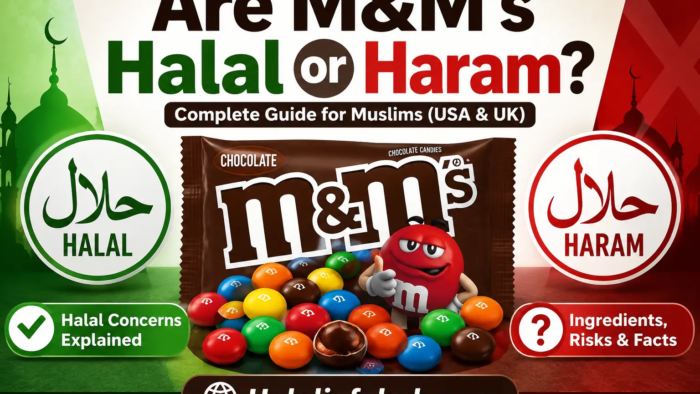
M&M’s are generally considered doubtful (mashbooh) for Muslims because they are not officially halal-certified in the United States or the United Kingdom. Plain chocolate versions are usually viewed as safer because gelatin is generally absent, but flavourings, emulsifiers, colour additives, and manufacturing processes still create halal concerns.
Many strict Muslim consumers prefer avoiding M&M’s unless halal certification or clear ingredient verification is available.
M&M’s are one of the most popular chocolate candies in the world. They are sold across the United States, the United Kingdom, and many other countries, with famous varieties including plain chocolate, peanut, crispy, brownie, caramel, and limited-edition flavours.
However, for Muslim consumers, the real concern is not taste — it is halal status.
Modern chocolate candies are highly processed products that may involve:
- artificial flavour systems
- emulsifiers and glazing agents
- colour additives
- dairy processing ingredients
- industrial manufacturing compounds
Because global candy companies use large-scale production systems, ingredient sourcing is not always fully transparent. This creates halal uncertainty, especially when products are not officially halal-certified.
Another important issue is that different M&M’s flavours use different formulas. Simple chocolate varieties are generally considered more acceptable, while speciality editions may contain more complex additives and greater halal concerns.
This is why thousands of Muslims search:
“Are M&M’s halal or haram?”
Related Post: Are Jolly Ranchers Halal or Haram?
What Are M&M’s Made Of?
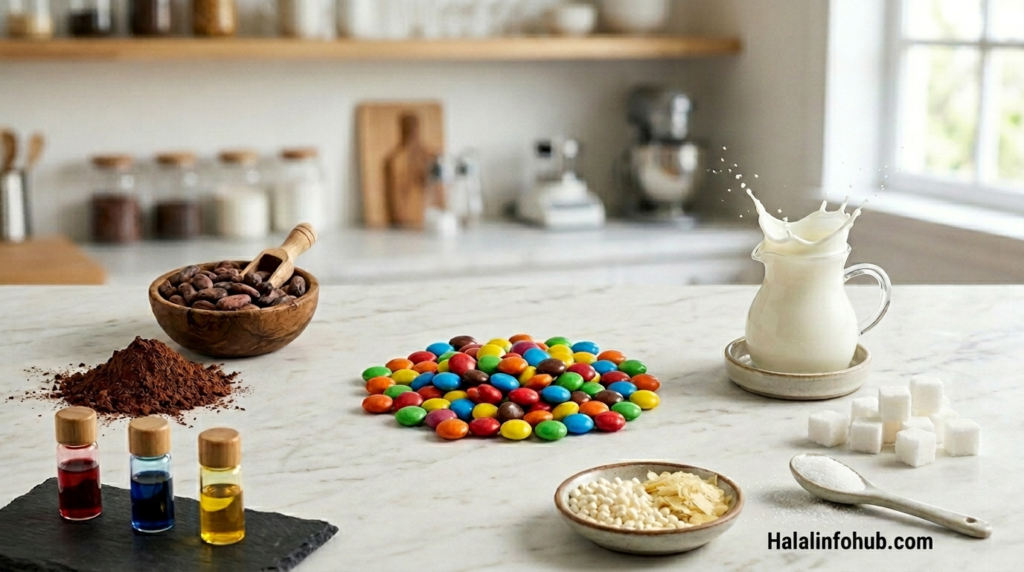
Standard M&M’s are chocolate candies covered with a colourful sugar shell.
Common ingredients may include:
- sugar
- milk chocolate
- cocoa butter
- skim milk
- soy lecithin
- flavourings
- food colourings
Depending on the flavour, additional ingredients may include:
- peanuts
- crispy rice
- caramel filling
- brownie centres
- pretzel pieces
- extra dairy compounds
The more processed and complex the flavour becomes, the more halal concerns may increase.
Why Muslims Question M&M’s
Many Muslims assume chocolate candy is automatically halal because it contains no visible meat or gelatin.
However, modern candy manufacturing is much more complicated than most consumers realise.
Muslims often question M&M’s because processed sweets may involve:
- artificial flavour compounds
- alcohol-based extraction methods
- emulsifiers
- industrial additives
- shared production systems
- contamination risks
Even when no obvious haram ingredient appears on the label, the lack of halal certification still creates caution for halal-conscious consumers.
M&M’s Halal Risk Overview
| Factor | Status | Risk Level |
| Halal Certification | Usually unavailable | High |
| Gelatin Presence | Usually absent | Low |
| Artificial Flavours | Source unclear | Medium |
| Food Colours | Mixed opinions | Medium |
| Emulsifiers | Source uncertainty | Medium |
| Cross-Contamination | Possible | Medium |
| Overall Status | Doubtful (Mashbooh) | Medium-High |
Do M&M’s Contain Gelatin?
Standard chocolate M&M’s usually do not list gelatin as a primary ingredient.
This makes them less controversial than:
- gummy candies
- marshmallows
- chewy sweets
However, some speciality products may include:
- processed fillings
- stabilisers
- additional dairy compounds
- flavour additives
Muslims should always check ingredient labels carefully because formulas can change over time and differ by region.
Hidden Halal Concerns in M&M’s
Artificial Flavour Systems
One of the biggest halal concerns in processed candy is flavour manufacturing.
Flavour systems may sometimes involve:
- alcohol-based extraction
- chemical carriers
- synthetic compounds
- industrial processing aids
Food companies are not always required to publicly explain every stage of flavour processing, which creates uncertainty for strict halal consumers.
Emulsifiers & Additives
M&M’s may contain emulsifiers such as soy lecithin, which is generally considered halal-friendly.
However, some Muslims still prefer certified products because:
- Ingredient sourcing may vary
- Manufacturing systems differ
- processing methods are complex
Halal standards focus not only on ingredients themselves but also on how they are processed.
Food Colouring Debate
M&M’s are famous for their bright candy colours.
Common colour additives may include:
- Red 40
- Yellow colouring systems
- Blue additives
- synthetic food dyes
Most modern colourings are synthetic, but some Muslims remain cautious regarding manufacturing transparency and industrial processing methods.
Why Ingredient Transparency Matters in Halal Foods
One of the biggest problems in modern processed food industries is ingredient transparency.
Many ingredient labels simplify highly complex manufacturing systems. Consumers may see simple terms like:
- natural flavour
- artificial flavour
- emulsifier
- colouring
without knowing:
- how the ingredient was processed
- whether alcohol extraction was involved
- whether animal-derived compounds were used
- how the ingredient was manufactured
This lack of transparency is one reason why halal certification remains important for many Muslim consumers.
Are Plain M&M’s Halal?

Plain chocolate M&M’s are generally considered the safest M&M’s option because:
- Gelatin is usually absent
- ingredients appear mostly dairy and plant-based
- Fewer additives are used compared to speciality editions
However, important concerns remain:
- Halal certification is missing
- Flavour sourcing is unclear
- Cross-contamination is possible
Because of this, many Muslims classify plain M&M’s as:
generally acceptable to some consumers, but still doubtful for stricter halal standards.
Which M&M’s flavours carry a higher halal risk?
Not all M&M’s products carry the same level of halal concern.
Simple chocolate varieties usually contain fewer processed ingredients, making them less controversial.
However, speciality editions often involve:
- extra flavour systems
- caramel processing
- brownie fillings
- crispy centres
- additional stabilisers
The more processed a candy becomes, the greater the halal uncertainty may become.
Plain vs Speciality M&M’s Halal Risk
| Product Type | Halal Risk | Main Concern |
| Plain Chocolate | Low-Medium | Flavor processing |
| Peanut M&M’s | Medium | Shared systems |
| Crispy Versions | Medium-High | Additional additives |
| Brownie Flavours | High | Complex ingredients |
| Caramel Editions | High | Industrial processing |
Are M&M’s Halal in the USA?
In the United States, M&M’s are generally not officially halal-certified.
Many Muslims consider plain versions more acceptable because:
- No pork ingredients are clearly listed
- Gelatin is generally absent
- ingredients appear mostly vegetarian-friendly
However:
- Flavour sourcing remains unclear
- Manufacturing systems are uncertified
- Speciality flavours may carry greater concerns
Because of this, many strict halal-conscious consumers still classify them as doubtful.
Are M&M’s Halal in the UK?
In the United Kingdom, the halal situation is very similar.
Some ingredients may vary slightly due to UK food regulations, but official halal certification remains generally unavailable.
UK consumers should:
- Check ingredient labels carefully
- Research flavour editions separately
- avoid assuming all formulas are identical worldwide
USA vs UK M&M’s Comparison
| Factor | USA | UK |
| Halal Certification | Rare | Rare |
| Gelatin Concern | Low | Low |
| Ingredient Transparency | Moderate | Slightly Better |
| Flavor Concerns | Medium | Medium |
| Consumer Confidence | Medium | Medium |
Why “No Gelatin” Does NOT Automatically Mean Halal
One of the biggest misunderstandings among Muslims is:
“If there is no gelatin, the product must be halal.”
However, halal standards involve much more than gelatin alone.
Islamic halal guidelines may also consider:
- flavour extraction methods
- alcohol processing
- contamination risks
- manufacturing systems
- ingredient sourcing transparency
This is why many Muslims still avoid uncertified processed candy even when gelatin is absent.
How Industrial Chocolate Manufacturing Creates Halal Concerns
Modern candy factories are designed for:
- mass production
- global distribution
- long shelf life
- industrial efficiency
Large factories may also produce:
- gummy candies
- marshmallow products
- caramel sweets
- dairy chocolates
using the same production systems.
Possible contamination areas include:
- conveyor belts
- flavour tanks
- ingredient storage systems
- packaging machinery
This creates caution for stricter halal-conscious consumers.
Why M&M’s Are Different From Halal-Certified Candy
Halal-certified candy companies usually follow stricter manufacturing standards.
These standards may include:
- verified ingredient sourcing
- halal-approved flavour systems
- contamination prevention
- supplier auditing
- dedicated production controls
Mainstream candy brands often focus more on:
- mass production
- long shelf life
- global consistency
- industrial efficiency
This difference is why halal-certified chocolate products usually provide stronger confidence for Muslim consumers.
What Most Muslims Actually Do
In real life, Muslim consumers usually follow different approaches based on their level of halal strictness.
Strict Halal Consumers
Only consume halal-certified chocolate products.
Moderate Consumers
May accept plain M&M’s if no obvious haram ingredient is listed.
Cautious Consumers
Avoid speciality flavours but may occasionally accept simpler versions.
This difference explains why opinions about M&M’s often vary between Muslims worldwide.
Better Halal Chocolate Alternatives
Muslims seeking complete certainty can choose:
- halal-certified chocolate brands
- Muslim-owned candy companies
- transparent ingredient products
- certified halal confectionery
These alternatives provide:
- stronger ingredient transparency
- lower contamination risk
- halal-certified manufacturing
- greater peace of mind
How Muslims Should Check Candy Ingredients
Before buying processed chocolate products, Muslims should:
✔ Read ingredient labels carefully
✔ Check for halal certification logos
✔ Research flavour-specific ingredients
✔ Avoid doubtful products when uncertainty is high
✔ Contact manufacturers if necessary
This approach helps reduce confusion and improve halal awareness.
See Also
- Feastables Halal or Haram?
- Are Skittles Halal Or Haram?
- Are Nerds Gummy Clusters Halal Or Haram?
- Are Jolly Ranchers Halal or Haram?
FAQs
Are M&M’s halal?
Most Muslims classify them as doubtful because halal certification is generally unavailable.
Do M&M’s contain pork?
Standard versions usually do not list pork ingredients.
Do M&M’s contain gelatin?
Plain chocolate versions usually do not contain gelatin.
Are plain M&M’s halal?
Many Muslims consider them more acceptable, but still not fully verified as halal.
Are peanut M&M’s halal?
They are generally viewed similarly to plain versions, though processing concerns remain.
Are crispy M&M’s halal?
Crispy editions may carry greater halal uncertainty because of additional ingredients.
Are brownie M&M’s halal?
Many Muslims consider them more doubtful due to complex flavour systems.
Are caramel M&M’s halal?
Caramel versions may involve more processing ingredients and greater halal concerns.
Are M&M’s vegetarian?
Some versions appear vegetarian-friendly, but vegetarian does not automatically mean halal.
Are M&M’s halal in the USA?
Most versions are not officially halal-certified in the USA.
Are M&M’s halal in the UK?
The UK situation is similar, though ingredients may differ slightly.
Why do Muslims avoid uncertified candy?
Because ingredient sourcing and manufacturing systems may not fully meet halal standards.
Are halal-certified chocolates safer?
Yes, they provide stronger ingredient transparency and halal verification.
Conclusion
So, are M&M’s halal or haram?
The most accurate answer is:
Standard M&M’s are generally considered more acceptable by many Muslims because most plain chocolate versions usually do not contain gelatin in the United States and the United Kingdom. However, they are still not officially halal-certified, which creates uncertainty for stricter halal-conscious consumers.
The main halal concerns include:
- flavour processing systems
- emulsifier sourcing
- colour additives
- industrial manufacturing methods
- cross-contamination risks
Speciality flavours such as crispy, brownie, caramel, and filled editions may carry greater halal concerns because they use more complex ingredient systems.
Many strict Muslim consumers classify M&M’s as doubtful (mashbooh) unless halal certification or transparent ingredient verification is clearly available.
For Muslims seeking complete peace of mind, halal-certified chocolate products remain the safest and most reliable option.
When clear halal-certified alternatives are available, many Muslims prefer choosing products that remove unnecessary doubt completely.